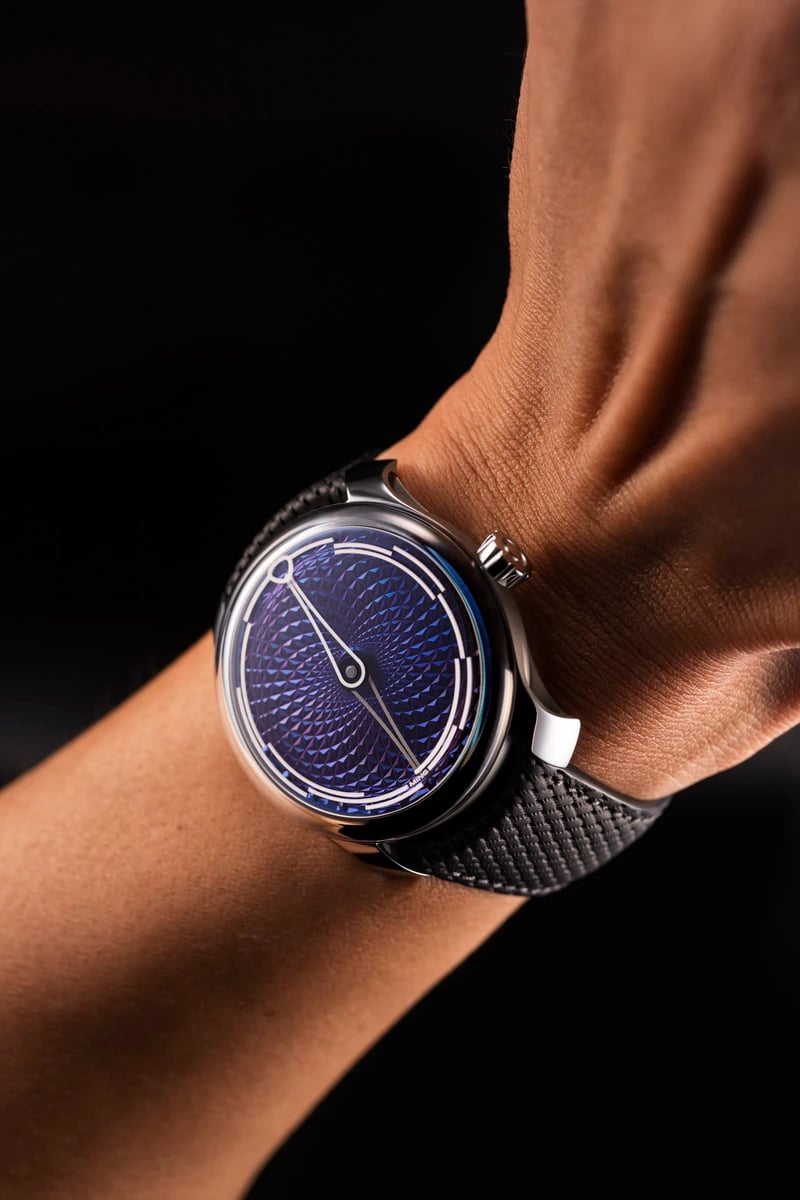
MING has spent the better part of a decade proving that a watch brand can be built on design discipline rather than heritage mythology. Founded in Kuala Lumpur in 2017 by the photographer and designer Ming Thein and a small group of partners, the company releases in tight batches, sells direct, and rarely repeats itself. The 2906 is the purest expression of that operating model: a limited-run automatic with no date, no complication worth the name, and no archive to lean on, and a secondary market that has behaved considerably better than its production numbers alone would justify.
For collectors who came up through the 2021 to 2023 independent boom, MING needs little introduction. The brand was one of the first small independents to be priced like a serious purchase and treated like a serious purchase by the market. Waitlists formed, batches sold out inside minutes, and flippers discovered that a well-chosen MING could clear a meaningful premium on the secondary market during the froth. That froth is gone. What remains is a much more useful test: does the watch still make sense when nobody is chasing it?
The 2906 is a good watch to run that test on, because it does not hide behind rarity theatre. It is a restrained, time-only automatic in a steel case, built around a Swiss ebauche, delivered on a strap, and priced in the territory where buyers start expecting a real point of view. This review covers what you are actually buying, how it wears, what the resale data says, and whether it belongs in a collection that is being built rather than traded.
The Brand Behind the Reference
MING's founding premise was aesthetic rather than horological. Ming Thein came to watches from photography, and the brand's early releases were built around contrast, legibility, and a dial-first hierarchy that most Swiss houses had abandoned in favour of applied-logo decoration. The formula has barely shifted since: a large dial aperture relative to the case, thin bezels, hands designed to read at a glance rather than to photograph well under studio light, sapphire front and back, and a strap-first approach to wearing.
The commercial model is equally consistent. MING sells direct, announces releases in advance to a mailing list, and publishes production quantities, a level of transparency that remains unusual in an industry that treats scarcity as a marketing tool. That transparency is a large part of why the brand's secondary market is as legible as it is. When you know a watch was made in a batch of a few hundred, you can price it.
What MING has not done is build a traditional collection. There is no perpetual flagship, no steel sports watch carried forward decade after decade. Each reference exists for a moment, sells through, and becomes a closed set. For a collector, that is both the appeal and the risk: you are buying a design object with a finite supply, not a lineage that will be reinforced by future generations of the same watch.
Case and Dial: Where the Money Goes
The 2906's case is stainless steel, and it is finished with a level of attention that is easy to miss in photographs. The surfaces alternate between brushed and polished in a way that reads as considered rather than decorative, and the lugs curve down from the caseband in a profile that does most of the work of making the watch sit properly on the wrist. There is nothing gratuitous here: no crown guards doing structural theatre, no bezel inserts, no caseback engraving competing with the dial.
That restraint is the point. MING's design language depends on the dial carrying the watch, and the 2906's dial is built in layers: a base surface, a rehaut that catches light at an angle, and markers that sit proud enough to cast a shadow under direct light. The handset is the brand's signature, slim, legible, and shaped so that the time reads instantly from a range of angles rather than only head-on. Low-light legibility is handled properly, with luminous compound applied where it actually matters rather than smeared across the dial for spec-sheet purposes.
The crystal is sapphire, with anti-reflective treatment that keeps the dial readable in daylight without the blue cast that cheaper coatings produce. This sounds like a small thing. On a watch whose entire value proposition is the dial, it is not.
Delivery is on a leather strap, closed with a pin buckle. MING has always treated the strap as part of the design rather than an afterthought, and the result is a watch that arrives looking finished rather than like a head waiting for a bracelet. The trade-off is the usual one: leather is a consumable, and a watch worn daily will go through straps faster than its owner expects.
The Movement: Honest, Not Heroic
Inside the 2906 is a Sellita-based automatic, the SW300-1, running at 28,800 vibrations per hour with roughly 42 hours of power reserve and 25 jewels. It is a thin, proven, widely serviced calibre, and MING has not attempted to dress it up as something it is not. The finishing is industrial with a branded rotor, visible through the sapphire caseback, and the architecture prioritises reliability over spectacle.
This is the correct decision at the price, even if it is not the romantic one. A collector buying at this level can find in-house movements from brands with far larger engineering budgets, but those movements typically come attached to cases and dials that are less interesting. MING's bet, and it has been vindicated repeatedly, is that its buyers care more about what the watch looks like on the wrist than about what is stamped on the bridge.
What you give up is haute horlogerie finishing and the bragging rights that come with it. What you get is a movement that any competent watchmaker can service, that parts availability supports, and that will not become a paperweight because a brand-specific component went out of production. For a watch intended to be worn rather than stored, that trade is defensible.
Timekeeping in the Real World
The 2906 is not chronometer-certified, and MING does not market it as such. In practice, a well-regulated Sellita of this specification will run within roughly ten seconds a day in either direction, with the usual positional variation: dial up and crown down will not agree, and the watch will gain or lose a couple of seconds depending on how it sits overnight. Owners who care about this sort of thing can have a watchmaker regulate it tighter, and many do.
The more useful expectation is behavioural. This is a watch that will keep time well enough that you stop thinking about it, which is the correct outcome for a time-only piece with no date to reset. If you are the kind of collector who checks a watch against a reference clock weekly, you will find it competent but unremarkable. If you wear a watch to know the time, it disappears into the job.
On the Wrist
The 2906 wears like a watch designed by someone who actually wears watches. The case sits low and centred, the curved lugs follow the wrist instead of hovering above it, and the weight distribution keeps the head from rotating during the day. On a leather strap, the whole assembly is light enough to forget and substantial enough to feel like a mechanical object rather than a piece of jewellery.
The balance is the notable part. MING's dials are large relative to their cases, which gives the watch presence without bulk, and the thin bezel means the visual weight sits where the design wants it. On a smaller wrist this reads as generous rather than oversized; on a larger wrist it reads as discreet. The trade-off is that a watch this dial-forward is not a subtle choice in a room full of people, because it draws the eye precisely because there is so little case framing the face.
Strap choice changes the character more than usual. On the supplied leather it is a dress watch with a design-school accent. Swap to a textured or rubber strap and it becomes a daily wearer without argument. That flexibility is a genuine part of the value case, and it is why so many 2906 owners end up with a drawer of straps.
The Secondary Market
MING's pricing history is one of the more instructive datasets in modern independent watchmaking. The brand's original retail prices have risen steadily, and several references have traded meaningfully above retail on the secondary market, not because of artificial scarcity, but because the batches were genuinely small and the demand was genuinely global.
The 2906 fits that pattern at the calmer end of the curve. Retail sat in the high three-thousand-dollar range, and pre-owned examples have generally transacted in a band from the mid three-thousands to the mid five-thousands, depending on condition, completeness, and how quickly the seller needs liquidity. That spread is wider than it looks: a full set with box and papers sells at a premium, and a watch without its original packaging or with a replaced strap can sit for months.
The important distinction for collectors is between scarcity and demand. The 2906 is scarce in absolute terms, but it is not a watch that the broader market knows by name. Its liquidity comes from a relatively narrow pool of MING collectors and design-led independent buyers. That pool is deep enough to sell into comfortably, but not deep enough to guarantee a fast exit at a strong price if you need cash in a week. Auction records are effectively nonexistent, this is not a watch that has been tested at public sale, and buyers should not assume that it will be.
Since the 2022 correction, secondary premiums across the independent segment have compressed. The 2906 has held up better than most of its peers because its retail price was never the aggressive part of the equation. It is a watch that has largely stopped appreciating and largely stopped falling, which, for a buyer rather than a speculator, is close to an ideal condition.
Hold or Sell?
If you own one, hold it. The 2906 is a closed production run of a design that the brand is unlikely to repeat exactly, and its value is tied to the design rather than to a trend cycle. There is no strong argument for selling into a flat market unless the proceeds are funding something rarer.
If you are buying, buy the best example you can find at or near the bottom of the band, complete, and plan to keep it. Paying a premium for a watch you intend to flip in eighteen months is a losing trade in this segment. Paying a fair price for a watch you intend to wear for a decade is not.
Ownership Costs
Servicing is the quiet advantage of a Sellita-based watch. The movement is a known quantity, parts are available, and any competent independent watchmaker can work on it. MING maintains its own service arrangements, but the 2906 will never be hostage to them in the way an in-house calibre might be. Straps are the real recurring cost: budget for at least one replacement a year if the watch is worn daily, and more if you rotate through different looks.
Alternatives Worth Considering
The obvious cross-shop is Kurono Tokyo, which occupies the same design-led, small-batch, direct-sale territory with a different aesthetic vocabulary. The Mori and its successors offer a similarly dial-first proposition at a lower entry point, though the finishing and case construction are a step behind.
Nomos Glashutte's Tangente is the more traditional choice: an in-house movement, a Bauhaus dial, and a dealer network. It is a more conventional watch in every sense, and for some buyers that is exactly the appeal.
Grand Seiko's SBGW231 sits at the top of the comparison. It costs more, it is manually wound, and its finishing is in a different league. If your priority is movement and case execution over design novelty, the Grand Seiko is the harder watch to argue against.
What none of them offer is the specific combination the 2906 delivers: a dial-forward design object, produced in a closed run, sold without a dealer network, at a price that does not require a justification speech.
The Verdict
The 2906 is not a watch for collectors who need their purchases validated by auction results or by a brand's century of history. It is a watch for collectors who have decided that design is a legitimate criterion, and who are willing to accept a competent Swiss movement rather than an exceptional in-house one in exchange for a dial and case that are genuinely better than the price suggests.
Buy it to wear. Hold it because the run is closed and the design will not come back. And treat any premium you pay as the cost of acquiring a specific object rather than as an investment thesis, because in this segment, that is the only thesis that has consistently held.