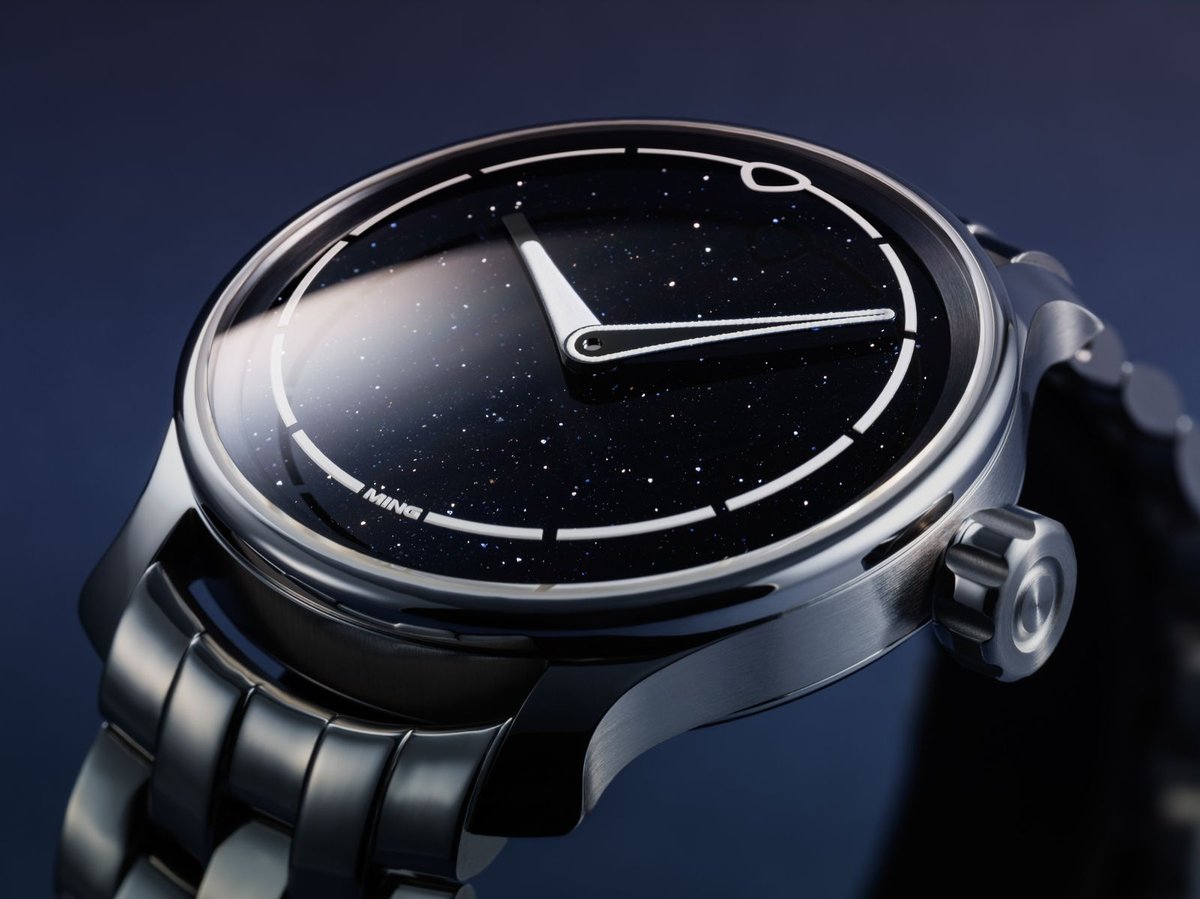
Ming Comet 57.05: The Indie That Earns Its Premium — And Where It Doesn't
Ming Watches has spent the better part of a decade proving that a small studio in Kuala Lumpur can out-design brands fifty times its size. The Comet, reference 57.05, is the kind of piece that argument rests on: a low-volume release with a dial that photographs better than most Swiss product at three times the money, sold through a drop model that turns a purchase into an event rather than a transaction.
For a collector, though, the interesting question is never whether a Ming looks good in a press image. It is whether the thing survives contact with a real wrist, a real service bill and a real resale market. Ming's production is small enough that comparables are thin, and the brand publishes less specification data than the Swiss majors — which means buyers have to do their own homework rather than lean on a spec sheet.
This review separates what Ming actually confirms from what forums assume. Where a figure is not published for this reference, we say so rather than substituting a plausible number. That discipline matters more in this segment than anywhere else, because in a market this thin, a single invented millimetre can turn into four figures of mispriced expectation.
The brand in ninety seconds
Ming Watches was founded in 2017 by Ming Thein, a photographer and longtime collector, and built its reputation on a very specific formula: take a well-understood third-party movement, wrap it in a case and dial designed with genuine restraint, and sell it direct in small batches at a price that undercuts anything comparable from an established house.
That formula has produced a collector culture rather than a customer base. Ming drops have historically cleared in minutes, and the brand has experimented with queue and lottery systems to keep bots and flippers from absorbing supply. The result is a secondary market that behaves unlike almost any other sub-five-figure watch: prices spike immediately after a drop, hold a premium for a while, then decay toward — and sometimes below — the original release price as the next reference steals attention.
Understanding that cycle is more useful than memorising the spec sheet. Ming is a brand where timing your exit matters more than timing your entry, because entry is largely decided for you by the drop.
What the Comet actually is
The Comet sits in Ming's core design lineage: a time-only piece with a wide dial aperture, a near-invisible bezel and a case profile built to sit flat rather than tall. There is no date window, no chronograph, no GMT hand. The complication list is empty, and that is the point — the design has to carry the watch on its own, with nothing to distract the eye.
Ming's public documentation for the 57.05 is thinner than collectors would like. The brand does not publish a calibre designation, a beat rate, a power reserve figure or a jewel count for this reference, and it does not publish case dimensions in the way a Swiss brand would. Buyers who need those numbers before committing should request them in writing from Ming directly. Buyers who can evaluate a watch on the wrist will find the absence less troubling than the forums suggest, but it is a genuine due-diligence gap and should be priced in.
Case, dial and the details that sell the drop
The case is titanium, which has become something of a Ming house material and which makes strategic sense for a watch with this much dial area. Titanium keeps the assembly light enough that a wide-aperture watch does not feel like a disc strapped to the wrist. It also gives the case a cooler, softer tone than polished steel, one that photographs as grey rather than white and that reads as deliberate rather than flashy.
The trade-off is the well-known titanium one: the metal marks more readily than stainless steel, and those marks polish out unevenly because titanium is softer and gummier under a buffing wheel. If you are the kind of owner who winces at a hairlined lug, this is not the case material for you. If you accept that a titanium case is meant to acquire a patina, it is one of the most honest finishes in the bracket.
The crystal is sapphire, and Ming's anti-reflective coating is the detail that separates the brand from its imitators. Ming has consistently applied double-sided AR to a standard that makes the crystal disappear under most lighting, which is what gives the dial its characteristic floated look. It is also the single most expensive thing for a homage to replicate convincingly, and the reason photographs of cheap imitations never quite land the same way.
Lume is present rather than decorative — Super-LumiNova in the X1 grade, which is bright and fast-charging but which has no real business on a dress watch. It is there because collectors ask for it, and because it costs almost nothing to add to an already-designed dial. Treat it as a bonus rather than a design feature.
The watch ships on a leather strap with a pin buckle. That is the correct configuration for this case, and it is also where owners do the most aftermarket fiddling — swapping to a tapered strap in a contrasting leather is the single cheapest way to change the Comet's character. It does, however, mean that many examples on the secondary market are no longer on their original strap, so completeness matters when you buy.
Movement and real-world accuracy
Here is where the honest analyst has to slow down. Ming does not publish a calibre name for the Comet 57.05, and the brand's automatic references have historically been built on Sellita base movements with Ming's own regulation and finishing. That is a perfectly respectable approach — Sellita ébauches are robust, serviceable just about anywhere, and cheap to maintain — but it is not in-house watchmaking, and buyers should not pay in-house money for it.
What you actually get is a thin automatic with a closed caseback, no chronometer certification and no published rate specification. In practice, owners report tight timekeeping, and Ming does regulate before dispatch. Plan for roughly five to fifteen seconds a day depending on position and temperature, and check the rate over a full week rather than a single afternoon. A lightly worn example may need regulation after several years of intermittent use, which is normal for any automatic and should not be read as a fault.
The absence of certification is not a problem in itself. It is a problem only if you are paying a premium on the assumption that it exists. Ming's pricing has never been justified by movement engineering, and the Comet is no exception.
On the wrist
Ming's house signature is a near bezel-less case with a very large dial-to-case ratio, and the Comet follows that template closely. The practical consequence is that the watch reads considerably larger on the wrist than its case measurement implies, because there is almost no metal between the crystal edge and the case flank. Collectors with smaller wrists should try before committing; collectors with average or larger wrists will find it sits flat and wide rather than tall and domed.
Titanium is the other half of the story. Weight is minimal, which makes the Comet disappear on a leather strap in a way steel dress watches rarely do, and it means the watch never feels front-heavy despite the wide dial aperture. On a thin strap with a pin buckle, the whole package is genuinely wearable for twelve hours without notice — which is the highest compliment a daily-wear dress watch can receive.
Wrist presence is moderate: three out of five. It has real visual weight across the dial, which is what you want from a design-led piece, but the restraint of the whole object keeps it from announcing itself across a table. That balance is harder to hit than it sounds, and it is the main reason people who buy one Ming tend to buy a second.
The market: pricing, liquidity and the Ming premium
Ming is a drop-driven brand, and drop-driven brands produce a specific price curve. Immediately after release, supply is exhausted and demand is at its peak, so secondary prices run well above the release figure. Over the following twelve to eighteen months, as the next reference lands and the collector conversation moves on, that premium compresses. Early Ming references have shown both patterns: some settled close to release price, a handful held a durable premium, and a few dipped below on thin trading.
The Comet 57.05 sits in a difficult place for price discovery. Ming is not an auction-house name, so there is no public sale record to anchor valuations. Comparables come from dealer listings and forum sales, which means the spread between asking and clearing prices is wide and the data is noisy. Anyone quoting you a definitive pre-owned range for this reference is guessing, and you should treat any figure as indicative rather than authoritative.
Liquidity is the real constraint. A small production run cuts both ways: it makes the watch scarce, which supports price, but it also means there may be no buyer on the day you want to sell. If you need to convert the Comet to cash inside a week, expect to discount. If you can wait a quarter, you will likely find the buyer who specifically wants this reference.
Hold or sell?
The disciplined answer is hold. The worst moment to sell any Ming is inside the first year after its drop, when the premium is still being quoted but the pool of buyers is already thinning. Collectors who flip into that window routinely give back most of the gain to the spread.
Sell only if one of three things is true: you bought the watch as an investment rather than to wear it; you have fallen out of love with the design and are not wearing it; or you have been offered a price at or above the post-drop peak. Otherwise, this is a piece to hold past the first-flip window and re-evaluate in three to five years, at which point the collector base for early Ming references will be either meaningfully larger or meaningfully smaller — and there is no way to know which today.
One practical note: keep the original strap, buckle, packaging and paperwork. Ming buyers are detail-oriented, and an incomplete set can cost you a meaningful percentage on resale in a market where every buyer is comparing three listings at once.
What else to consider
If the appeal is the design-led, small-studio ethos, Kurono Tokyo's Mori offers a similar proposition with Japanese execution and comparable secondary-market thinness. If the appeal is minimalist design at a similar outlay, Nomos Glashütte's Tangente gives you an in-house movement and a service network that spans the globe — a materially easier ownership proposition. If you want finishing above the price, Grand Seiko's hand-wound dress pieces deliver more than Ming can at this level, though without the scarcity theatre. And if the appeal is specifically craft from a tiny studio, anOrdain's enamel dials make the same emotional argument in a different register.
Cheap homages exist and are worth a look if you are unsure about the wide-aperture look on your wrist. A San Martin or a Pagani Design dress automatic will tell you within a week whether the aesthetic suits you. It will not tell you anything about Ming ownership, because the finishing, the AR coating and the case architecture are precisely what you are paying for.
Service and ownership cost
Ming services through its Kuala Lumpur base and a small set of regional partners rather than a global boutique network. That is workable, but it requires planning: transit, insurance and return shipping all add to the actual cost of a service, and turnaround times depend on parts availability for the base movement. Ming has not published a fixed service interval or a standard service price for this reference, so budget conservatively and confirm the current process with the brand before you send anything.
The upside of a Sellita-based automatic is that any competent independent watchmaker can handle the mechanical work if you are out of warranty and out of patience. The downside is that the case, crystal and dial are Ming-specific, so anything cosmetic has to go back to the source.
Verdict
The Ming Comet 57.05 is a design-led watch that asks you to buy with your eyes and your wrist rather than a spreadsheet. It wears light, wide and exceptionally clean, and it will hold its own against dress watches costing considerably more. What it will not do is provide a documented resale curve, a certified movement or a deep service network — and those are real costs, not footnotes.
Buy it to wear. Hold it past the first-flip window. Treat any premium as a bonus rather than a thesis, and verify every specification directly with Ming before you commit, because the brand's public documentation for this reference does not answer the questions a careful buyer should be asking.