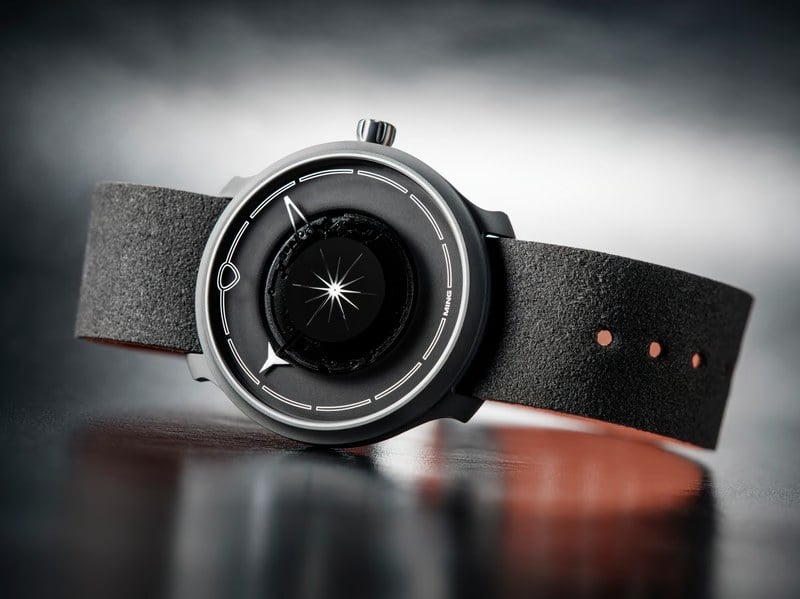
The Philosophy of Mass Reduction
In the world of high-end horology, weight has long been a proxy for quality. The 'heft' of a gold rotor or the solid click of a steel bracelet provides a tactile reassurance of value. However, a parallel movement has emerged among the avant-garde: the pursuit of the absolute minimum. The Ming LW.01 Automatic is the latest and perhaps most significant entry into this category. Designed by Ming Thein, the LW.01 is not just a watch; it is a laboratory for testing the limits of what a mechanical timepiece can endure when stripped of every non-essential atom.
The challenge of creating a lightweight watch is twofold: you must find materials with low density, but those materials must also possess enough torsional rigidity to keep the movement's gears in perfect alignment. If the case flexes, the movement stops. Ming’s solution was to look outside the traditional horological catalog and toward aerospace and high-performance cycling, leading them to AZ31 Magnesium-Aluminium-Zinc alloy.
Material Science: AZ31 and PEO Coating
AZ31 is a remarkable material. It is lighter than titanium and offers a better strength-to-weight ratio than many steels. However, magnesium is notoriously difficult to work with. It is flammable in powder form and highly susceptible to corrosion. To solve the latter, Ming utilized Plasma Electrolytic Oxidation (PEO). This process creates a hard, ceramic-like oxide layer on the surface of the magnesium, protecting it from the environment while providing a unique matte-grey aesthetic that is both tactical and sophisticated.
The choice of Gorilla Glass 6 for the crystal is another masterstroke of weight saving. While sapphire is the industry standard for scratch resistance, it is significantly denser than Gorilla Glass. By using a chemically strengthened glass typically found in high-end smartphones, Ming was able to reduce the weight of the crystal by nearly 50% while maintaining sufficient impact resistance for daily wear.
The 'Hat' Architecture
The internal structure of the LW.01 is where the technical brilliance truly shines. Traditional watches use a case, a movement spacer, and a dial. The LW.01 does away with this. Instead, it employs a 'hat' construction. The movement is mounted to a central structural ring that doubles as the dial and is held in place by specialized PEEK (Polyether ether ketone) screws. These screws are not only lighter than steel but provide excellent vibration damping.
This monocoque-adjacent design means that the case itself is a load-bearing member. There is no traditional dial; the top of the movement assembly is finished to provide the visual depth one expects from a Ming, featuring the brand's signature radial patterns and minimalist indices. This integration of components is what allowed Ming to achieve a thickness of just 6.5mm, including the automatic winding mechanism.
The Movement: A Refined Workhorse
Powering the LW.01 Automatic is a modified ETA 2000.1. While some might have hoped for a bespoke caliber, the choice of the 2000.1 is a pragmatic one. It is one of the thinnest automatic movements available with a proven track record for reliability. Ming’s team has stripped the movement of all unnecessary components and regulated it to ensure it meets the expectations of a high-end collector.
The winding rotor has been optimized for the lightweight case. In many ultra-light watches, the movement of the rotor can be felt quite prominently because there is so little mass to dampen the kinetic energy. Ming has tuned the bearings and the rotor weight to ensure that while the watch remains light, the winding action is smooth and unobtrusive.
Ergonomics and the 'Phantom' Effect
On the wrist, the LW.01 Automatic is a revelation. At 10.8 grams, it is approximately 1/15th the weight of a standard Rolex Submariner. The sensation is akin to wearing a piece of silk ribbon. The Alcantara strap, manufactured by Jean Rousseau, is a critical part of this equation. It is breathable, incredibly light, and features a pin buckle made from the same AZ31 alloy as the case.
The 38mm diameter is the 'sweet spot' for modern enthusiasts, offering enough presence to be legible without dominating the wrist. The lack of lume might be a detractor for some, but in the context of a watch where every milligram was scrutinized, the omission of heavy luminous pastes is a logical design choice.
Investment and Collectibility
With only 200 units produced (split between the manual and automatic versions), the LW.01 was an instant sell-out. In the secondary market, it has become a 'grail' for those who appreciate technical innovation. Unlike many 'hype' watches, the value of the LW.01 is rooted in its genuine contribution to horological engineering. It is a milestone piece—the kind that will be referenced in textbooks decades from now when discussing the evolution of materials in watchmaking.
The LW.01 offers something that gold and diamonds cannot: the luxury of absolute efficiency. It is a watch for the person who has everything and is now looking for the nothingness of weight.
Conclusion
The Ming LW.01 Automatic is a polarizing masterpiece. It challenges our fundamental perceptions of what a luxury watch should feel like. By prioritizing engineering over tradition, Ming has created a timepiece that is not only a record-breaker but a wearable work of art. It is precise, it is technical, and above all, it is a testament to the power of modern independent watchmaking.