The Philosophy of the Void
In the world of luxury horology, we are often taught that more is more. More polishing, more complications, more heritage. Ming Thein, the visionary behind his eponymous brand, has always pushed back against this narrative, but with the 37.02 Monolith, he has practically deleted it. The Monolith is a watch that exists in the negative space. By stripping away color and traditional finishing, Ming has created a timepiece that relies entirely on form, proportion, and the interplay of matte surfaces.
As a daily wearer, the Monolith is a revelation. In an age where the 41mm 'sport-chic' integrated bracelet watch has become the default setting for the young professional, the 38mm Monolith feels like a quiet rebellion. It is a watch for those who have moved past the need for a recognizable logo and instead seek a recognizable silhouette. During my week with the piece, I found that it didn't just tell the time; it set a tone for my entire wardrobe—sharp, intentional, and modern.
A Week on the Wrist: Ergonomics and Survival
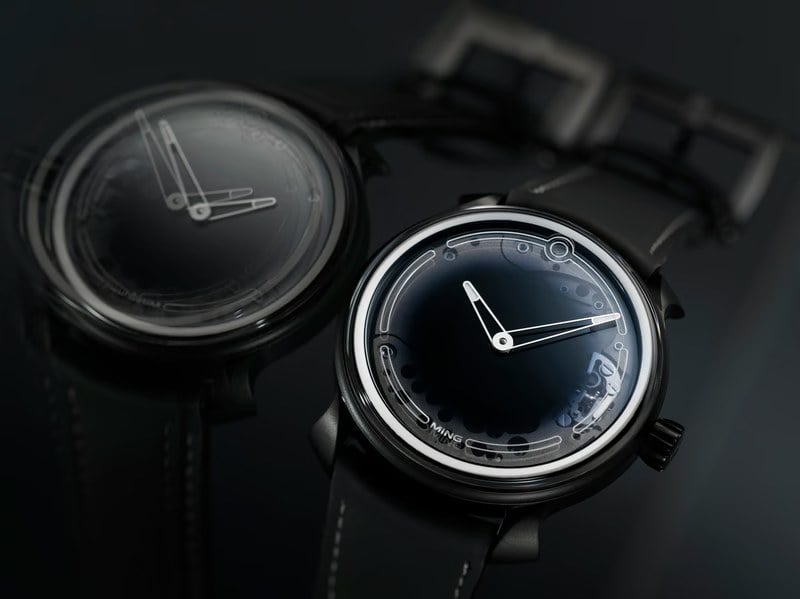
The true test of any daily watch is the 'Wednesday slump'—that point in the week where a heavy or uncomfortable watch starts to feel like a chore. The Monolith never reached that point. The Grade 2 titanium case is the secret weapon here. Unlike Grade 5, which is often polished to a mirror shine, Grade 2 has a naturally darker, more industrial hue that takes to the DLC (Diamond-Like Carbon) coating beautifully. The result is a matte finish that feels warm to the touch and hides fingerprints far better than its steel counterparts.
The lug-to-lug measurement of 44.5mm is particularly clever. The lugs flare out with a characteristic Ming curve, but they terminate quickly, ensuring that the watch never overhangs even a smaller 6-inch wrist. On my own wrist, the balance was centered perfectly. Whether I was typing at my desk or reaching for a strap on the Metro, the watch remained anchored. The FKM rubber strap deserves its own praise; it is supple, lacks the 'vanilla' scent of cheaper rubbers, and features a tuck-in design that keeps the tail of the strap out of the way.
Legibility in the Shadows
One might assume an all-black watch would be a nightmare to read. However, Ming utilizes a sapphire dial with a gradient that transitions from a deep black at the periphery to a slightly more transparent center. The hour markers are not printed; they are HyCeram—a composite of ceramic and Super-LumiNova—injected into the sapphire. This gives the markers a three-dimensional quality that catches whatever ambient light is available.
In low-light conditions, the Monolith transforms. The HyCeram glow is intense and crisp, providing a neon-like outline that is far more legible than traditional lume pips. Even in total darkness, the orientation of the dial is clear thanks to the unique shape of the hands. My only gripe during the week was the lack of a running seconds hand. While the 'pulse' of a mechanical watch is usually visible through a moving hand, the Monolith is a static, serene object. You have to trust that the modified Sellita SW300-1b is doing its job—which, in my testing, it did with chronometer-adjacent accuracy.
The Movement: Hidden Depth
Flip the watch over, and the 'Monolith' theme continues, but with a twist. The Sellita SW300-1b has been stripped of its standard industrial finish. Instead, the bridges have been skeletonized and coated in a matte anthracite. The rotor is a circular affair that allows for an unobstructed view of the balance wheel. It is a reminder that while the watch looks like a piece of modern art from the front, it is a piece of mechanical engineering at its heart.
The choice of the SW300 is a pragmatic one. For a brand based in Malaysia with a global clientele, using a movement that can be serviced by any high-street watchmaker is a service to the owner. It keeps the long-term cost of ownership low while allowing Ming to focus their budget on the exterior components—which are clearly punching in the $10,000+ category.
The Vivir Verdict
Is the 37.02 Monolith the perfect watch? For the collector who demands heritage and 'The Holy Trinity' on their dial, perhaps not. But for the sophisticated collector who views horology as an extension of architecture and industrial design, it is near-perfect. It survives the week not just by being durable, but by being interesting. Every time I looked down to check the time, I found myself tilting my wrist to see how the light interacted with the matte DLC and the sapphire layers.
In the current market, where prices for independent watchmaking are skyrocketing, the Monolith represents a fair value proposition. It offers a distinct identity that is entirely its own. It is a watch that doesn't just survive a week on the wrist—it dominates it.