Scarcity engineered in advance
Most watch reviews start with the case and work inward. That is the wrong order for the MING 29.06 Peepshow. The first thing to understand about this watch is not how it is made but how it is sold: it arrived as a discrete drop, not as a permanent catalog line. That single fact determines its secondary market behaviour more than any movement specification ever could.
MING has built something unusual over the past several years — a brand whose releases are events. Announcement, then a narrow order window, then closure. There is no dealer stock to browse, no discounting cycle, no end-of-season clearance. The supply of any given reference is effectively decided at launch and then frozen. For collectors, that produces a very particular psychology: the watch you did not order on the day is a watch you can only buy from someone who did.
Against that backdrop, the 29.06 has to be judged as a collectible rather than a purchase. The question is not whether it is a good watch — it plainly is — but whether it deserves the space in a considered collection and the capital it currently commands on the secondary market.
Where the reference sits in MING's catalog
MING was founded in Kuala Lumpur in 2017 by Ming Thein, a photographer and designer whose visual instincts shaped the brand far more thoroughly than any heritage narrative could have. Production is Swiss, executed through specialist partners, while dial architecture, typography and case design are controlled in-house. That structure — Swiss execution, Malaysian authorship — keeps output deliberately small and keeps the brand's aesthetic coherent in a way that volume manufacturing rarely manages.
The 29 series is MING's dress-leaning territory, sitting alongside references like the 17.01 and 27.01 in the brand's three-hand lineup. Where those references established the house codes — near-absent bezels, wide dial apertures, typography as ornament, indices that float rather than sit — the 29.06 pushes the dial treatment further. This is not the entry point to the brand; it is the reference for buyers who already understand what MING is doing.
That matters for valuation. Entry-level MING references attract first-time buyers and therefore have the deepest, most liquid secondary market. More conceptually specific references like the 29.06 have a shallower pool of buyers, but those buyers are more determined. In practice, thin liquidity and committed demand roughly cancel out — which is why this reference has held rather than spiked or collapsed.
The Peepshow concept
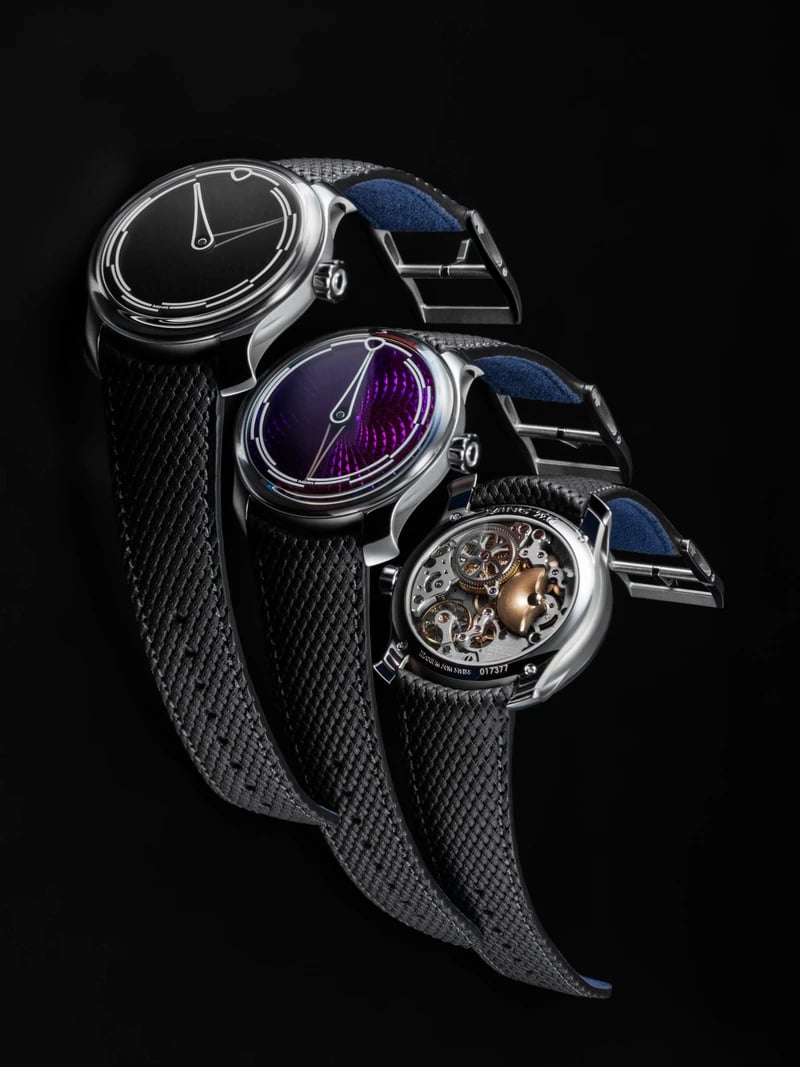
The name is the design brief. MING's dials have always been about withholding and revealing — layers, negative space, elements that appear to hover above the surface plane rather than sit on it. The Peepshow treatment takes that logic and makes it the organising principle of the dial, framing a controlled aperture rather than presenting a flat field of markers and a logo.
This is where the 29.06 earns its price. At this level, dial architecture is the differentiator. A three-hand automatic on a leather strap is functionally identical across a dozen brands; what separates them is whether the dial gives the eye something to do on the fourth year of ownership. MING's references tend to pass that test, and the 29.06 passes it more emphatically than most. Photographs undersell it — the layering reads as depth in person in a way that flat product shots routinely fail to capture.
It is also the reason the watch is not for everyone. If you want a dress watch that reads as traditional, restrained and invisible, this is the wrong object. The 29.06 is a deliberate conversation piece in a quiet register: distinctive to anyone paying attention, unremarkable to anyone who is not.
Case, crystal and strap
The case is stainless steel, and the crystal is sapphire — both the correct answers at this price, and neither a marketing claim worth expanding on. What matters is the proportion philosophy rather than the individual figures: MING's design language produces a watch that reads larger on the dial than it does on the wrist, because the bezel effectively disappears and the aperture occupies the full visual field. Readers looking for exact dimensions should go to MING's own release documentation for the reference; where the brand has not published a figure, we have not substituted a plausible-sounding one, because guessed dimensions are worse than absent ones.
The watch is delivered on leather, closed with a pin buckle — the right call for a dress-leaning reference. A deployant would add convenience and bulk in equal measure, and this watch does not need bulk. Strap changes are straightforward and, given how much of the design's character lives in the dial rather than the case, a strap swap genuinely changes the watch's register: darker leather moves it formal, a lighter or textured strap pulls it toward daily wear.
Luminescence is present in the Super-LumiNova family, applied with the restraint you would expect. This is not a watch designed around darkness; treat the lume as a courtesy rather than a capability.
The movement question
The 29.06 runs an automatic calibre built on a Sellita SW200-1 base to MING's specification, beating at 28,800 vibrations per hour with roughly 38 hours of power reserve. For a subset of collectors, that sentence ends the conversation. It should not.
A small brand producing in limited quantities has two realistic movement routes: an in-house calibre that would be expensive, thinly supported and difficult to service outside one or two workshops, or a well-proven Swiss ébauche specified, finished and regulated to the brand's standard. MING chose the second, and for a watch meant to be worn and kept rather than stored, that is the more responsible engineering decision. The movement is honest, tidy and — crucially — repairable by any competent watchmaker with Sellita parts access for the next several decades.
What it is not is a movement you buy the watch to admire. There is no manufacture halo here, no hand-finished bridges to lose an afternoon in. If in-house architecture is a non-negotiable part of your collecting criteria, the 29.06 will not satisfy you, and the alternative set looks like Nomos or a step up into Grand Seiko territory. Be honest with yourself about which collector you are before you buy.
Expected real-world accuracy sits comfortably inside roughly minus five to plus ten seconds a day in normal wearing conditions. That is entirely appropriate for a dress watch worn a few days a week, and it is not a chronometer claim. Do not chase COSC-level consistency from a calibre that was never sold on that promise.
On the wrist
This is a watch engineered to disappear into a cuff. The visual mass sits in the dial rather than the case flanks, so there is no slab-like sensation; the strap does most of the positioning work and the case follows. Balance is good, weight is unobtrusive, and the leather pairs with the case without the break-in period that stiffer dress straps demand.
The trade-off is presence. The 29.06 does not announce itself across a dinner table. It rewards the person sitting opposite you who recognises the typography or the layered dial — which, depending on your temperament, is either the entire point or a reason to look elsewhere in the catalog. Owners consistently describe it as a watch that gets noticed by the right people and ignored by everyone else, and that is a fair summary.
Versatility is better than its dress-watch billing suggests. It handles formal wear without strain, works as a daily for anyone in a professional environment, and travels well because it reads as nothing in particular to a customs officer or a stranger at a bar. It is not a sports watch and should not be treated as one.
The market: drops, flips and the secondary curve
Here is where the analyst's hat replaces the enthusiast's. MING's drop model created one of the more interesting secondary markets in independent horology between roughly 2020 and 2022, when demand for design-led micro-production watches outpaced supply by a wide margin. Premiums over retail were common, sometimes substantial, and the brand became a case study in how distribution mechanics can create value independent of specification.
That cycle has cooled. The broader correction in enthusiast watch pricing — the same one that took the heat out of steel sports models — reached the independent segment too. Premiums compressed, holding periods lengthened, and the buyer pool became more selective. The 29.06 entered this environment rather than the peak, which is, counterintuitively, a point in its favour: you are not buying at the top of a hype curve.
Current pre-owned pricing clusters in a band that sits partly above and partly at the original retail level, depending on condition, completeness and whether the original packaging and paperwork are intact. Full sets command a premium; watch-only examples sit at the bottom of the band and take longer to move. Trend direction is best described as stable rather than appreciating — there is a real floor created by fixed supply, but no mechanism pushing the ceiling higher. This reference does not have the ingredients for compounding appreciation: no manufacture movement, no precious metal, no historical significance, no auction record.
Liquidity deserves an honest note. The 29.06 will sell, but not in a week. The pool of buyers who understand what a Peepshow dial is and are willing to pay for it is narrower than forum chatter implies. Sellers who need to exit quickly will accept the bottom of the band; sellers who can wait will find the top of it.
The comparable set
The honest comparison is not other dress watches — it is other drop-built independents. Kurono Tokyo occupies the same market mechanics with a different aesthetic register, and its secondary behaviour rhymes closely with MING's: fixed supply, thin liquidity, committed buyers, stable-to-soft pricing in the current cycle. Collectors frequently own both, and both serve the same portfolio function: design authorship at accessible money.
anOrdain sits alongside for buyers drawn to dial craft as the primary value proposition, though the Scottish brand's enamel work attracts a slightly different sensibility. Nomos Glashütte is the rational alternative for anyone who wants an in-house calibre, a dealer network and a watch they never have to think about — and it is worth acknowledging that the Tangente does everything the 29.06 does functionally, at a lower emotional temperature. Grand Seiko's hand-wound dress references are the step-up option, trading scarcity for genuine manufacture craft.
None of these are substitutes. They are different answers to the same question, and the 29.06's answer — buy the design, accept the movement compromise, benefit from fixed supply — is coherent on its own terms.
Hold or sell
Hold. The reasoning is straightforward. The supply of this reference is fixed and small; there is no scenario in which MING produces more of them. That creates a genuine floor that is not dependent on hype. At the same time, the absence of an in-house movement and the thin buyer pool cap the upside. The expected return profile is roughly flat with a modest floor — which is precisely the profile of an object you should own because you like it, not because you are underwriting a return.
Buyers entering today should assume they are paying close to fair value and should not expect to flip profitably inside a year. Sellers should not panic-exit into a soft market; the reference moves at the top of its band for patient sellers with complete sets. The worst outcome for either side is treating a design object as a trade.
Service and long-term ownership
Ownership economics are favourable. Because the movement is a widely used Swiss ébauche, routine servicing is not a captive situation — MING's network handles it, and any competent independent watchmaker with Sellita parts access can perform standard work. The caveat is dial-side: a layered MING dial is not something to hand to the nearest strip-mall watchmaker. Anything requiring the dial to come apart should go back to the brand.
The practical recommendation is a routine check on a sensible interval rather than a rigid schedule, with attention to the crown and gaskets if the watch sees regular wear. Long term, this is a watch that can be kept running indefinitely — a meaningful advantage over small-batch in-house movements whose parts supply depends on a single workshop staying in business.
Verdict
The 29.06 Peepshow is a design object first and a financial instrument a distant second, and collectors who buy it on the second premise will be disappointed. Buy it because the dial rewards long ownership and because the supply will never grow. Hold it because the floor is real and the ceiling is not. For a young collector building an independent-focused collection, it earns its place — as a keeper, not a trade.