The Architecture of Light: The Starfield Dial
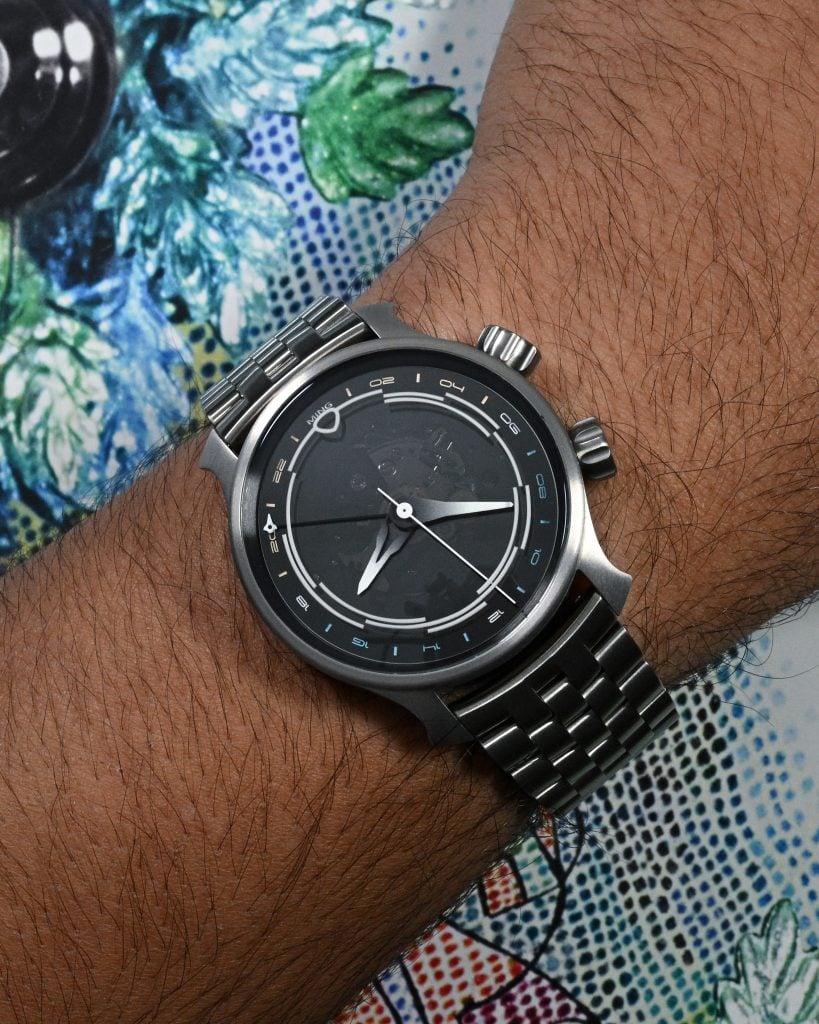
The defining characteristic of the Reference 56.00 is its dial. Ming has long experimented with sapphire as a structural component, but here it is used as a medium for light manipulation. The 'Starfield' effect is achieved through a multi-stage laser etching process on the underside of the sapphire crystal. Thousands of tiny pits are etched at varying depths and densities, creating a three-dimensional representation of a galactic field.
Underneath this etched sapphire layer lies a deep black base, which provides the necessary contrast to make the stars 'pop.' When viewed in direct sunlight, the dial exhibits a shimmering quality that changes as the wrist moves. In low-light conditions, the Super-LumiNova X1—applied to the hands and the underside of the crystal—creates a ghostly, ethereal glow that illuminates the etched patterns from within. This is not just a dial; it is a miniature light installation.
The hands are typical of the Ming aesthetic: skeletonized, high-polish, and perfectly proportioned to the indices. The lack of a logo on the dial (a bold move for any brand) emphasizes the purity of the design. The brand name is instead discreetly engraved on the caseback, allowing the dial's celestial theme to remain uninterrupted by commercial branding.
Mechanical Integrity: The Schwarz-Etienne Calibre 330.M1
While Ming's early successes were built on modified Sellita and ETA movements, the brand has increasingly turned to Schwarz-Etienne to realize its more ambitious mechanical visions. The Calibre 330.M1 found in the 56.00 is a manual-wind movement that has been extensively modified to meet Ming's aesthetic standards. The architecture is characterized by skeletonized, anthracite-coated bridges that offer a stark, modern contrast to the traditional brass and steel components.
The finishing is exemplary for this price point. One can observe diamond-cut chamfers on the bridges, which catch the light and provide a sharp border to the matte-blasted surfaces. The black-polished screws and the circular-grained wheels indicate a level of hand-finishing that is rarely seen in watches under $10,000. The movement beats at 21,600 vibrations per hour, a choice that favors longevity and stability over high-frequency precision.
From a technical standpoint, the 330.M1 is a robust caliber. It features a hacking seconds mechanism and a smooth winding action that provides satisfying tactile feedback. While the 42-hour power reserve is modest by modern standards, it is a fair trade-off for the movement's slim profile, which allows the watch to maintain its 11mm thickness.
Case Geometry and Ergonomics
The Ming 56.00 case is crafted from 316L stainless steel and features a complex interplay of polished and brushed surfaces. The 'flying blade' lugs are perhaps the most recognizable element of Ming's design language. They are flared and hollowed out on the sides, a detail that reduces weight and adds visual complexity. More importantly, the lugs are incredibly short, resulting in a lug-to-lug distance of 43.9mm.
This compact footprint makes the 38mm case wear significantly smaller than its dimensions suggest. It is a watch that feels 'at home' on the wrist immediately. The bezel is thin and highly polished, which maximizes the dial aperture and gives the watch a larger visual presence than its 38mm measurement would imply. The sapphire crystal is box-shaped, adding a vintage-inspired warmth to an otherwise ultra-modern design.
The crown is large and deeply fluted, making it easy to grip and operate. Despite its size, it does not dig into the back of the hand, thanks to the careful positioning of the lugs and the overall case balance. The caseback is secured by screws and features a sapphire exhibition window, allowing for an unobstructed view of the Schwarz-Etienne movement.
The Vivir Verdict: A New Standard for the Young Collector
The Ming Starfield 56.00 is more than just a successful design; it is a testament to the power of collaborative watchmaking. By combining Malaysian design sensibility with Swiss mechanical prowess, Ming has created a reference that feels truly unique in a crowded market. It avoids the tropes of 'vintage-inspired' design, opting instead for a future-forward aesthetic that is grounded in technical excellence.
For the sophisticated young collector, the 56.00 offers a compelling value proposition. It provides the exclusivity and design-led approach of high-end independents like MB&F or De Bethune, but at a price point that is accessible to those earlier in their collecting journey. The Starfield is not a watch for everyone—its lack of a date window and its 50m water resistance make it less than ideal as a 'one-watch collection'—but for those who appreciate horology as an art form, it is a masterpiece of light and shadow.
In conclusion, the Reference 56.00 is a significant achievement for Ming. It demonstrates that the brand is not resting on its laurels but is instead pushing the boundaries of what can be achieved with sapphire and steel. It is a celestial study that deserves a place in any serious modern collection.