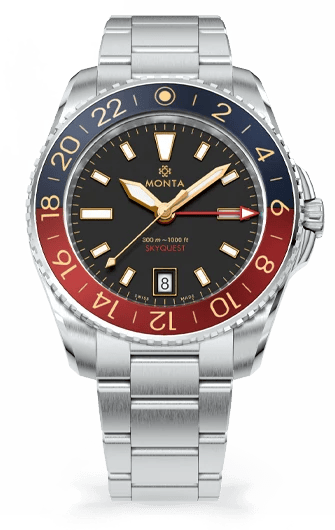
The Fourth Hand Problem
A GMT is the most compromised object in watchmaking. Adding a fourth hand and a 24-hour scale means adding parts to the movement, depth to the case, and visual noise to a dial that must still read instantly in bad light. Most brands solve that equation by adding more: more bezel, more colour, more complication, more presence. Monta's Skyquest has always solved it by subtraction, and the Neuchâtel X is the most disciplined version of that argument the brand has yet shipped.
That matters because the travel watch is a category full of solutions looking for a problem. The traveller who genuinely crosses time zones needs one thing above all: a second time zone that can be read at a glance without mental arithmetic. Everything else — the bezel, the finishing, the case architecture — exists to support that single function. The Neuchâtel X is interesting precisely because it treats that hierarchy seriously.
Monta, Briefly
Monta was founded in St. Louis in 2016 by the team behind Everest Horology Products, the strap maker that built its reputation on fitting modern Rolex cases with unusual precision. That origin story explains nearly everything about the brand's instincts. Everest taught its founders that tolerances at the case-and-bracelet interface are what separate a good watch from an irritating one, and Monta carried that lesson directly into its own steel sports watches.
The formula has been consistent: design in Missouri, produce in Switzerland, use Sellita movements, and spend the money saved on case finishing, bracelet engineering and lume rather than on marketing. The Triumph established the language; the Oceanking and Atlas broadened it; the Skyquest turned it into a travel watch. Monta does not have a heritage archive to raid and does not pretend otherwise, which is oddly liberating — every design decision has to justify itself on the merits rather than on a 1960s reference.
The result is a brand that collectors tend to discover sideways, usually through the bracelet, and then defend with unusual heat. The Neuchâtel X is aimed squarely at that audience: people who already understand what Monta is doing and want the most refined expression of it.
What the Neuchâtel X Actually Is
The name is a small confession. Monta designs in St. Louis but has its watches made in Switzerland, and the Neuchâtel X takes its name from the Jura watchmaking region where that assembly happens. It is an edition within the Skyquest line rather than a new model — the same case architecture, the same bracelet, the same movement — with the differentiation concentrated where Monta has always been strongest: the dial and the hand finishing.
That is a more meaningful distinction than it sounds. On a watch like this, the case is already excellent and there is very little room to improve it without changing the price bracket entirely. The dial, by contrast, is where a small brand can genuinely differentiate itself from a larger one, because it is labour-intensive rather than capital-intensive. The Neuchâtel X leans into that, with a dial treatment and handset finishing that read as deliberate rather than decorative.
It is also, unapologetically, a limited run. Monta has used small editions before to test ideas and reward its existing customers, and this is in that tradition. Buyers should be clear-eyed about what that means: limited availability, yes; instant collectibility, no.
Case and Finishing
The Skyquest case is the part of this watch that most rewards a loupe. Monta finishes its cases in the traditional two-tone discipline — broad brushed surfaces on the case flanks and the top of the lugs, with polished bevels running along the lug edges and a polished chamfer where the case meets the bezel. The transitions between the two are crisp and consistent, which is the detail that separates a well-finished case from a merely shiny one. Run a fingernail along the bevel and it catches cleanly; there is no rounding over, no softness at the edges.
Equally important is what the case does not do. There is no decorative frippery, no gratuitous crown guards, no attempt to look like a dive watch that forgot its depth rating. The lugs curve downward from the caseband in a way that is clearly designed around how the watch sits rather than how it photographs, and the crown is guarded without being armoured. The whole thing reads as a piece of engineered product rather than a piece of jewellery, which is exactly the register a steel travel watch should occupy.
The exhibition caseback is a reasonable choice here. The Sellita underneath is not spectacular to look at, but Monta finishes it properly, and being able to see a signed rotor and striped bridges on a watch at this price is a small pleasure rather than an embarrassment. It also reminds you what you paid for and what you did not.
Dial, Bezel and Lume
The Skyquest's dial is built around a simple premise: the GMT hand should never be the hardest thing to find. Monta uses applied indices with lume-filled plots, a framed date window at three, and an arrow-tipped 24-hour hand that is visually distinct from the hour hand at a glance without being cartoonish. The Neuchâtel X tightens the execution — the applied furniture sits proud of the dial with clean edges, and the printing is fine and sharp rather than thick and safe.
The 24-hour bezel is the other half of the legibility equation, and it is where the Skyquest earns its keep as a travel watch. A rotating 24-hour scale lets you track a third zone, or simply mark home time while you set the local hour hand forward as you land. That is the caller-GMT workflow, and it is the one most travellers actually use, regardless of what the forums say about flyer movements.
Lume is Super-LumiNova applied generously to the indices and hands. It is not the loudest glow in the category, but it charges quickly and reads evenly across the dial without hotspots — which is what you actually want at three in the morning in a hotel room you do not recognise.
The Movement
Inside is Sellita's SW330-2, and it is worth being precise about what that means, because the marketing around GMT movements is frequently misleading. The SW330 family descends from the ETA 2892 line rather than the 2824, which gives it a slimmer base architecture and a smoother winding feel than the workhorse calibres most micro-brands use. The GMT function is integrated rather than bolted on as an aftermarket module, and the local hour hand jumps independently — a caller GMT, sometimes dismissively called an office GMT.
That label is unfair. A caller GMT is the correct complication for the way most people actually travel: you land, you jump the hour hand forward or back, and the 24-hour hand keeps telling you what time it is at home. A flyer GMT, with its independently adjustable 24-hour hand, is a better tool for people who live across two zones permanently. Neither is superior; they are different tools, and Monta picked the one its customers will use.
The movement beats at 28,800 vibrations per hour and carries roughly two days of power reserve, which is unremarkable but entirely adequate for a watch that will be worn daily and wound by motion. Finishing is honest rather than artisanal: Côtes de Genève on the bridges, a signed rotor, and clean assembly throughout. Monta regulates each watch before it ships, and that final step is where the value sits — the difference between a well-regulated Sellita and an unregulated one is the difference between a watch you trust and a watch you check.
It is not an in-house calibre and no COSC certificate accompanies it. At this price, that is a fair trade rather than a compromise. In-house movements at this level usually mean a smaller brand absorbing development costs and passing them on; Sellita means parts availability, independent serviceability, and a movement any competent watchmaker has seen a hundred times before. For a watch designed to be worn hard, that is arguably the better answer.
On the Wrist
Monta's bracelets are the reason people become Monta customers, and the Skyquest's is the best argument for the brand. The links articulate closely enough that the bracelet wraps rather than hangs, the end links meet the case with no visible gap, and the clasp is compact enough that it does not become a paperweight on the underside of the wrist. The tool-free micro-adjustment is the killer feature: a few seconds and a fingernail are all it takes to loosen the fit as your wrist swells in the afternoon heat, which is exactly the kind of small, practical engineering that separates a daily wearer from a weekend watch.
Balance is the other thing Monta gets right. A GMT carries more hardware than a three-hander, and the temptation is always to let the case grow to accommodate it. The Skyquest resists that, and the result is a watch that sits flat and stays centred rather than rolling to one side. It slides under a shirt cuff without being a small watch, which is precisely the brief a travel watch should be judged against. On a leather strap it becomes a different, dressier object; on the bracelet it is a tool in the best sense.
The one caveat is weight. Steel on steel, fitted snugly, is a substantial thing on a humid day. Monta's clasp adjustment solves the fit problem, but not the mass. If you run hot, the leather option is not merely aesthetic.
Accuracy and Ownership
Expect a well-regulated SW330-2 to sit within a few seconds a day either way, with the usual positional variation you get from an uncertified movement. There is no chronometer certificate and Monta does not claim one; the honest answer is that daily-wear accuracy will be perfectly satisfactory, and that a watchmaker can improve it further for the price of a lunch if you care enough to ask.
Ownership is straightforward. Monta does not publish a fixed service interval, and because the movement is a Sellita, any competent independent can service or regulate it without factory involvement. What factory service does preserve is the bracelet's specific fittings and the case refinishing, which is worth considering if you intend to keep the watch for a decade. Buy it as a wearer, service it when it drifts, and it will outlast your interest in most other things in the box.
Value and the Alternatives
At around the two-thousand-dollar mark, the Neuchâtel X is competing with the Longines Spirit Zulu Time, the Christopher Ward C63 Sealander GMT, and a long tail of Sellita-based micro-brand GMTs. What it offers against all of them is finishing discipline at the case-and-bracelet interface, which is where most of that competition quietly gives ground. What it does not offer is a manufacture movement, a chronometer certificate, or any meaningful secondary-market protection — Monta watches typically change hands well below retail, which is good news for the second owner and neutral news for the first.
The limited-edition framing adds desirability without adding much of a premium. Monta editions do trade a little stronger than standard production, but this is not a brand with an auction history, and nobody should buy the Neuchâtel X expecting it to fund a retirement. The correct way to read the price is this: you are paying roughly what a well-made Swiss sports watch costs, and receiving case work and bracelet engineering that would normally cost appreciably more, funded by a modest movement and an unknown name on the dial.
For a certain kind of buyer — someone who has owned the obvious watches and wants something that does the job better than its price implies — that is an extremely compelling trade.
Verdict
The Neuchâtel X is Monta refining the parts of a watch most brands ignore: the clasp, the end links, the dial furniture, the transition between brushed and polished surfaces. It is not a trophy and it will not appreciate. It is, instead, a genuinely well-made travel watch that disappears into your life — and at a time when so many GMTs are shouting, a watch content to be quiet is its own kind of statement.