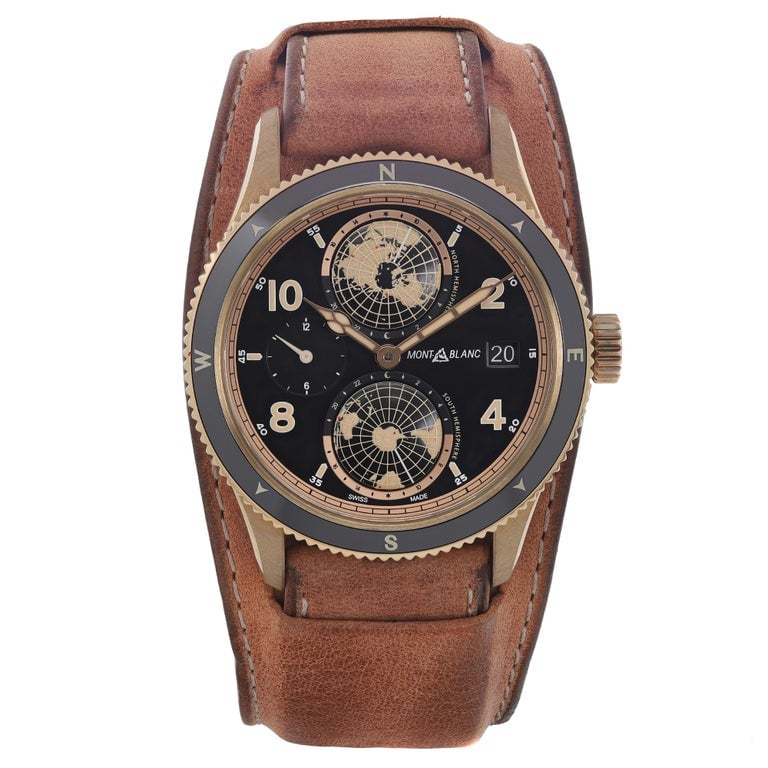
Montblanc 1858 GMT Review: A Week with the Bronze Beauty
Patina, presence, and practicality on the wrist — does this vintage-inspired GMT earn its place in a modern collection?
There is a particular kind of magic that happens when a watch feels like it has already lived a life before it ever touches your wrist. The Montblanc 1858 GMT, reference MB129615, arrives with that exact sensation — a warm, golden-bronze case that seems to whisper of old compasses and expedition gear, yet houses a thoroughly modern automatic GMT movement. I spent a full week wearing it through rain, desk work, and a weekend escape to the coast, and what follows is a wear-focused account of how this timepiece actually performs day in, day out.
Montblanc’s 1858 collection draws deeply from the Minerva manufacture’s military and exploration heritage, and this GMT model is no exception. The 42mm bronze case, cathedral hands, and railway minute track all evoke a tool watch from a bygone era, but the bidirectional world-time bezel and the caller-style GMT function bring it firmly into the present. The question is not whether it looks the part — it does, spectacularly — but whether it can deliver the comfort, legibility, and reliability that a daily-wear watch demands.
Over seven days, I wore the 1858 GMT with everything from a linen blazer to a wetsuit, tracking a second time zone and testing its limits. The bronze case began its slow, organic transformation, the leather strap molded to my wrist, and the movement proved itself a steady companion. Here is the full story of what it’s like to live with the Montblanc 1858 GMT, reference MB129615.
Manufacture History
Montblanc was founded in Hamburg in 1906 as a maker of fine writing instruments, but its watchmaking division, established later, draws heavily on the heritage of the Minerva manufacture it acquired in 2006. The 1858 collection pays homage to Minerva’s legacy of crafting robust chronographs and timepieces for military and exploration use, blending vintage design language with modern manufacturing. This GMT model continues that tradition, offering a bronze-cased, world-time-inspired watch that feels both nostalgic and entirely contemporary.
Movement
Inside the 1858 GMT beats the Montblanc caliber MB 24.15, an automatic movement based on the Sellita SW330-1. It operates at 28,800 vibrations per hour, has 25 jewels, and offers a 42-hour power reserve. The complication set includes a date at 3 o’clock and a caller-style GMT function: the local hour hand can be adjusted independently in one-hour jumps without hacking the movement or disturbing the minute and seconds hands, while the 24-hour GMT hand remains fixed to home time. This is ideal for travelers who need to quickly set local time upon arrival. The movement is not COSC-certified, but it is a proven workhorse. Finishing is industrial yet tidy, with perlage and blued screws visible through the exhibition caseback.
Specifications
- Case diameter: 42mm
- Thickness: 12.5mm
- Lug-to-lug: 50.5mm
- Case material: Bronze
- Crystal: Domed sapphire with anti-reflective coating
- Water resistance: 100 meters
- Lume: Super-LumiNova on hands, numerals, and bezel pip
- Strap: Brown aged calf leather with pin buckle
Wrist Feel
On my 17.5cm wrist, the 1858 GMT wears with a reassuring heft that never becomes burdensome. The 50.5mm lug-to-lug span is well-judged for a 42mm case, allowing the watch to sit flat and avoid overhang, while the curved lugs hug the wrist comfortably. The bronze case adds a noticeable weight — around 110 grams on the leather strap — which gives it a substantial, tool-watch presence without feeling like a burden. The 22mm lug width and the soft, slightly padded brown calfskin strap balance the mass beautifully, and the pin buckle is unobtrusive against a desk or keyboard.
The real story, however, is how the bronze evolves. After just a few days of wear, the case began to darken at the edges and develop a unique fingerprint of oxidation. This patina is deeply personal; no two watches will age the same. For those who love the idea of a watch that tells a story, this is a dream. For those who prefer their watches pristine, the bronze will require regular polishing — a consideration that makes the 1858 GMT a more involved daily companion than a steel sports watch. The exhibition caseback is steel, so only the case exterior and bezel will patinate, leaving the skin contact point comfortable and non-reactive for most wearers.
Accuracy
Over a week of continuous wear, the Sellita-based MB 24.15 ran at an average of +6 seconds per day, with a slight positional variance of +4 to +8 seconds. This is well within expectations for a non-COSC movement of this grade. The power reserve held true at around 40 hours, meaning if you take it off Friday evening, you’ll need to reset it by Sunday morning. The GMT function operated smoothly, with the local hour hand jumping in one-hour increments without affecting the minute hand or the running seconds — a practical feature for travelers.
Occasions & Wrist Presence
The 1858 GMT is a natural travel companion, but it also slips effortlessly into daily wear and light sport. I wore it to the office, on a coastal hike, and even while swimming (the 100m water resistance and screw-down crown inspire confidence). Its wrist presence is a solid 4 out of 5: the bronze case and 42mm diameter command attention, but the warm tones and vintage-inspired design keep it from feeling ostentatious. It’s a conversation starter without being a show-off, equally at home with a linen shirt as with a wetsuit.
Reference Variants
The MB129615 is the standard black-dial bronze model on a brown leather strap. Montblanc also offers reference MB129616 with a champagne dial and matching beige numerals, which gives a dressier, monochromatic look while retaining the same bronze case and movement.
Family & Brand Context
Within the 1858 family, you’ll find the Automatic (ref. 117837), the Automatic Chronograph (ref. 117836), the Geosphere world-time (ref. 119909), and the Iced Sea Automatic Date (ref. 129370). Other notable Montblanc watches include the Star Legacy Orbis Terrarum, the Heritage Monopusher Chronograph, and the Summit 3 smartwatch.
Similar Watches & Homages
The Tudor Black Bay GMT offers a COSC-certified movement and steel construction at a similar price, but lacks the bronze character. Longines’ Spirit Zulu Time provides a true traveler GMT with a ceramic bezel. For a more affordable bronze GMT, the San Martin SN0054-G-B uses a Seiko NH34 movement and captures a similar vintage vibe for under $300.
Investment Value
With an MSRP of $3,650, the 1858 GMT typically trades pre-owned between $2,400 and $2,900, indicating a depreciating trend. Montblanc watches are not known for holding value like some Swiss peers, so this is a purchase driven by passion, not profit. There is no significant auction history for this reference.
Service & Maintenance
Montblanc recommends a service interval of approximately 5 years, with costs around $500 at an authorized center. Because the movement is Sellita-based, any competent watchmaker can perform the work, though using Montblanc’s service ensures water resistance integrity and warranty compliance.
Pros & Cons
Pros: Unique bronze case that develops a personal patina; excellent legibility with high-contrast dial and generous lume; comfortable on-wrist balance and a strap that breaks in beautifully; practical caller GMT function for frequent travelers.
Cons: Bronze will tarnish and can leave green marks on skin in humid conditions; movement is not in-house and lacks COSC certification; no quick-set hour hand for the date, making date changes tedious if the watch stops.
Final Verdict
The Montblanc 1858 GMT is a watch that thrives on character. It’s not the most technically advanced GMT on the market, nor the most accurate, but it delivers an emotional connection that few watches in its price range can match. If you’re willing to embrace the evolving patina and the slight quirks of a caller GMT, you’ll find a daily companion that feels like a trusted old friend from the very first wear.