Introduction
Moritz Grossmann is one of those Glashütte names that whispers rather than shouts. The revived brand has spent the last decade and a half building a reputation for hand-finished, manually wound movements that rival the best from Saxony, but without the marketing machine of A. Lange & Söhne. The Central Second reference MG-002909 is significant because it adds a practical complication—a true central seconds hand with stop-seconds—to a lineup that has often leaned on small seconds or regulator layouts.
I wore the steel version for a full week, through desk days, a wedding reception, and a few long evenings where the only light was candlelight. This is not a watch that demands attention from across the room. It rewards the wearer who glances down at the right moment and sees the seconds hand glide, the blued hands catch the light, and the dial reveal its quiet depth.
What follows is a wear-focused review. I care less about spec-sheet bravado and more about how a watch survives real life: the tug of a cuff, the weight on the wrist after ten hours, the legibility when you are tired, and the small joys of winding it each morning.
Manufacture History
The modern Moritz Grossmann brand was revived in Glashütte by Christine Hutter in 2008, drawing on the legacy of Karl Moritz Grossmann, a 19th-century master watchmaker who helped establish the town's watchmaking school. The brand focuses on hand-finished in-house calibres and traditional Saxon construction, with the Central Second showcasing a modern take on a practical complication.
Unlike many revived names, Grossmann does not lean on heritage for marketing alone. Every movement is assembled and finished in its Glashütte atelier, with a level of handwork—black polishing, hand-engraved balance cocks, and micrometer screw regulation—that places it firmly in the upper tier of German watchmaking.
Movement
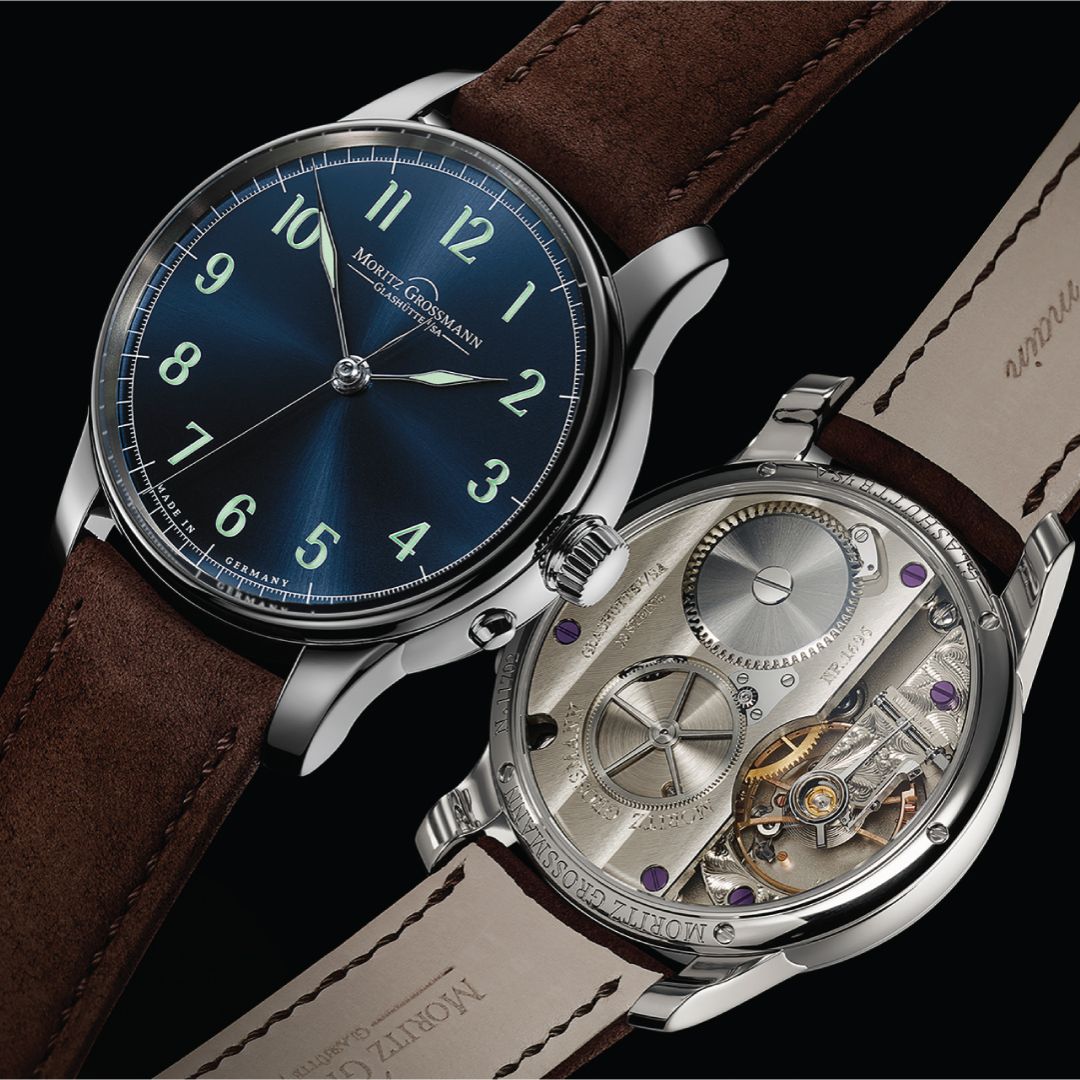
Inside the Central Second beats the in-house Calibre 102.0, a manually wound movement with a 42-hour power reserve and a deliberately slow 18,000 vph beat. The architecture is classic Glashütte: a two-thirds plate, screwed gold chatons, and a hand-engraved balance cock. The central seconds is driven indirectly to avoid stutter, and the stop-seconds mechanism halts the balance when the crown is pulled, allowing precise time setting.
Winding the watch each morning is a tactile pleasure. The crown turns with firm, even resistance, and you can feel the mainspring tighten as you approach full power. There is no rotor to obscure the view through the sapphire caseback, so the entire movement is on display—a treat for anyone who appreciates hand-finishing.
Specs at a Glance
The steel case is paired with a sapphire crystal, an alligator leather strap, and a pin buckle. There is no lume, which is appropriate for a dress watch of this character. The dial is silver-plated with blued hands, and the overall effect is clean, legible, and quietly luxurious.
Wrist Feel
The Central Second wears like a proper dress watch should: close to the wrist, balanced, and never top-heavy. The steel case has a gentle curve to the lugs that hugs the wrist without creating hot spots, and the alligator strap is supple from day one. I wore it for twelve hours at a stretch and often forgot it was there until I needed the time—which is exactly what you want from a daily piece that leans formal.
There is a satisfying heft to the steel that reminds you this is not a featherweight quartz, but it never pulls at the wrist. The crown is large enough to wind easily, with crisp clicks that feel mechanical and deliberate. Because there is no rotor, the watch sits flat and stable, and the caseback is smooth against the skin.
Accuracy
Grossmann regulates its movements in-house to exacting standards, and my example ran within a few seconds per day over the week. Expect single-digit daily deviation, often better if you keep a consistent winding routine. The 18,000 vph beat gives the seconds hand a slightly relaxed, almost vintage glide rather than a high-frequency stutter, which suits the dressy character.
Occasions and Presence
This is a watch for formal and dress occasions, but it can absolutely work as a daily piece if your daily environment is not too rugged. It slides under a shirt cuff easily, and the silver dial is legible in most lighting. Wrist presence is a 4 out of 5: it won't dominate a room, but the silver dial, blued hands, and polished steel case catch light beautifully. Up close, the hand-finished movement and engraved balance cock reward a second look. It is a watch for people who notice details, not for those who need a billboard.
Reference Variants and Family
The reference MG-002909 is the steel entry point to the Central Second line, with a silver-plated dial and blued hands. Other metal variants exist within the Central Second family, but this steel version is the most accessible and arguably the most daily-wearable.
Similar Watches and Homages
If you are cross-shopping, the A. Lange & Söhne 1815 offers a fellow Glashütte dress watch with hand-finished manual movement, though the Lange costs significantly more and lacks central seconds. The Glashütte Original Senator Excellence is a more accessible German dress watch with central seconds and an in-house automatic movement, but with less hand-finishing. H. Moser & Cie's Endeavour Centre Seconds is a minimalist luxury alternative with a stunning fumé dial, though its movement architecture is Swiss rather than Saxon.
For those who want the spirit without the price, the Stowa Marine Classic 40 offers a German manual-wind watch with central seconds and a clean silver dial for around $1,200—a fraction of the Grossmann's cost, but with far simpler finishing.
Investment and Service
Grossmanns are niche and produced in small numbers, so they tend to hold value better than mass luxury, but they are not speculative assets. The pre-owned range for a steel Central Second typically sits between $12,000 and $18,000, reflecting steady but not dramatic depreciation from retail. Buy this watch for craftsmanship and daily wear, not as an investment.
Service should be handled through authorized Grossmann retailers or the Glashütte workshop. Typical intervals are around five years, though the brand can confirm exact timing and cost based on the movement's condition.
Final Verdict
The Central Second is Moritz Grossmann's most daily-wearable watch, pairing a practical complication with meticulous Saxon finishing. It won't shout, but it rewards close inspection and long-term ownership. If you want a steel dress watch from Glashütte that isn't a Lange, this is the connoisseur's choice.