Brand history: Glashütte, revived
Moritz Grossmann was a real watchmaker in 19th-century Glashütte, a contemporary of Ferdinand Adolph Lange. He died young, and his name faded. In 2008, Christine Hutter revived the brand with a focus on hand-wound movements, traditional finishing, and small-batch production. The company is based in Glashütte, Germany, and it makes everything from the movement to the dial in-house or with closely held partners.
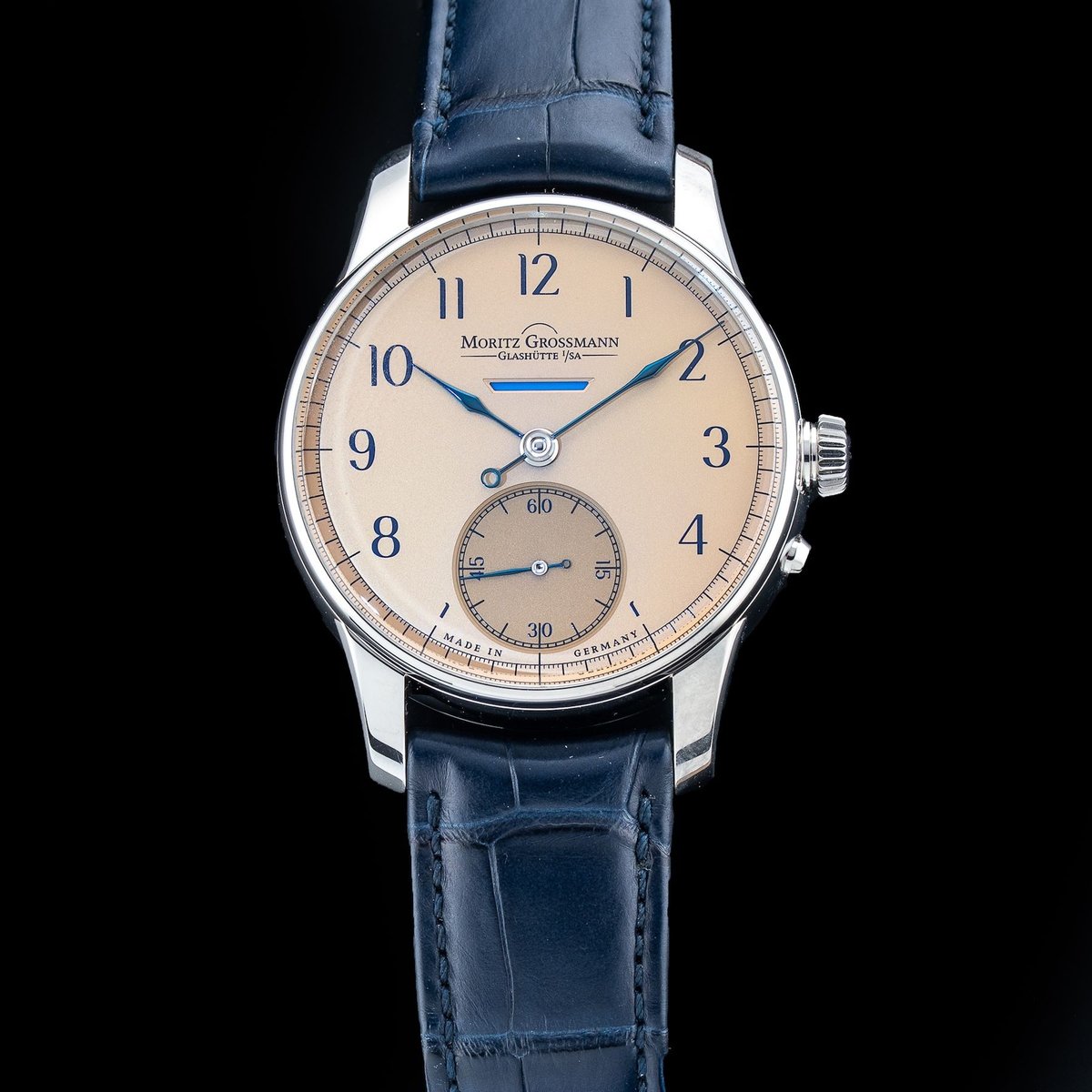
The Heritage sits at the heart of that story. It is not a reissue of a specific pocket watch, but a modern dress watch that borrows the visual language of the founder's era: a silvered dial, a historical logo, a small seconds subdial at six, and a slim gold case. The point is not to cosplay vintage. The point is to carry the craft forward.
Design: the quiet dial
The first thing you notice is the dial. It is silver-plated, with a fine grain that catches light without shouting. The Moritz Grossmann logo is in a historical script, and the minute track is printed thin and precise. The small seconds sits at six, with a hand that is heat-blued and shaped like a needle. It is a layout that has been done a thousand times, but the execution is what separates it. The printing is crisp, the applied numerals are faceted, and the whole thing feels like it was made by someone who cares about the difference between good and correct.
The case is gold—understated, polished, and sized for a cuff rather than a camera. It does not try to be a sports watch. There is no lume on the dial, no screw-down crown, no bezel grip. This is a watch for a suit, a good shirt, and a room where people know what they are looking at. The crystal is sapphire, and the strap is leather. The pin buckle keeps the profile low. It is a dress watch in the old sense, and it makes no apologies for that.
Movement: Caliber 100.1 and the art of the visible
The Heritage is powered by the in-house Caliber 100.1, a manually wound movement with a 42-hour power reserve and a frequency of 21,600 vph. It is not a chronometer-certified movement, but it is finished to a standard that makes COSC paperwork feel beside the point. The two-thirds plate is decorated with Glashütte ribbing, the screwed gold chatons are polished, and the balance cock is hand-engraved. Flip the watch over and you understand why people pay for independent watchmaking.
The movement also carries Moritz Grossmann's signature stop-seconds mechanism. When you pull the crown, a hammer stops the balance and the seconds hand. Set the time, push the crown back in, and press the pusher at four o'clock to restart the seconds. It is a small ritual, but it makes setting the watch feel intentional. It is also a reminder that this is a mechanical object, not a smart device. You have to engage with it.
In daily use, the manual-wind caliber is a pleasure. Winding it every morning becomes a habit, a moment of quiet before the day starts. The power reserve is enough for a weekend on the desk, but not so long that you forget the ritual. The finishing is the kind you notice in raking light: the bevels, the chatons, the engraving. It is not shouty. It is just there.
On the wrist: balance over bulk
The Heritage wears like a proper dress watch. It sits close to the wrist, the gold case has enough heft to feel serious but not so much that it swings, and the lugs curve down to meet the strap. The leather strap is supple, and the pin buckle keeps the underside flat. On a medium wrist, it reads elegant and proportionate. It does not dominate the wrist. It complements it.
This is not a watch you wear to the gym, and it is not a watch you wear to the beach. It has no lume, and the water resistance is not meant for swimming. But for the office, dinner, a gallery opening, or a wedding, it is exactly right. It disappears under a cuff, which is the point. The people who notice it will notice the dial first, then the finishing, then the name. Everyone else will just see a nice gold watch. That is the quiet flex.
Accuracy and daily life
The Caliber 100.1 is regulated in Glashütte, and in real-world use you can expect a few seconds a day either way. It is not a COSC-certified movement, so you should not expect quartz-like precision. What you get is a stable, hand-finished manual-wind caliber that is easy to live with. The stop-seconds makes it easy to set precisely, and the power reserve is enough for a normal week. If you wear it every day, you will wind it every morning. If you rotate it, you will wind it when you pick it up. That is the deal.
The watch is also easy to service in the sense that it is a known independent caliber, but you should not take it to the mall. Moritz Grossmann has a small service network, and authorized watchmakers are the safe choice. The brand recommends service every few years, and you should budget for it. This is not a watch you buy to abuse. It is a watch you buy to keep.
Occasions: where it belongs
Formal, dress, and daily are the three lanes for the Heritage. It is obviously at home with a suit, but it also works with a jacket and a T-shirt if you know what you are doing. It is not a sports watch, and it is not a travel watch. It is a dress watch that happens to be robust enough for normal life. The gold case will pick up scratches, and the leather strap will wear, but that is part of the charm. It is meant to be worn, not preserved in a safe.
Wrist presence is a three out of five. It is understated, elegant, and not flashy. The gold case catches light, and the dial has a vintage warmth, but it does not scream. It is the kind of watch that rewards a second look. If you want a watch that announces you from across the room, this is not it. If you want a watch that makes the right impression when someone shakes your hand, it is.
Market: price, value, and the auction question
The Moritz Grossmann Heritage is an expensive watch. The MSRP is in the mid-thirty-thousands, and pre-owned examples trade in the low-to-mid twenties to low thirties depending on condition, box, and papers. That is not a huge depreciation, but it is not a profit center either. The market for independent German dress watches is thin. The buyers are out there, but they are not lining up. If you need liquidity, this is not the watch for you.
On the auction front, there is no major auction history for this reference. That is not surprising. Moritz Grossmann is a small brand, and the Heritage is not a hype piece. The people who buy it are usually collectors who already know what they want. That means the secondary market is stable but slow. You buy it because you love it, not because you plan to flip it. The value is in the craft, the scarcity, and the fact that you will not see it on every wrist.
If you are comparing it to a Lange Saxonia or a Patek Calatrava, the Heritage is the more independent choice. It has less brand recognition, but it also has a different kind of appeal. It is for the collector who wants something that is not the obvious answer. The price buys a hand-finished in-house movement, a gold case, and a dial that feels like it belongs in a museum. Whether that is worth it depends on what you value.
Service and ownership
Service is through Moritz Grossmann or authorized partners. The brand is small, so you should not expect a boutique on every corner. The good news is that the movement is well made and should be reliable. The bad news is that if something goes wrong, you may have to wait. Budget for service every few years, and keep the paperwork. If you buy pre-owned, make sure the watch has been serviced or that the price reflects the cost.
The Heritage is not a watch you buy for convenience. It is a watch you buy for the experience. The winding, the setting, the pusher, the finishing—it is all part of the ritual. If you want a watch you can put on and forget, this is not it. If you want a watch that makes you pay attention, it is.
Comparisons: what else is out there
If you want a Glashütte dress watch with a broader network, the A. Lange & Söhne Saxonia Thin is the obvious alternative. It has the same hand-finished German movement, but more brand recognition and a higher price. The Patek Philippe Calatrava 5196 is the default gold dress watch, with more status and less independent character. The Vacheron Constantin Patrimony is another blue-chip option, with slim elegance and haute horlogerie finishing. The Heritage sits in the middle: more independent than the big names, more accessible than the ultra-high-end independents.
For homages, the Orient Bambino 38 gets the vintage dress-watch proportions for a fraction of the price. The Seiko Presage Cocktail Time has a dial that plays with light and a similar mood. The Junghans Max Bill Hand-Winding is a German manual-wind dress watch with a different design language but the same quiet energy. None of them are the same watch, but they capture part of the idea.
Verdict
The Moritz Grossmann Heritage ref. MG-003327 is a connoisseur's dress watch. It is not for everyone. It is not a status symbol in the way a Rolex is, and it is not a safe bet in the way a Patek is. It is a watch for the collector who wants something different, something hand-finished, something that rewards a closer look. It is old-world craft with a modern independent's attitude. It won't chase wrist trends, but it will outlast them.
If you are in the market for a gold dress watch and you want to stand slightly outside the usual conversation, the Heritage deserves a spot on your list. Buy it because you want to wear it. Buy it because you want to wind it. Buy it because you want to know that the balance cock was engraved by a human being. That is the value. Everything else is just market noise.