The atelier behind the watch
Naoya Hida & Co. was established in Tokyo in 2018 by watchmaker Naoya Hida, whose background runs through restoration and independent production rather than the marketing departments of large groups. The atelier's annual output is measured in dozens of pieces, not thousands, and distribution is allocation-driven: existing clients and a handful of trusted retailers get first refusal, and everyone else waits.
That structure is not an accident. It is the same model that has turned small independent makers in Switzerland and Japan into collector cults over the past decade, and it has a direct effect on the secondary market. When supply is structurally short and the design language is distinctive, pre-owned prices tend to firm up rather than soften. The TYPE 1 is the model that established that dynamic for Naoya Hida, and the 1D is one of its most refined expressions.
It is also worth understanding what the brand is not. Naoya Hida is not trying to compete with Grand Seiko on volume, technology or global reach, and it is not trying to compete with the Swiss independents on complication count. It is competing on taste, scarcity and the quality of the small things — the parts of watchmaking that a spec sheet cannot capture and that a photograph reliably flattens.
Design and dial
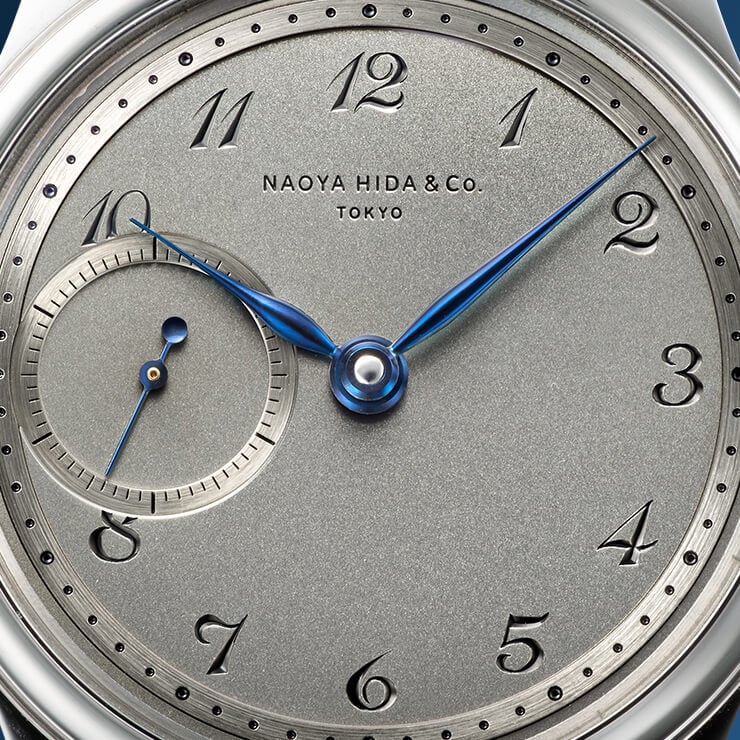
The TYPE 1D is a study in restraint. The dial is clean and symmetrical, with applied indices and a hand set that nods to mid-century watchmaking without cosplaying as a specific vintage reference. There is no date window, no text clutter, and no attempt to fill empty space. What is left is proportion and finish, and that is exactly where the watch earns its keep.
Look closely and the details start to stack up: the way the hands catch light, the subtle step between dial and chapter ring, the quality of the printing. Naoya Hida's design language sits somewhere between Japanese minimalism and Swiss mid-century classicism, and the result is a watch that looks expensive without looking loud. It is the kind of dial that photographs poorly and lives beautifully on the wrist — the opposite of the Instagram-first releases that dominate the current market.
The case follows the same logic. Brushed flanks, polished bevels, and lugs that curve rather than jut. It is a watch designed to be worn under a cuff and looked at closely, not spotted across a room. The finishing is deliberately understated: there is no mirror-polish showboating, and the surfaces are the sort that will pick up honest wear and look better for it over a decade rather than worse.
In collector terms, this is a dial you buy for the long haul. It does not depend on a trend cycle, a colourway of the moment, or a celebrity wrist shot. It is a design that will read the same in 2035 as it does today, which is precisely the quality that makes a small independent worth holding on to.
The movement
Inside, the TYPE 1D runs a Swiss automatic sourced from Vaucher Manufacture Fleurier and finished and regulated to Naoya Hida's specification. The micro-rotor architecture keeps the movement thin enough to suit a dress case, and the display back is worth the flip: bridges with Geneva-style finishing, polished anglage, and the kind of hand work that is increasingly rare at this price point.
Power reserve is in the region of two days, and the beat rate is a conventional high-frequency 28,800 vph. There is no COSC certification, which will bother spec-sheet readers and nobody else — Vaucher-based movements are well-regulated in practice, and the absence of a certificate says more about the brand's priorities than about the movement's quality. The lack of a date also means no quickset to fuss with and no midnight-change anxiety.
It is worth being clear about what this movement is and is not. It is not an in-house calibre, and Naoya Hida does not pretend otherwise. What the atelier does is specify, finish and regulate a high-quality Swiss base to its own standard — a legitimate and increasingly common approach among small independents, and one that keeps the price within reach of serious young collectors rather than the ultra-wealthy.
For a collector, the practical upside is confidence. Vaucher is a known quantity with a deep parts and service ecosystem, so the TYPE 1D is not a service hostage in the way some micro-brand calibres can be. The aesthetic upside is the micro-rotor itself: it keeps the watch slim, it looks good through the back, and it signals that the brand spent its money on the parts you look at rather than the parts you read about.
On the wrist
The TYPE 1D wears like a watch from another era, which is the point. The case is slim and the lugs curve down gently, so the watch settles into the wrist rather than perching on top of it. On a leather strap it disappears under a shirt cuff, and the balance is neutral enough that you forget you are wearing it until you glance down.
Weight is modest, as you would expect from a stainless case and a leather strap, but the watch does not feel flimsy. The finishing gives it a density of detail that reads as quality rather than heft. It is not a watch you notice in the mirror; it is one you notice when you are reading it.
Wrist presence is deliberately low. This is a three-and-a-half-out-of-five watch in a room full of people, and a five-out-of-five watch in the hand of someone who knows what they are looking at. Collectors who want a statement piece should look elsewhere; collectors who want a watch that feels personal will find it hard to take off.
The strap pairing matters more than usual here. A simple leather strap in a muted tone lets the dial do the talking, and the pin buckle keeps the profile low and the look period-correct. This is not a watch that needs a bracelet or a rubber option to feel complete — it is a one-look piece, and that is a feature rather than a limitation.
Accuracy and ownership
Owners report day-to-day accuracy in the range of a few seconds per day, comfortably within chronometer-adjacent territory even without certification. As with any mechanical watch, expect variation with wear patterns, temperature and position, and a watchmaker can regulate it further if you are particular.
Ownership is where the TYPE 1D demands a little patience. Service runs through Naoya Hida & Co. in Tokyo and a small number of authorized partners, so if you are outside Japan you should factor in shipping, insurance and turnaround time. That is the trade-off for buying from an atelier of this size, and it is worth going in with eyes open rather than discovering it at the first service.
The upside is that the watch is mechanically conventional underneath the finishing. There is no exotic complication to frighten a competent watchmaker, no proprietary tooling beyond the usual, and no reason to expect the kind of service horror stories that occasionally attach to micro-brand exotica. It is a watch you can own for decades, provided you accept that the relationship is with a small Japanese atelier rather than a global service network.
Market and investment
Naoya Hida is not a liquid market, and it is not trying to be. The brand is too young and too thinly traded for meaningful auction comps, so secondary pricing is set by dealer inventory and private sales rather than by a public record. What that means in practice is that the TYPE 1D is easy to hold and harder to sell quickly — the opposite of a hype watch, and arguably a healthier place for a collector to be.
Retail pricing has moved upward across the TYPE 1 line as the brand's reputation has grown, and pre-owned examples now trade at or above original retail when they surface. The trend is appreciating, but the honest caveat is liquidity: the buyer for a Naoya Hida is a specific collector, not a walk-in. If you need to exit in a weekend, this is the wrong watch. If you can wait for the right buyer, the supply-demand picture is favourable.
The demand cycle here is also unusually clean. Naoya Hida has not had a viral moment, a celebrity endorsement or a hype drop, which means the current interest is being driven by collectors who actually understand the product. That tends to produce a stickier, less volatile market than the boom-and-bust pattern that follows influencer-driven releases.
The hold-versus-sell call is straightforward. Hold. Production is capped, demand from Japanese-watch collectors is still building outside Japan, and the design language does not date. The risk here is not depreciation; it is impatience.
For a young collector building a serious rotation, the TYPE 1D functions as an anchor piece rather than a trade. It sits comfortably alongside a sports watch and a beater, it does not compete for wrist time with either, and it quietly signals that you know what you are doing — which, in this hobby, is worth more than a few seconds on the spec sheet.
Alternatives worth considering
If you want the same vintage-souled dress-watch brief with more liquidity, a Grand Seiko SBGW231 delivers hand-wound Japanese watchmaking and comparable restraint with a global service network. If you want the Tokyo independent-adjacent energy, Kurono Tokyo's sector-dial releases scratch a similar itch at a lower entry point, though without the finishing depth. If you want the archetype the TYPE 1D is quietly in conversation with, a Patek Philippe Calatrava 5196 is the reference — at several times the money. And if you want independent Swiss micro-rotor watchmaking in the same spirit, Laurent Ferrier's Galet Micro-Rotor is the aspirational end of the same road.
None of these replace the TYPE 1D. They frame it. The Naoya Hida sits in a narrow gap between mass-produced Japanese dress watches and six-figure Swiss independents, and that gap is exactly why it has a following.
It is also worth saying plainly that the TYPE 1D is not the obvious first nice watch. It is the second or third — the one you buy once you have already owned a Submariner, a Speedmaster or a Grand Seiko and you know what you actually reach for. That is a narrower audience, and it is the right one.
Verdict
The NH TYPE 1D is the kind of watch that makes sense to collectors who have already owned the obvious stuff. It will not win a spec-sheet argument, and it is not trying to. What it offers is genuine independent finishing, a design language that does not exist at this level in mass production, and a supply curve that will never catch up with demand.
Buy it to wear, hold it because the supply is capped, and do not expect to flip it in a weekend. In a market that increasingly rewards scarcity and story, the TYPE 1D has both — and it has the wrist feel to back them up.