A trade older than the wristwatch
There is a moment in every good watch story when the object stops being a product and becomes a record of somebody's afternoon. The Naoya Hida NH Type 2C-1 Lettercutter is that moment made wearable. Tokyo's most quietly stubborn independent does not advertise, does not chase boutiques, and does not build watches in numbers that would make a spreadsheet smile. What it does instead is hand a dial over to a letter cutter — a craftsman whose trade predates the wristwatch by several centuries — and ask him to incise the markings one at a time, by hand, with a burin.
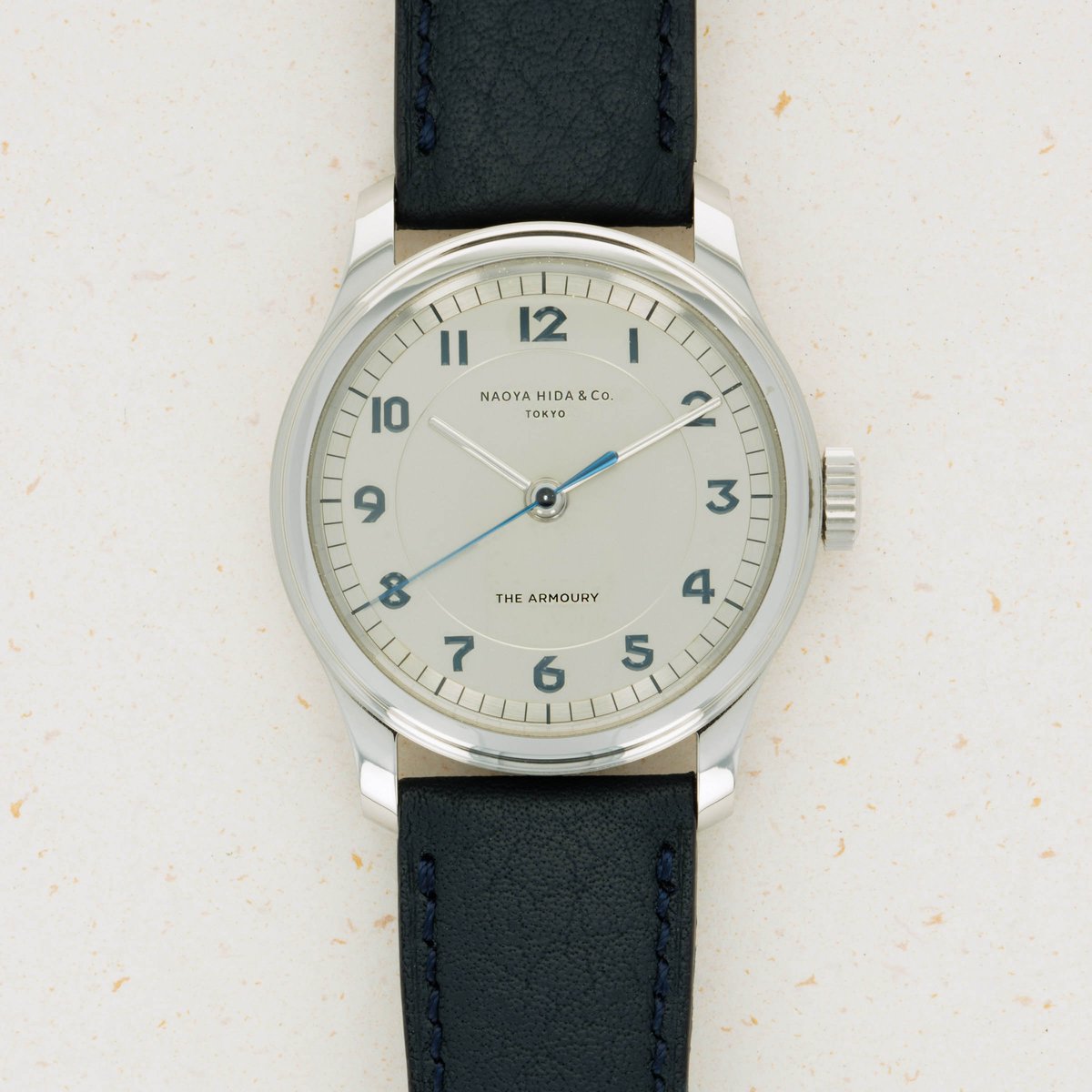
The result reads like a signature rather than a print run. Look closely at the dial of a Lettercutter and you can see the difference between a line that was cut and a line that was applied. Edges catch light unevenly. Depth varies by a hair. The numerals have a slight, human wobble that no laser will ever reproduce and no CAD file will ever anticipate. That is not a flaw. That is the whole proposition.
In a market saturated with anniversary editions and colourway drops, a watch that stakes its entire identity on a vanishing hand skill feels almost confrontational. It shouldn't. But here we are.
Naoya Hida, the editor who started making watches
Naoya Hida came to watchmaking sideways. A longtime figure in Japanese watch media — someone who spent years handling other people's products, interviewing other people's watchmakers, and developing an unusually sharp eye for what actually matters on a wrist — he founded his eponymous brand in Tokyo in 2018. The premise was unfashionable at the time and remains so: build a handful of classical watches a year, finish them to a standard that survives a loupe, and trust that the right collectors will find them.
That trust has been repaid. Production is counted in dozens annually. Waitlists exist for models that most of the buying public has never heard of. And the brand has developed the kind of quiet, word-of-mouth gravity that money cannot buy — the same dynamic that built the reputations of the great independent houses before the auction houses noticed them.
What makes Naoya Hida unusual among independents is the movement strategy. Rather than developing a calibre from scratch — an exercise that consumes years and capital and often produces something technically novel but temperamentally wrong — the brand builds on restored vintage Swiss ébauches. These movements are re-finished and assembled in Japan, with hand-applied anglage and the kind of decoration that only happens when someone is working at a bench rather than a production line. It is, in its own way, a more honest form of independence: the brand is independent of fashion, not of history.
Reading the dial
The Lettercutter's dial is where the argument is won. Everything else — case, strap, movement — is supporting cast.
The markings are engraved rather than printed, which changes the way the dial behaves in light. A printed dial is flat; it reflects uniformly and reads the same from every angle. An engraved dial has topography. Turn your wrist and the incisions go bright, then dark, then bright again. In a meeting room with overhead lighting, the dial shimmers subtly as you move. Under a restaurant's warm downlights it goes soft and legible. At a dealer's table under a loupe, it turns into a landscape.
This matters more than it sounds. Most five-figure dress watches are exercises in restraint that tip over into anonymity — beautiful objects that no one ever notices. The Lettercutter avoids that trap without raising its voice. It is not a watch that announces you from across a room. It is a watch that rewards the person who leans in.
The layout is deliberately classical, and the execution is deliberately Japanese — the kind of restraint that comes from confidence rather than from a fear of offending. There is no extraneous text, no unnecessary graphic flourish, and no attempt to modernise the genre. The design language belongs to a period when a watch was a tool that had been dressed up for company, and the brand has the good sense not to apologise for it.
The movement: vintage bones, Japanese hands
The calibre inside the Lettercutter is hand-wound and built on a restored vintage Swiss ébauche. That sentence will delight some collectors and irritate others, and both reactions are reasonable.
The irritation comes from the assumption that a five-figure watch should contain a ground-up in-house calibre. The delight comes from understanding what actually happens to a vintage ébauche in the hands of a small Japanese atelier. These movements are disassembled, inspected, restored where necessary, and then finished to a standard far beyond what they received in their original lives. Bridges get hand-applied anglage. Surfaces get striped. Screws get polished. The result is a movement that is classical in architecture and modern in execution — a combination that is becoming rarer as more brands chase technical novelty.
The practical trade-offs are real. Power reserve is roughly forty hours, which means the watch wants to be wound daily and will stop if you leave it in a drawer over a long weekend. The beat rate is classical rather than high, which is part of the charm and part of the accuracy story. There is no chronometer certification and no silicon escapement. What you get instead is a thin, serviceable, beautifully finished movement that lets the case stay slim and the watch disappear under a cuff.
Look at it through a display back and the argument resolves itself. The finishing is genuinely hand-work — anglage that varies slightly, stripes that were laid down by a person rather than a machine, and the particular warmth that comes from surfaces that have been restored rather than manufactured. It is not the equal of a Grand Seiko or a high-end Swiss manufacture, but it was never trying to be. It is a different kind of object.
How it wears
Dress watches live or die on the wrist, and this one lives comfortably. The case is proportioned for a shirt cuff rather than a wetsuit, and the thin hand-wound movement means there is no rotor mass rolling around inside. Strap it on and it settles immediately, without the top-heaviness that makes so many modern all-purpose watches want to rotate around the wrist.
The lack of heft is the point. Putting on the Lettercutter feels less like gearing up and more like putting on a jacket. It doesn't dominate a room and it isn't supposed to; the presence lives in the dial, and the dial is for the person sitting across the table from you. On leather, it balances slightly toward the buckle — which is exactly what a classical dress watch should do — and it stays put through a working day of typing, commuting and coffee.
There are things it will not do. It will not survive a swim, it will not glow in a cinema, and it will not take a knock against a doorframe with the stoicism of a sports watch. Treat it as what it is — a fine mechanical object built for civilised circumstances — and it will be a lifelong companion.
Accuracy and daily life
There is no chronometer certificate, and you should not buy this watch expecting one. A well-regulated example will typically run comfortably inside a minute a day, and many owners report considerably better once the watch has been regulated by the brand. If you need atomic precision, this is not your watch. If you can accept that a mechanical hairspring is not a quartz oscillator, you will find it entirely liveable.
The daily ritual is part of the appeal. Hand-wound watches force a relationship: you wind it every morning, you feel the mainspring take tension, you notice when something changes. It is a small ceremony that most modern watch owners have traded away for convenience, and the Lettercutter gives it back.
Service should go back to the brand or a specialist it approves. Vintage-ébauche calibres are not the place for the mall watchmaker, even a competent one. Parts availability and correct lubrication matter more here than on a mass-produced movement, and the brand's small scale means the right hands are a specific and limited set.
When to wear it
Formal and dress occasions are the obvious answer: weddings, dinners, anything that involves a jacket and a seated table. It handles daily office wear without complaint and slips under a cuff better than almost anything in its bracket. It travels well, provided the travel involves cities rather than beaches.
What it is not is a one-watch collection. There is no lume, no meaningful water resistance, and no pretence of athletic capability. The Lettercutter is the watch you reach for when you want to look like the most considered person in the room, not the busiest.
The market
Naoya Hida's retail prices sit well into five figures, and the brand's production scale means access is a relationship game rather than a shopping-cart exercise. That scarcity has translated into a secondary market that treats the brand with unusual respect for a house this young. Values have held firm and, on some references, drifted upward as the collector base has deepened.
There is no meaningful auction history to point at, which is exactly what you would expect from a brand whose watches are bought by people who wear them. That is a healthier signal than a lot of hype-driven price charts. A watch that doesn't circulate is a watch people want to keep.
The value case is straightforward: you are paying for hand-engraving, Japanese hand-finishing, a restored and re-finished vintage calibre, and scarcity — not for a logo with a marketing budget attached. Compared with a comparable-money dress watch from a large maison, the Lettercutter offers less prestige and considerably more craft. For a certain kind of collector, that trade is the entire point.
What else to look at
If the Japanese-independent, hand-finished, time-only brief is what excites you, Kikuchi Nakagawa's Murakumo occupies adjacent territory with similarly tiny production and obsessive finishing. Laurent Ferrier's Classic Origin offers a hand-wound, classical alternative from a more established independent, with the service network that comes with it. Kurono Tokyo's Mori is the accessible entry point into the same design culture. And for buyers who want the look with a conventional ownership experience, Chopard's L.U.C XPS remains one of the most underrated thin dress watches on the market.
At the other end of the spectrum, Orient's Bambino and Seiko's Presage Cocktail Time deliver the vintage-dress aesthetic at a fraction of the cost — a good way to test whether this style of watch actually suits your life before committing five figures to it.
Verdict
The NH Type 2C-1 Lettercutter is not trying to be your only watch, and it is better for it. It is a document of a hand skill that most of the industry has quietly abandoned, wrapped around a movement chosen for proportion rather than spec-sheet bragging, and produced in numbers small enough that owning one still means something.
If you want to own something that rewards a decade of looking — something that changes in the light, that carries the evidence of a person's hand, that gets better the closer you get — this is one of the most interesting dress watches being made anywhere. If you want a daily beater with a warranty card and a shopping mall service centre, keep walking.
The Lettercutter is for the collector who has already bought the obvious things and is now looking for something that isn't.