There is a particular kind of pleasure in wearing a watch that almost no one notices. The Naoya Hida NH TYPE 3B-3 is that watch. It arrived in a modest box, sat on the wrist without ceremony, and then quietly refused to leave. Over seven days it went to meetings, on trains, through a rainy school run, and to a dinner where someone finally asked whether it was a vintage piece. It is not. It is something rarer and, for a certain kind of collector, more interesting.
This is not a review about a press sheet. It is about what happens when a hand-finished, small-batch Japanese watch is asked to do the most demanding job in horology: be worn every day, by one person, without fuss. Naoya Hida & Co. builds in tiny numbers, and the TYPE 3 line is the brand's most consciously wearable idea — a restrained three-hander meant to disappear into a life rather than dominate it.
First impressions, and what the box doesn't tell you
Small independent houses often arrive with a certain theatre: the heavy box, the certificate, the sense that you are being inducted into something. Naoya Hida does not do theatre. What you get is a watch, a strap, and the sense that a person made a decision about every visible surface. The case is stainless steel, the crystal is sapphire, and the strap is leather on a pin buckle — the most conventional possible recipe, executed with unusual care.
The first thing I noticed was not the dial but the case flanks. There is a softness to the transitions, a lack of the machined crispness you get from mass production, that reads immediately as hand work. Under a loupe the difference is obvious; at arm's length it reads as warmth. The second thing I noticed was how little I thought about it afterwards, which is the highest compliment a daily wearer can receive.
A very small house, and the TYPE 3 idea
Naoya Hida & Co. was founded in Tokyo in 2018, and it operates at a scale that most brands would find unworkable. Production is measured in tens rather than thousands, and the value proposition is inverted from the mainstream: rather than buying a famous name and a complication, you are buying finishing, dial work and the attention of a very small team.
The TYPE 3 is the house's everyday proposition. Where the TYPE 1 leans formal and later models push in different directions, the TYPE 3 is the one designed to be worn on a Tuesday. The 3B-3 sits within that family as a dial-and-strap configuration rather than a different architecture — which is worth knowing, because it means the wear experience described here applies broadly across the TYPE 3 line even if the dial colour or strap changes.
On the wrist: seven days of honest wear
Let me be direct about the thing that matters most: this watch wears beautifully. The case is slim in profile, the lugs curve down rather than out, and the whole assembly settles into the wrist rather than perching on top of it. There is no perceptible crown dig, no weight bias toward the head, and no need to re-tension the strap in the middle of the day. On a warm afternoon it stayed put. After a long flight it did not feel like a brick.
I wore it from roughly seven in the morning until eleven at night for a week. It went under a shirt cuff without complaint, tolerated being pushed up the forearm while I typed, and never once made me aware of it in the way that a heavy or top-heavy watch does. The leather strap was supple from the first wear rather than stiff for a fortnight — a small thing that makes a large difference to whether you reach for a watch on day four. The pin buckle is thin enough that it does not create a lump under a cuff, which is more than can be said for many deployants.
The balance is the real achievement. A lot of small-batch watches are beautiful objects that wear like jewellery: precious, slightly self-conscious, and faintly exhausting over a full day. This one wears like a tool that happens to be beautifully made. That distinction is the whole ballgame for a watch at this price, because at this price you are not buying a beater — you are buying something you intend to wear constantly and protect unconsciously.
The dial in daylight
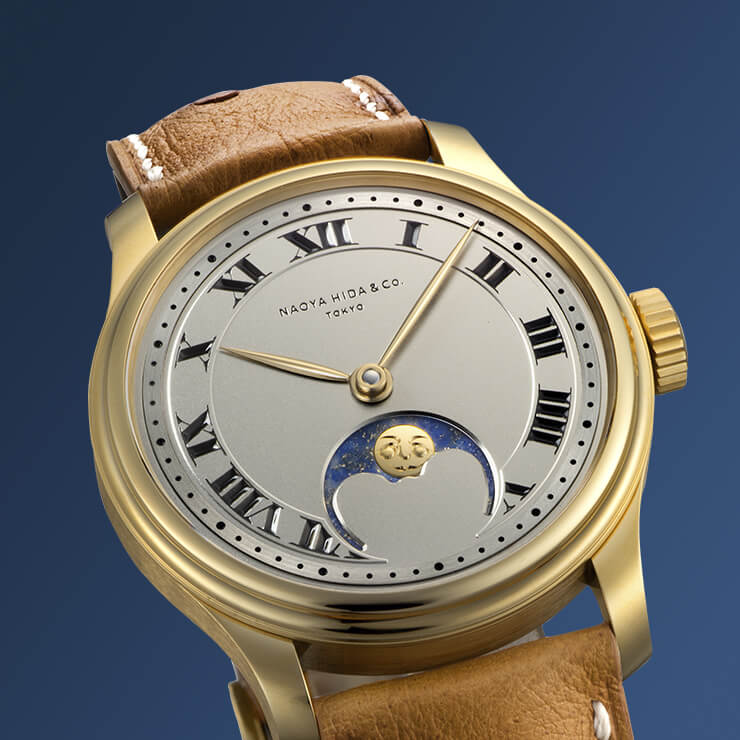
Naoya Hida's reputation rests substantially on dial work, and the 3B-3 does not disappoint. The dial is light and restrained, with applied markers and a fine printed track, and it rewards close looking in a way that photographs rarely capture. In flat office lighting it reads as clean and slightly old-fashioned. In low evening light the applied elements catch a warm edge and the whole thing becomes more interesting without becoming louder.
This is a dial designed for reading rather than for photographing, which is a rarer virtue than it sounds. There is no oversized logo, no colour accent competing for attention, no date window breaking the symmetry. What there is, is a very legible hours-and-minutes presentation with a thin seconds hand sweeping around it. If you are the sort of collector who has spent years accumulating busy dials and has begun to crave silence, this is the antidote.
Legibility at a glance
Legibility is where restrained watches often fail: the hands are too thin, the contrast too low, the markers too small. The 3B-3 avoids all three traps. The hands are slim but not fragile, the contrast between hand and dial is strong enough to read in a moving car, and the markers are large enough to register in peripheral vision. I could read the time at a glance in every lighting condition I encountered indoors, and without effort outdoors in daylight.
The absence of lume is the one real compromise. There is no luminescent material here, and at night in a dark room the watch is simply a dark object on the wrist. For a watch pitched as a daily wearer this is worth flagging honestly: if you habitually check the time at 3am or spend nights outdoors, this is not the watch for that job. In every other circumstance it is more legible than most of its lume-equipped peers, because a clean dial beats a glowing one in daylight.
The case, the crystal, and the practicalities
The case is stainless steel and the crystal is sapphire, which is the correct modern answer for a watch meant to be worn hard. The sapphire sits essentially flush, with no distracting dome and no visible edge distortion at the periphery. The case finishing is where the hand-work shows: brushed surfaces with a softness to them, polished transitions that catch light in a slightly irregular, human way rather than with the hard uniformity of a CNC line.
Water resistance is not published for this reference, and I would treat the watch accordingly: it is a fair-weather companion. Wash your hands with it on and it will be fine; swim with it and you are taking a decision the brand has not endorsed. That is a real limitation for a daily wearer, and it is the honest reason many collectors will keep a second watch for the pool and the garden.
The movement, and why it matters for ownership
The 3B-3 runs on a Swiss automatic base movement, finished and regulated in Japan. Naoya Hida does not invent proprietary calibers for this line and does not pretend to; the value is added in finishing, adjustment and the dial above it. Whether that bothers you is a philosophical question, but practically it is good news.
A familiar Swiss base means a well-understood service path, widely available parts, and no need to ship the watch back to Tokyo for every minor intervention. For a watch you plan to wear for twenty years, that matters more than the romance of an in-house caliber. Power reserve and frequency figures are not published for this reference, and I will not invent them; what I can tell you is that the watch kept running through a week of mixed wear with no drama and no need to reset it.
The finishing is worth a mention. Turn the watch over and the movement is presented with more care than the price might suggest — anglage, a degree of decoration, and the sense that someone spent time on surfaces nobody will see. It is not haute horlogerie finishing, but it is several levels above what a stock ébauche normally receives.
Accuracy in the real world
Because the movement is a known Swiss automatic regulated in Japan, the sensible expectation is roughly plus or minus ten seconds per day, with well-adjusted samples often landing inside that. Over a week of mixed wear — desk time, walking, a couple of nights off the wrist — the rate stayed consistent rather than drifting, which matters more than any single impressive number. This is not a chronometer-certified movement and it is not sold as one.
What I appreciated was the stability. A watch that gains eight seconds every single day is easy to live with; a watch that gains two seconds one day and loses twelve the next is annoying even if the weekly average is better. The 3B-3 behaved like the former, and for a daily wearer that is exactly the right character.
Strap, clasp, and the small annoyances
The leather strap is good — supple, well-finished at the edges, and comfortable from day one. The pin buckle is thin and unobtrusive. And yet, at this price point, a pin buckle and a leather strap feel like the one place where the specification does not quite match the ambition. A watch costing this much arguably deserves a deployant, or at least a strap option that feels a little more considered. It is a small complaint, but it is the kind of small complaint that a discerning buyer will notice immediately and a casual one never will.
The consolation is that straps are consumables. This is a watch that will look excellent on a wide range of leathers, and the conventional lug geometry means you are not locked into a proprietary system. That is a genuine long-term advantage.
Occasions: where it actually belongs
This is a formal-to-daily watch, not a sports watch. It looked correct with a suit and a shirt cuff, entirely natural with a knit and trousers, and slightly overdressed with shorts and a t-shirt. It is not a travel watch in the GMT sense and not a watch you take to the beach. It is the watch you put on when you want to look considered without looking like you are trying.
In that role it is close to ideal. The dial is quiet enough for a conservative office, the finishing is good enough for a dinner, and the comfort is good enough that you forget to take it off when you get home. If your week is mostly indoor, mostly urban, and mostly spent in clothes with sleeves, this watch fits the shape of your life.
Service and long-term ownership
Because the movement is Swiss rather than exotic, a competent independent watchmaker can handle the mechanics. But the dial and case finishing are the reason you bought the watch, and that argues for authorised care when the time comes. The brand's small scale means service logistics are less frictionless than with a major Swiss house, and buyers should go in with realistic expectations about turnaround.
The flip side is that this is not a watch that will fail in a mysterious way. There are no exotic complications, no unusual materials, no proprietary lubrication regime. It is a well-made object with a well-known engine inside, and that is a perfectly sound basis for a twenty-year relationship.
Value: what the money buys
Naoya Hida does not publish a single stable retail figure across markets, and secondary pricing varies with configuration and completeness. In broad terms, expect to pay somewhere in the mid four figures to just under five figures in US dollars, with the higher end reserved for complete, well-documented examples. What you are buying at that price is not a complication and not a logo — it is hand-finishing, dial work, and scarcity.
Whether that represents value depends entirely on what you already own. If your collection is a row of mass-produced sports watches, the 3B-3 will feel expensive for what it is. If you have spent years with the obvious answers and want something that no one else at the table is wearing, the calculus flips completely. This is a watch that holds its value reasonably well because supply is tiny and demand among Japanese-watch collectors is sincere, but it is low-liquidity: selling quickly means selling cheaply. Buy it to wear.
The competition
The most obvious alternative is Grand Seiko's SBGW231, which offers Japanese restraint and a far larger service network, though with a more industrial, less artisanal character. Nomos offers Glashütte minimalism at a comparable outlay. Rolex's Oyster Perpetual is the default daily three-hander and utterly lacks the intimacy of hand-finishing. And Kurono Tokyo, another tiny Japanese house, competes for the same collector's attention with dial-led watches in small batches.
None of these is a substitute. The 3B-3 occupies a narrow slot: a hand-finished, small-batch, quietly expensive daily wearer from a house few people have heard of. If that description makes you lean forward rather than recoil, you are the intended buyer.
Verdict
The Naoya Hida NH TYPE 3B-3 is not trying to win an argument on paper, and that is precisely why it works on the wrist. It is one of the rare small-batch watches that behaves like a daily tool rather than a display piece, with finishing good enough to justify the price and restraint good enough to justify the wrist time. The absence of lume, the unpublished water resistance and the modest clasp are real caveats, honestly stated, and none of them undermined a single day of wear.
If you want a watch that disappears into your life and only reveals itself to people who know, this is a very persuasive answer. If you want a spec sheet that wins forum arguments, look elsewhere. Dr. Hélène Rousseau, Vivir.com