The case for watching Naoya Hida
The Naoya Hida NH TYPE 5B-1 is the kind of watch that rarely shows up in a boutique window and almost never in a glossy campaign. It is produced in tiny numbers by a Tokyo atelier led by a former retailer-turned-watchmaker, and it has become a cult object for collectors who want the romance of a small independent without abandoning the reliability of a Swiss-based movement. The TYPE 5B-1 sits within a family that prizes vintage proportion, sector-style legibility, and a refusal to chase the oversized, high-lume, high-contrast trends of mainstream horology.
What makes the 5B-1 interesting from an investment standpoint is not a grand complication or a headline spec sheet. It is scarcity, distribution, and the soft power of a brand that has been quietly written up by the independent-collector press. Naoya Hida does not publish exhaustive technical data, and that opacity is part of the appeal: the watch is sold on feel, finishing, and the story of a man who spent years around vintage watches before building his own.
A Tokyo atelier built on restraint
Naoya Hida & Co. was established in Tokyo in 2018. Hida came to watchmaking through the retail and vintage side of the business rather than a grand Swiss manufacture apprenticeship, and that background shapes the output. The brand is deliberately small, distribution is narrow, and the design language borrows from mid-century sector dials rather than from contemporary sport-watch fashion. Where many young independents lean on a signature complication or an aggressive case shape, Naoya Hida leans on proportion, dial layout, and the perceived quality of finishing.
That positioning matters for collectors because it places the brand in the same conversation as other low-volume Japanese ateliers rather than in the crowded sub-$10,000 bracket. The TYPE 5B-1 is not a mass-market product, and the brand has no interest in making it one. The result is a watch whose value is tied to its scarcity and its story as much as to any objective specification.
Case, dial, and the vintage proposition
The 5B-1 is a dress watch in the traditional sense. The case is deliberately compact by modern standards, and the dial follows a legible, symmetrical layout with applied markers and a restrained palette. There is no lume, no bright colour accent, and no oversized crown. This is a watch designed to be read at a dinner table rather than in the dark, and that single decision tells you almost everything about the intended owner.
The design rewards long looking rather than quick scrolling. Sector-style dials have a way of making a watch feel older and more considered than its production date, and the 5B-1 leans into that effect. It is the sort of piece that photographs modestly and then surprises you in the metal, where the finishing and the proportions do the talking. Buyers who need a watch to make an immediate visual statement should look elsewhere. Buyers who understand that restraint is its own kind of luxury will find a lot to like.
The movement question
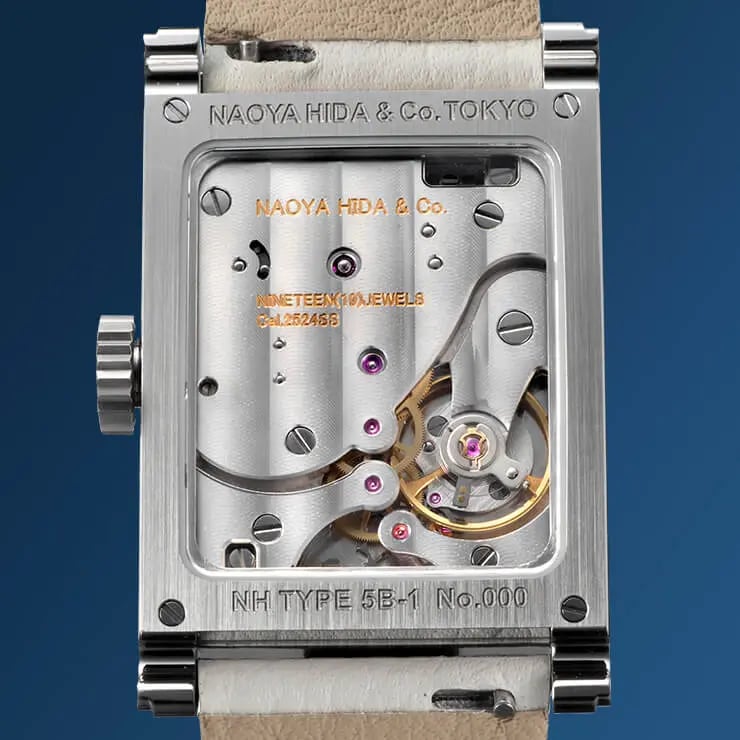
Naoya Hida does not publish the full technical specification for the 5B-1, including the base calibre designation, jewel count, beat rate, or power reserve. What is known is the philosophy: the brand uses Swiss-sourced automatic movements and reworks them in Japan, adding a signed rotor and hand-applied finishing. The result is a movement that behaves like a well-sorted Swiss calibre while carrying the cosmetic identity of a small atelier.
Collectors should treat the unpublished figures as undisclosed rather than as evidence of a standard specification. There is no COSC certification here, so the appeal is finishing and consistency rather than a documented accuracy claim. For a dress watch at this level, that is a defensible trade-off, but buyers who want a full data sheet with every number filled in will find the opacity frustrating. The honest framing is that you are buying the watch on trust, reputation, and the evidence of your own eyes.
On the wrist
The 5B-1 is conceived as a dress watch first, and it wears that way. The case sits close to the wrist with a low, unobtrusive profile that slips under a shirt cuff without a second thought. Balance is the dominant impression: the watch does not torque or flop, and the leather strap keeps the whole thing light enough that you forget it is there until you glance down.
That lightness is both the charm and the caveat. Collectors who are used to a chunky sports watch on a bracelet will initially read the 5B-1 as almost insubstantial, but that is the point. It is a watch for people who want the ritual of wearing something refined rather than a statement piece. The compact proportions also mean smaller wrists are flattered, and larger wrists get a classic, mid-century silhouette rather than a modern slab. In a market that has spent two decades inflating case sizes, a watch that is comfortable being small is a quiet statement of confidence.
Accuracy and daily behaviour
Because the movement is a Swiss automatic regulated in Japan and the brand does not publish chronometer certification, expect real-world performance in the range of a well-adjusted Swiss calibre: roughly within ten seconds a day in normal wear, with better figures possible after regulation. Owners report stable timekeeping, and the closed caseback means you are buying the movement for its behaviour rather than its decoration on display.
The watch is not built for abuse. There is no lume, water resistance is not published, and the leather strap is the weak point in any daily-wear scenario. Treat it as a dress watch that can handle an office day and a dinner, not as a travel or sports companion. That is not a criticism; it is simply the correct expectation for the category.
The market and the hold-versus-sell call
Naoya Hida has become a name that collectors mention in the same breath as other low-volume Japanese independents, and the TYPE 5B-1 has benefited from that reputation. Retail pricing sits in the mid-teens to high-teens in US dollars depending on the market and configuration, and pre-owned examples are typically asking in the mid-teens to low-twenties. The trend is best described as appreciating, but the market is thin and private. There is no deep auction record to point to, and most trades happen through specialist dealers or direct collector-to-collector sales.
That combination, firm demand and limited supply, supports a hold recommendation rather than a flip. If you already own one, the case for selling is weak unless you need liquidity or have fallen out of love with the format. If you are buying, understand that you are paying a scarcity premium and that exiting quickly may mean accepting a discount to the asking prices you see online. This is not a watch to buy on margin; it is a watch to buy because you want to wear it for a decade.
Service and ownership reality
Service is handled through Naoya Hida & Co. in Tokyo and its limited authorized network. The brand does not publish a service interval or a standard cost for this reference, so owners should plan for Japan-based servicing and build that into the total cost of ownership. For a collector used to Swiss brands with global service centres, the narrower network is a real consideration, but it is also part of what keeps the brand small and the watches special.
Verdict
The Naoya Hida NH TYPE 5B-1 is a connoisseur's dress watch that rewards buyers who value proportion, finishing, and scarcity over headline specifications. It is not a liquid asset and it will not suit everyone's wrist or wardrobe, but for collectors building a serious independent-focused collection it is a credible, quietly appreciating hold. Buy it because you want to wear it, and let the market do what it will.