The brand and the model
Naoya Hida & Co. was founded in Tokyo in 2018 by Naoya Hida, a watchmaker whose work sits at the intersection of Japanese craftsmanship and classical Swiss watchmaking. The brand produces small batches rather than industrial volumes, and its watches are often built around modified Swiss ébauches that are finished and assembled with studio-level attention to detail.
The TYPE 6A belongs to that same tradition. It is a classical dress watch made in limited numbers for collectors who value craft over broad distribution. The reference does not chase sports-watch specifications or trend-driven case shapes. Its purpose is to deliver a traditional watchmaking experience in a modern context: a clear dial, a hand-wound movement, a comfortable case, and finishing that rewards close inspection.
That positioning matters because the independent watch market is crowded with watches that promise exclusivity but deliver little beyond a limited number. Naoya Hida's reputation rests on something more durable: the sense that each watch has been considered as a whole. The TYPE 6A is not a collaboration piece or a marketing exercise. It is a statement of the brand's values, expressed in a restrained, classical form.
Dial and design
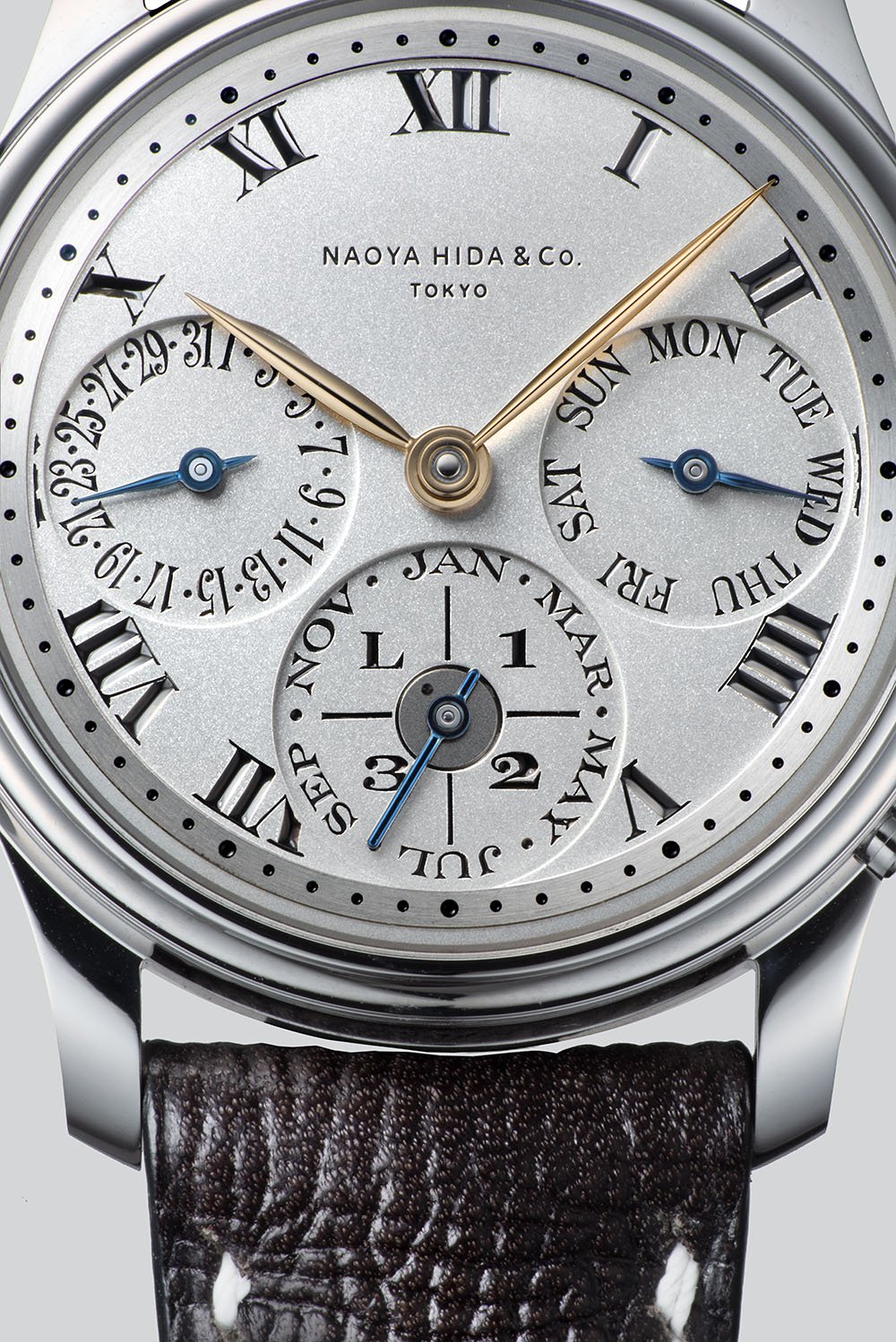
The first thing to understand about the TYPE 6A is that its dial is not trying to be novel. It is trying to be correct. The layout follows the logic of a classic time-only watch: a clear chapter of hours, a discreet small seconds display, and hands that are shaped to read against the dial without shouting. The sector-style tracks and restrained typography give the face a technical, almost instrument-like clarity, but the overall effect is warm rather than clinical.
Naoya Hida's dials tend to reward close viewing. Printing is crisp, the tracks are balanced, and the hands are finished to catch light without becoming distracting. The TYPE 6A is not a watch that flashes across a room. It is a watch that makes sense at conversation distance, when the owner sees the dial many times a day and notices the small decisions: the length of the hands, the spacing of the minute track, the way the small seconds register sits within the composition. Those are the details that separate a thoughtful independent from a generic dress watch.
The design also avoids the trap of false vintage. There is no artificial aging, no forced patina, and no overwrought decoration. The TYPE 6A feels classical because its proportions and layout are classical, not because it has been dressed up to look like an antique. That gives it a longer life in a collection. It will not feel dated when the current enthusiasm for heritage-inspired watches moves on.
Case and wrist feel
The case is deliberately classical. It does not chase current fashion with exaggerated lugs or an oversized profile. Instead, it is designed to sit close to the wrist and disappear under a cuff when necessary. That is the right brief for a watch like this. The TYPE 6A is meant to be worn with tailoring, but it should not feel fragile or precious. The case finishing, the strap, and the buckle all contribute to a package that feels considered rather than merely expensive.
On the wrist, the watch is comfortable and balanced. The leather strap and pin buckle keep the package light, and the case does not feel top-heavy. Because the brand does not publish every dimension in all materials, this review does not quote a case diameter, thickness, or lug-to-lug measurement. What matters is the proportion: the TYPE 6A reads as a modest dress watch, not a modern statement piece. Collectors who need a large wrist presence should look elsewhere. Collectors who want a watch that feels intimate and correct will understand the intent immediately.
Wrist presence is best described as discreet. This is a watch that sits within the wearer's personal space rather than projecting outward. It works with a suit, a sports jacket, or a simple knit and trousers. It is also a viable daily watch for someone whose days are not physically demanding. It is not a sports watch. It has no lume, no date, and no high water resistance, so it should not be treated as a travel beater or a weekend tool watch.
Movement and finishing
The TYPE 6A is a hand-wound watch. That is an important part of its character. A manual movement asks for a small daily ritual, and in a watch of this type that ritual is not a burden; it is part of the ownership experience. The brand's approach is rooted in classical movement architecture and hand finishing, though Naoya Hida has not published a complete technical breakdown for every reference in every market. This review therefore does not invent a caliber designation, frequency, jewel count, or power reserve. Collectors considering a purchase should request the current specification sheet from the brand or an authorized retailer.
What can be said is that the movement is intended to be viewed and appreciated. The independent watchmaking world often talks about finishing as if it were a decorative add-on. In a Naoya Hida, it is closer to the reason the watch exists. Bridges, levers, and wheels are treated as parts of a mechanical landscape rather than hidden machinery. The TYPE 6A is not a chronometer-certified sports watch, and it does not pretend to be one. It is a mechanical dress watch with a classical soul.
This is also where the TYPE 6A differs from many mainstream dress watches. A mass-produced movement can be reliable and well-finished, but it rarely carries the same sense of authorship. The Naoya Hida approach is more artisanal. It asks the owner to appreciate the movement as a crafted object, not just as an engine. That is a meaningful distinction for collectors who buy independent watches for reasons beyond brand recognition.
Accuracy and daily use
No chronometer certification is claimed for this reference. A well-regulated hand-wound movement of this type should keep good time in normal wear, but owners should expect the small positional variations that come with a mechanical watch. The TYPE 6A is not designed for timing competitions or rough treatment. It is designed to be worn, wound, and enjoyed.
If precision to the second is the priority, a quartz watch or a certified chronometer will serve better. If the pleasure of a mechanical rate is the priority, the TYPE 6A is in the right territory. The watch rewards a consistent routine: winding at the same time each day, wearing it regularly, and having it serviced when the rate or power delivery begins to drift. That is the normal rhythm of ownership for a classical mechanical watch.
Daily use should be approached with common sense. The TYPE 6A is a dress watch, not a tool watch. It should be kept away from prolonged water exposure, hard impacts, and magnetic fields. The leather strap will show wear over time, but that is part of the ownership experience. A change of strap can refresh the watch and shift its character from formal to relaxed without altering the case or dial.
Occasions and ownership
The TYPE 6A is at its best with formal and dressy clothing. It works with a suit, a sports jacket, or a simple knit and trousers. It is also a viable daily watch for someone whose days are not physically demanding. It is not a sports watch. It has no lume, no date, and no high water resistance, so it should not be treated as a travel beater or a weekend tool watch. Within its lane, however, it is versatile. The leather strap can be changed to alter the mood, and the dial is legible enough for everyday use.
Owning a Naoya Hida is different from owning a mainstream luxury watch. Distribution is limited, information is not always centralized, and the service network is narrow. That is not a flaw so much as a condition of independent watchmaking. The TYPE 6A rewards a collector who is willing to build a relationship with the brand or its retail partners. It is not a watch to buy casually online and forget. It is a watch to buy with intention.
That intentionality extends to the buying process. Collectors should ask about delivery timing, warranty terms, service policy, and the exact specification of the watch they are receiving. In a low-volume independent context, those details matter as much as the dial color. The TYPE 6A is not a commodity, and it should not be bought as one.
Service and long-term care
Service should be arranged through Naoya Hida & Co. or an authorized partner. Independent watchmakers may not have access to parts, and a low-volume movement should not be entrusted to a general repair shop without confirmation. The brand does not publish a universal service interval and cost in the materials reviewed, so this review leaves those figures unresolved. Owners should ask for the current service policy at the time of purchase and budget for the care that an independent watch requires.
The long-term ownership experience is likely to be rewarding for the right collector. A hand-wound dress watch with a classical design ages well. It does not depend on a trend, and it does not need to be updated every season. The TYPE 6A is the kind of watch that can be worn for decades, passed on, and still make sense. That is a different kind of value from resale speculation, and it is the value that matters most in independent watchmaking.
Market and value
Naoya Hida watches are low-volume objects with a specific collector base. They are not liquid in the way a steel Rolex sports model is liquid, and they should not be bought as short-term financial instruments. The value proposition is craft, scarcity, and design. The TYPE 6A offers a classical dress watch experience from a respected Japanese independent, and that is what the buyer is paying for. Pricing varies by market and configuration, and this review does not invent an MSRP or pre-owned range where public data is not established. The most honest value verdict is this: buy it because the watch itself is the reward.
The TYPE 6A is best treated as a long-hold piece. Its production is small, its collector base is knowledgeable, and its design is not trend-driven. That combination tends to support stable interest over time, but it does not guarantee appreciation. The hold recommendation is straightforward: if you love the dial, the hand-wound ritual, and the independent character, keep it. If you need liquidity, choose a different watch.
For collectors comparing the TYPE 6A with mainstream dress watches, the decision comes down to priorities. A Patek Philippe Calatrava offers broader recognition and a different service network. A. Lange & Söhne Saxonia Thin offers a very different interpretation of German finishing. A Grand Seiko SBGW231 offers Japanese craftsmanship at a different price point. The Naoya Hida sits among them as a quieter, more niche choice. It is for the collector who wants something that is not seen on every wrist and who values the story of a small independent studio.
Pros and cons
Pros: classical, legible design; high-level hand finishing; low production volume; comfortable dress-watch character; strong independent identity.
Cons: limited public technical data; scarce availability; narrow service network; not a sports watch; no lume, date, or high water resistance.
Final verdict
The Naoya Hida NH TYPE 6A is a connoisseur's dress watch. It does not compete on specifications, and it does not need to. Its appeal lies in proportion, finishing, and the quiet confidence of a small independent studio. For the right collector, it is a watch that improves with familiarity and deserves a long place in the collection.
It is not the obvious choice. It is not the loudest choice. It is the choice that rewards a wearer who values the rituals of mechanical watchmaking and the satisfaction of owning something made in small numbers by people who care about the details. In a market full of noise, that is a rare and valuable quality.