Naoya Hida NH TYPE 7A: A Small-Series Dress Watch With a Restored Heart
The Naoya Hida NH TYPE 7A arrives in a category that rewards patience. It is a hand-wound dress watch from a Japanese independent, built in small numbers and shaped by a designer’s eye rather than a marketing department’s checklist. The reference NH TYPE7A is stainless steel, sapphire-covered, leather-strapped, and entirely without lume. It does not chase sport-watch versatility. Instead, it asks whether a watch can be compelling through proportion, dial discipline, and movement character alone.
That question matters because the independent watch world has become loud. Limited editions are announced with theatrical dials; case sizes inflate; movements are increasingly described as in-house even when the claim is more complicated than the phrase suggests. Naoya Hida & Co. takes a different route. The brand’s watches are small-series objects, often built around restored Swiss ébauches, and they tend to look older than they are in the best sense. The Type 7A is not a replica of a vintage watch, but it understands why vintage dress watches worked.
For a young collector, the appeal is not simply rarity. It is the chance to own a watch that feels considered. The Type 7A is not trying to be everything. It is trying to be a very good version of one thing: a classical wristwatch with a hand-wound movement, a clean dial, and enough finishing to justify close inspection. On those terms, it deserves attention.
Brand context: Tokyo, small series, long memory
Naoya Hida & Co. was founded in Tokyo in 2018. Naoya Hida came from the broader Japanese watch industry, and his brand reflects an unusual combination of design discipline and independent-scale production. The watches are not mass-produced, and they are not positioned as industrial luxury. They are small-series pieces with a strong authorial stamp.
The brand’s historical reference points are early-20th-century dress watches: narrow bezels, legible dials, modest case proportions, and movements that were built to be serviced rather than sealed away. Naoya Hida does not simply copy those references. The cases and dials are resolved for contemporary wear, but the underlying values remain classical. The Type 7A belongs to that lineage. It is a watch that looks backward for its grammar and forward for its ownership experience.
This is also a brand that benefits from informed collectors. The production is limited, the distribution is narrow, and the secondary market is thin. That means the Type 7A is not a watch you buy casually after seeing it in a mall. It is a watch you research, handle if possible, and buy with an understanding of what small independent watchmaking actually is. The reward for that effort is a piece with a distinct point of view.
Case and dial: the discipline of omission
The Type 7A is housed in stainless steel, a material that suits the watch’s understated brief. There is no precious-metal flash here, and that is part of the appeal. The case is paired with a sapphire crystal and a leather strap secured by a pin buckle. The overall impression is traditional, but not precious. It is the kind of watch that can be worn with a suit without looking like it was fetched from a vault.
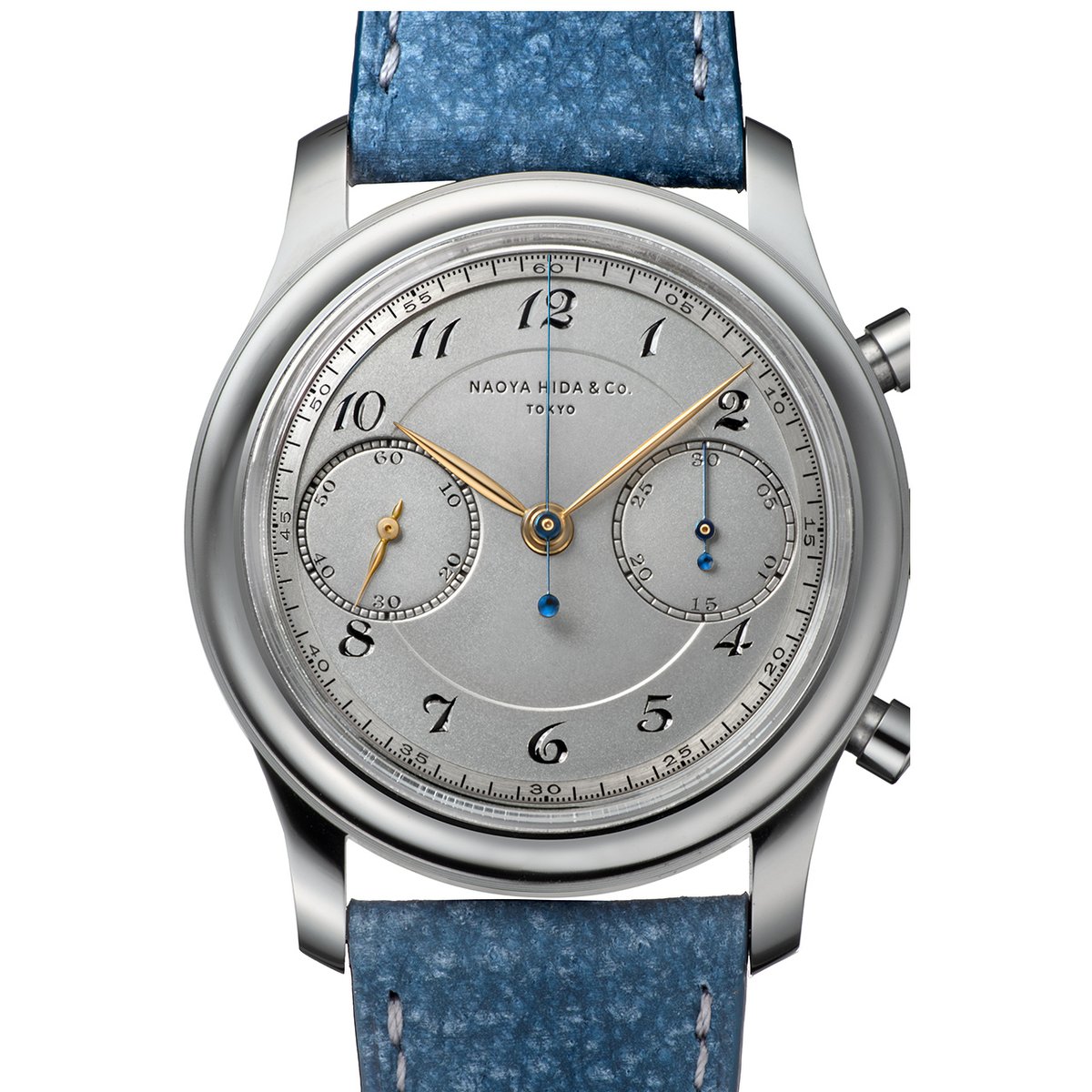
The dial is where the Type 7A makes its strongest argument. It is clean, balanced, and free of the visual clutter that often passes for sophistication. The absence of lume is not a deficiency in this context; it is a design decision. A dress watch does not need glowing markers, and the Type 7A does not pretend to be a travel or sports companion. The dial is meant to be read in ordinary light, with a clarity that comes from good typography, well-judged hands, and a restrained layout.
Naoya Hida’s work often rewards the second look. The first impression is one of simplicity; the second reveals the care taken with the relationship between dial and case. The bezel does not crowd the dial. The lugs are resolved rather than merely attached. The crown is integrated into the profile rather than emphasized. These are not details that sell a watch in a photograph, but they matter on the wrist. The Type 7A is not trying to dominate a room. It is trying to remain interesting over years.
Movement: Peseux 7001, restored and finished
The Type 7A is powered by a hand-wound Peseux 7001-family movement. This is an important point, and it should be stated plainly: the caliber is not in-house. Naoya Hida’s approach is to select a traditional Swiss ébauche, restore and prepare it, and finish it to a standard appropriate for a small-series independent watch. That is a legitimate approach, and it places the Type 7A in a long tradition of watchmakers who built their reputations on choosing and finishing movements well.
The Peseux 7001 architecture is a known quantity among collectors. It is a manual-wind design with small seconds, a power reserve in the region of 42 hours, a frequency of 21,600 vibrations per hour, and 17 jewels. Those figures are not spectacular on paper. They are, however, entirely appropriate for a classical dress watch. The movement is not built around a huge power reserve or a high beat rate. It is built around a sensible, serviceable layout that keeps the watch thin enough to wear easily under a cuff.
Finishing is where the Type 7A earns its keep. The movement is not decorated in the industrial manner of a mass-produced automatic. The bridges and steel components are prepared with an eye toward visible quality: bridge work, polished elements, and a level of hand attention that suits the price point. The result is not supposed to look like a skeletonized showpiece. It is supposed to look correct when the caseback is removed or when the watch is serviced. That is a quieter kind of finishing, and it suits the watch’s character.
The absence of date and other complications is a strength. A small-seconds dress watch does not need a date window interrupting the dial. The Type 7A keeps the movement and the dial aligned around one purpose: timekeeping with clarity. For collectors who have grown tired of watches that do too much, that single-mindedness will be appealing.
On the wrist: balance over bulk
The Type 7A wears like a dress watch should. It sits close to the wrist, with a balance that comes from a case designed around classical proportions rather than modern sport-watch expectations. The stainless steel case has enough substance to feel secure, but it does not dominate the wrist. The leather strap and pin buckle reinforce the traditional character. This is not a watch that encourages you to fiddle with micro-adjustments or admire a bracelet’s articulation. It is a watch you strap on and forget about until you need the time.
Comfort will depend on strap fit, as it does with most dress watches. A properly sized leather strap allows the case to settle without sliding, and the pin buckle keeps the package light. The lack of lume and the clean dial mean there is no visual weight to compensate for. The Type 7A is at its best under a shirt cuff, where its restraint becomes an advantage. It can be worn daily, but it is not a daily beater in the rugged sense. It is a daily watch for someone whose days are more likely to involve a desk than a trail.
Wrist presence is moderate. The Type 7A does not announce itself across a room, and that is intentional. Its presence comes from proportion and finish rather than size or shine. For collectors who want a watch that feels personal rather than performative, that is exactly the right balance.
Accuracy and ownership
The Peseux 7001 is not a chronometer-certified movement, and the Type 7A is not sold as one. Real-world accuracy should be assessed on the individual watch. A well-regulated example can be expected to keep stable daily time, but owners should anticipate normal positional variation. The state of restoration and the quality of regulation matter more than a laboratory certificate in this context.
Ownership is straightforward in principle and specialist in practice. The movement is a known Swiss design, which means a competent watchmaker can service it. But the Type 7A is a small-series independent watch, and its finishing and parts should be handled with care. Service is best coordinated with Naoya Hida & Co. or a specialist familiar with the brand and with restored Swiss ébauches. There is no public fixed service interval that should be treated as universal; the watch’s condition and running behavior should guide the decision.
The lack of water resistance is not a feature to celebrate, but it is consistent with the watch’s dress-watch brief. The Type 7A should be treated as a watch that dislikes water, not as a sports watch that can tolerate it. Owners should keep it away from swimming, showering, and prolonged exposure to moisture. That is not a criticism; it is a reminder that the Type 7A is designed for a different kind of life.
Variants, family, and alternatives
The reference under review is NH TYPE7A. At the time of writing, the A-series dial is the known public variant, and there is no broad catalog of Type 7 variants to choose from. That scarcity is part of the brand’s model. Naoya Hida does not operate like a large maison with a matrix of dials and bracelets. Each release is a small series, and collectors follow those releases closely.
Within the brand’s family, the NH Type 1A and NH Type 3A are the most natural reference points for collectors. The Type 1A established the brand’s classical small-seconds language, while the Type 3A shows how Naoya Hida approaches a more complex watch. The Type 7A sits between those poles: more evolved than the earliest pieces, but still committed to the dress-watch format.
Collectors who like the Type 7A but want to compare options should look at other Japanese independents. Kurono Tokyo offers a more accessible entry into small-series Japanese watchmaking, though its design language is more decorative. Otsuka Lotec appeals to collectors who value an art-deco case and a hand-wound mechanical focus. Kikuchi Nakagawa represents the high end of Japanese independent dress watchmaking, with classical finishing and a more rarefied price point. None of these are substitutes for the Type 7A, but they help frame what makes it distinct.
For buyers who want the general look at a lower price, the Orient Bambino 38, Timex Marlin Hand-Wound, and Seiko Presage Cocktail Time offer vintage-inspired dress-watch style without the independent premium. They do not deliver the same movement finishing, small-series scarcity, or brand context. They are homages in mood rather than execution, and that is fair. The Type 7A is not priced for entry-level buyers, and it should not be judged against them.
Value, investment, and service
The Type 7A sits in the high-teens to low-twenties price range at the time of writing, depending on retail allocation and secondary market conditions. That is a significant sum for a watch with a non-in-house movement. The value case rests on three factors: small-series production, the quality of finishing and assembly, and the brand’s growing collector reputation. Buyers who expect in-house movement architecture at this price will be disappointed. Buyers who understand the independent tradition of selecting and finishing ébauches will see the logic.
Investment performance is difficult to predict with precision because the secondary market is thin. The trend has been firm to appreciating, driven by limited supply and collector demand for Japanese independents. That does not mean the Type 7A is a safe financial instrument. It means that buying at retail is likely to be more advantageous than chasing a secondary listing. Hold recommendations should be based on enjoyment first and market performance second. The Type 7A is a watch to wear, not a certificate to trade.
Service should be planned rather than improvised. The Peseux 7001 is serviceable, but the watch is still a small-series independent piece with specific finishing. Owners should keep service records, avoid unnecessary intervention, and use a watchmaker who understands the brand’s standards. The cost will depend on the work required and the service provider. There is no public fixed interval that applies to every example; condition and running behavior should determine when service is needed.
Final verdict
The Naoya Hida NH TYPE 7A is a watch for collectors who value restraint. It is not the most complicated watch in its price range, and it does not pretend to be. Its strengths are proportion, dial discipline, and a restored Swiss movement finished with care. Its weaknesses are equally clear: limited availability, a non-in-house caliber, no lume, and specialist service requirements. Those weaknesses are acceptable if the brief appeals to you.
For the sophisticated young collector, the Type 7A offers something increasingly rare: a watch that feels authored rather than assembled from a focus group. It is classical without being costume, independent without being eccentric, and expensive without being ostentatious. That combination is difficult to execute well. Naoya Hida has done it, and the Type 7A deserves a place in the conversation about modern dress watches.