Introduction: the watch nobody has heard of, and everybody should
Most watches arrive for review with a press kit, a heritage diagram and a paragraph about a founder's grandfather. The Naoya Hida NH TYPE 8A arrives with almost none of that. It comes from a small Tokyo atelier founded in 2018, produced in numbers so small that the brand's references are allocated rather than stocked, and priced in the low five figures — territory where buyers are used to being flattered. There is no flattery here. There is a case, a dial, a hand-wound movement and a strap, and the entire argument for the watch has to be made by how those four things feel on the wrist.
So that is how I reviewed it. The TYPE 8A went under shirt cuffs and jacket sleeves, got caught in the rain on a Tuesday, was knocked against a doorframe on a Thursday, sat through a long-haul flight and a black-tie dinner, and spent a Sunday morning being rotated thoughtfully by a four-year-old. This is not a catalogue recitation. It is a report on what the watch is like to live with, and whether the considerable romance of independent Japanese watchmaking survives an ordinary week.
Spoiler: it does. But the caveats are real, and they are the kind that only show up after the honeymoon.
Naoya Hida & Co.: a brand built backwards
Naoya Hida spent years inside Japanese watch publishing before founding his own house in Tokyo in 2018. That background matters, because it explains everything about the brand's priorities. A journalist-turned-watchmaker does not start with a movement architecture and work outward; he starts with a mental archive of watches he has handled, photographed and written about for two decades, and then tries to distil the ones that stayed with him.
The result is a design language that is unapologetically retrospective. Naoya Hida's watches look like the mid-century pieces that Japanese collectors quietly prized long before the rest of the world caught up — modest cases, confident dials, restrained printing, hands that are shaped rather than stamped. The brand does not manufacture its own movements; it specifies Swiss-supplied calibers, then finishes, assembles and regulates them in Japan. That honesty about what it is and is not is one of the most attractive things about the house.
Production is deliberately tiny. Watches are made in small batches, sold through a limited network and allocated to clients who tend to keep them. That has two consequences for anyone reading this review: you will probably have to wait, and you will probably have to accept that the person sitting next to you at dinner has no idea what is on your wrist. For the right buyer, both of those are features rather than bugs.
What the NH TYPE 8A actually is
The TYPE 8A sits in the brand's numbered family alongside earlier references such as the TYPE 1A and TYPE 2A, and it follows the same philosophy: a time-only watch, stripped of complication, built around proportion and finishing rather than features. There is no date to set, no chronograph to reset, no lume to charge. You wind it, you set it, you wear it. In a market crowded with skeletonised, dual-time, 300-metre-rated everything, the restraint is almost provocative.
This is a dress watch in the older sense of the term — a watch intended to be worn with a suit but not so delicate that it cannot be worn with a shirt and trousers on a Tuesday. The leather strap, the polished case and the absence of any luminous treatment place it firmly in that world. It is not a sports watch, it is not a travel watch in any practical sense, and it will not survive a swim. What it will do is look correct with almost everything you own that is not made of nylon.
Case and finishing: where the money went
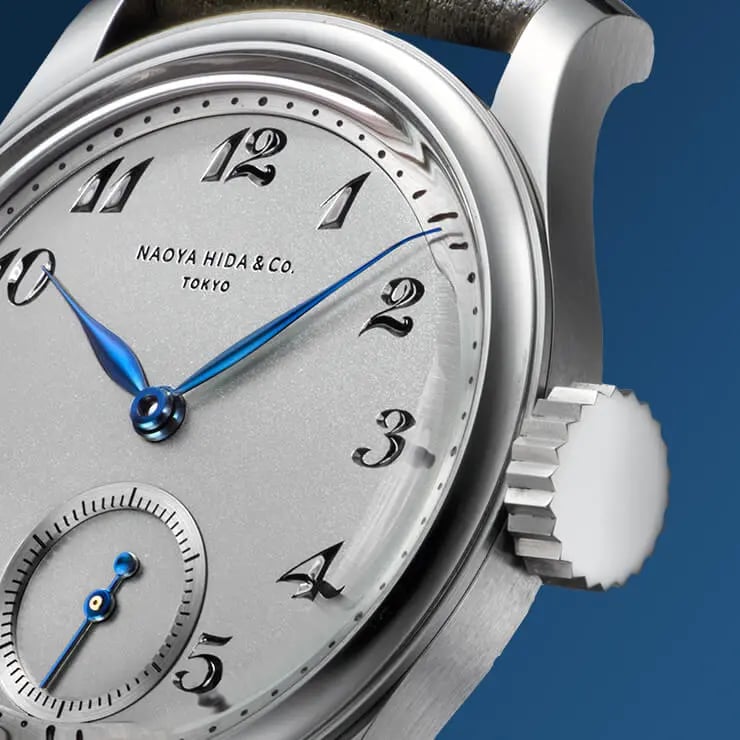
Naoya Hida publishes a deliberately sparing set of specifications for this reference, so I will not pretend to a precision the brand has not offered. What I can tell you is what you see and feel. The stainless-steel case is finished with the kind of alternating polished and brushed surfaces that only make sense when someone has spent a long time at a polishing wheel. The caseband catches light in a narrow ribbon rather than a broad flare, which keeps the watch looking smaller and more elegant than its nominal footprint might suggest. The lugs are shaped, not extruded — they taper, they curve down toward the wrist, and the transition from lug to caseband is smooth enough to run a fingertip over without interruption.
The sapphire crystal sits essentially flush, with very little distortion at the edges, and the anti-reflective treatment is subtle enough that the dial does not look greyed out in daylight — a common failure on watches that over-coat their crystals. The caseback is solid, which is the correct decision here: there is nothing about the movement that needs to be displayed, and a solid back lets the watch sit flatter against the wrist, which is the single biggest determinant of daily comfort.
It is worth saying plainly that the finishing is the reason to buy this watch. At this price you can find excellent movements from large houses and you can find heritage and service networks. What you rarely find is hand-level case and dial work executed in small batches by people who will look at the same watch twice before it leaves.
Dial and legibility: the quietest kind of confidence
Legibility is the specification nobody puts in a press release and everybody notices within an hour. The TYPE 8A is exceptionally legible, and it achieves that without the usual tricks. The dial carries only what it needs: the hour markers, the branding, the hands. There is no date window interrupting the symmetry, no depth rating cluttering the lower half, no applied logo competing with the indices for attention.
The printing is crisp and the applied elements sit proud enough to cast a small shadow in raking light, which gives the dial a sense of depth without any texture or guilloché busyness. Hands are shaped and finished rather than flat, so they hold a highlight along their length and remain readable at oblique angles. In flat office lighting the dial reads instantly; in direct sun the crystal handles the glare; in a dim restaurant, the absence of lume is obvious but so is the contrast, and I never once had to bring the watch to my face to read it.
What this dial does best is restrain itself. It is the sort of watch that someone notices on your wrist three hours into a conversation, and then asks about. It does not perform.
On the wrist: a week of real wear
The first thing you notice is how little there is to notice. The TYPE 8A disappears under a cuff, sits close to the skin and does not rotate on the wrist when you type. The lugs curve down sharply, and the caseback is gently rounded, which means the watch finds a stable position rather than balancing on a single point. On a leather strap it feels lighter than you expect, and the centre of mass sits over the top of the wrist rather than dragging toward the hand.
I wore it for a full week without swapping it out, which is a harder test than it sounds. By day three I had stopped adjusting it. By day five I had stopped thinking about it as a review watch and started thinking about it as a watch. That is the highest compliment a daily-wear piece can receive. The only genuine friction point is the pin buckle: it is nicely finished, but a pin buckle on a thin dress strap will always crease, and after a week of daily wear the strap had already taken on the shape of my wrist. Budget for a spare strap, or plan to move it to a deployant.
One honest limitation: this is a watch that looks best with long sleeves. Worn with a t-shirt on a hot weekend it can read a little formal, a little earnest. That is not a fault, but it does mean the TYPE 8A works better as one of three watches than as a single-watch collection.
Movement and winding: the daily ritual
The movement is a Swiss-supplied hand-wound caliber, finished and regulated for the brand, and the winding action is one of the small pleasures of ownership. There is enough resistance through the crown to feel mechanical rather than springy, and the crown itself is easy to grip without being oversized. Winding it each morning takes perhaps fifteen seconds and becomes a habit surprisingly quickly — the sort of tiny ritual that people who wear quartz watches genuinely do not understand.
The trade-off is that a hand-wound watch requires you to participate. Stop wearing it for two days and you will be resetting it. That is either the charm or the irritant, depending on your temperament, and there is no way to know which camp you are in until you have lived with one. What I can say is that the TYPE 8A's lack of a date makes the reset trivial — two hands, a crown, done — which removes the single biggest annoyance of hand-wound ownership.
Accuracy in the real world
Naoya Hida does not pursue chronometer certification on this reference and does not publish a single headline accuracy figure, which is the correct stance for a watch like this. What you should expect is a well-adjusted Swiss caliber that settles after a few weeks: in practice, a handful of seconds a day, with the exact number depending on how fully you wind it and how consistently you wear it. Wind it at the same time every morning and the rate becomes repeatable in a way that makes checking it weekly rather than daily entirely reasonable.
This is not a watch you buy for timekeeping superiority. It is a watch you buy because it keeps time well enough that you never think about it, which is a different and more useful standard.
Ownership, servicing and the practical reality
Here is the part of the review where the romance meets logistics. Naoya Hida does not have a global service network. Servicing runs through the brand's own channels in Japan and a very small number of appointed partners, which means that owners outside Japan should plan for shipping, insurance and waiting. That is not unusual for an independent house, but it is worth saying plainly because it is the single most common surprise for first-time buyers of small-brand watches.
The compensating factor is that the movement is a Swiss ébauche rather than a proprietary design, which generally makes life easier for a watchmaker when the time comes. The case and dial, however, should only be touched by people who know what they are doing, which argues strongly for using the appointed route rather than your local generalist.
Market, value and whether it holds
Naoya Hida's watches trade thinly. That is both the appeal and the risk. Retail pricing on the TYPE 8A sits in the region of five figures in US dollars, secondary examples trade at or above that when they appear at all, and the brand's waiting lists do most of the work of supporting values. There is no meaningful auction record to point to, because the brand is too young and too few pieces change hands publicly.
What this means practically is that you should buy the TYPE 8A because you want to wear it for a decade, not because you want to flip it in eighteen months. Scarcity will probably protect your capital; illiquidity will definitely frustrate you if you need to sell quickly. Treat it as a long-term relationship and the economics are entirely reasonable.
Alternatives worth considering
If you want the same philosophy with a global service network, Grand Seiko's SBGW231 delivers hand-wound Japanese dress-watch excellence with far more infrastructure behind it. If you want the small-batch Tokyo experience at a lower entry point, Kurono Tokyo offers a similar allocation-driven thrill. And if you want the European version of the same idea, Habring² builds quiet, independent, hand-wound watches with a comparable sensibility. None of them is a substitute for the TYPE 8A's particular combination of finishing and restraint, but all of them are worth trying on before you commit.
Final verdict
The Naoya Hida NH TYPE 8A is one of the most convincing arguments for independent Japanese watchmaking you can currently put on a wrist, precisely because it never raises its voice. It is comfortable enough to wear for a week without adjustment, legible enough to read at a glance in poor light, and finished well enough that you will catch yourself turning it over at your desk. It is not a one-watch solution, it is not a sports watch, and it will require you to accept a small atelier's idea of service rather than a multinational's.
For the collector who has already bought the obvious things and is now looking for something that rewards attention rather than announcement, that is exactly the trade worth making.