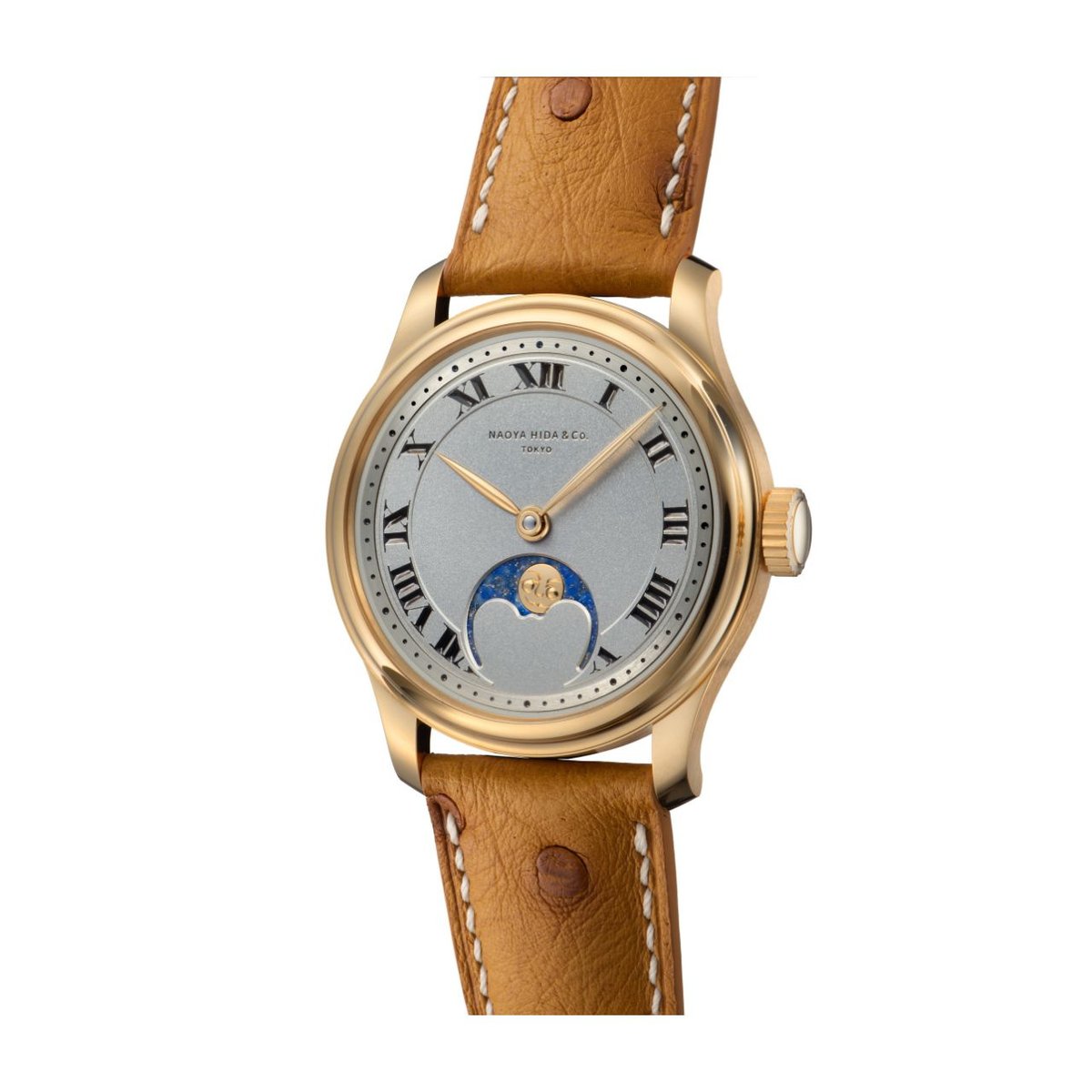
Japan's most discreet independent builds a dress watch you can't just buy.
The watch that never hits the display case
There is a specific kind of young collector — fluent in auction results, allergic to logos, bored of the same three steel sports watches on every wrist at every dinner — who has quietly stopped shopping the big houses' dress lines. Not because those watches are bad. Because they are everywhere. The Naoya Hida & Co. NH TYPE3B-3 sits at the exact opposite pole: a Tokyo-made, mid-century-inflected time-only watch produced in numbers so small that the brand does not so much sell them as distribute them, usually through a lottery or a waitlist that behaves like one.
That scarcity is not a boardroom invention. Naoya Hida & Co. is a genuinely small atelier, and output is measured in dozens a year rather than thousands. Which makes the TYPE3B-3 the rare watch that rewards the person who reads, who waits, and who can tell a sector dial from a railroad dial at ten paces.
This is a review of a watch most readers will never handle in person. So let's be concrete about what it is, how it wears, and whether the quiet hype is earned.
A Tokyo atelier built on restraint
Naoya Hida & Co. was founded in 2018 in Tokyo by Naoya Hida, a figure who came to watchmaking through the industry's editorial and product side rather than the traditional apprentice route. That background matters. It explains why the brand's design language reads like someone who spent years looking at the best mid-century watches, filing away what worked, and then decided to make the version he actually wanted.
The house's output is organized into numbered families rather than collections: TYPE1, TYPE2, TYPE3 and their lettered sub-variants. Each family shares a design grammar — round cases, narrow bezels, dials that lean on typography and proportion rather than applied hardware, and hands that are blued or polished to a mirror. The TYPE3B-3 is a dial execution within the TYPE3B line, and it is the purest expression of the idea: a time-only watch with nothing on the dial that does not need to be there.
Distribution is deliberately unglamorous. There is no global boutique network, no airport presence, no celebrity seeding. Watches are allocated, often by lottery, and the secondary market is almost entirely private and dealer-driven. For a certain kind of collector, that is the entire appeal. You do not buy a Naoya Hida to be seen buying it.
Case and dial: mid-century grammar, modern execution
The TYPE3B-3's case is stainless steel, and the silhouette is the classic mid-century dress formula: a round body, a slim bezel, and lugs that taper with intent rather than aggression. There is nothing tactical about it. This is a watch designed to disappear under a cuff and then reappear at exactly the right moment.
Finishing is where the money goes. The case surfaces alternate between broad, flat planes and tight, hand-worked transitions — the kind of beveling you only notice when light rakes across the case at an angle. It is the sort of detail that separates a small atelier from a volume manufacturer, and it is the reason photographs of the TYPE3B-3 never quite do it justice.
The dial is the headline. The TYPE3B-3 uses a sector-style layout, where the dial is divided into concentric zones — the outer track carrying the minute scale, the inner field reserved for the hour indications. It is a format that peaked in the 1930s and 1940s, when legibility and industrial design briefly agreed on everything, and it has aged better than almost any other dial architecture of the period.
Typography is applied with the confidence of a brand that knows exactly how much is enough. The numerals are crisp and slightly elongated. The hands are slender, echoing the era without cosplaying it. The brand signature is small, restrained, and positioned where it does not fight the geometry. There is no date window. There is no lume. There is no text explaining what the watch is — the watch explains itself.
Covering it is a sapphire crystal, and the watch is fitted on a leather strap closed with a pin buckle. That is the correct call. A deployant would add bulk to a watch defined by its lack of it, and a bracelet would break the spell entirely.
Movement: Swiss bones, Japanese hand
Naoya Hida & Co. does not publish exhaustive movement specifications, and the brand is notably discreet about the calibers it uses. What is clear is the architecture: a Swiss ébauche, hand-finished and regulated in Japan, in a hand-wound, time-only configuration. The house is not pretending to have built a movement from a blank sheet of paper, and that honesty is refreshing in an era when "in-house" has become a marketing reflex rather than a technical description.
What matters more than the base is what happens to it afterward. The finishing on these movements — the anglage, the polishing of the steelwork, the treatment of the bridges — is done to a standard most watches at several times the price never approach. The movement is not chronometer-certified, and the brand does not chase certification. It is a hand-wound, time-only architecture, which means no rotor, no date mechanism, and nothing between you and the going train.
That matters for a reason beyond romance. A hand-wound, time-only movement is the simplest thing a mechanical watch can be, and simplicity is where finishing is most visible. There is nowhere to hide. On the TYPE3B-3, there is nothing to hide behind.
On the wrist
This is a small watch by contemporary standards, and that is the point. It sits low and close, with a center of gravity that keeps it from rolling on the wrist. The caseback is flat enough to sit comfortably against skin, and the lugs curve in a way that suits both a slim wrist and a larger one — the watch reads as elegant rather than undersized.
Weight is minimal, which is a feature, not a compromise. You will forget you are wearing it, and then you will catch it in a shop window and remember. The leather strap is supple from the first wear, and the pin buckle is slim enough that it does not create a lump under a shirt cuff. This is a watch that lives under a sleeve and emerges when you check the time over dinner.
The one adjustment most wearers make is strap-related. Because the case is understated, the strap does a disproportionate amount of the styling work. Dark alligator or grained calf pushes it formal; textured or lightly distressed leather pulls it toward everyday. The TYPE3B-3 is versatile enough to take either, and it will look like a different watch depending on which you choose.
Accuracy and daily life
There is no chronometer certificate here, and Naoya Hida does not market the watch on rate. In practice, a properly regulated Swiss ébauche of this type will typically run within a handful of seconds a day — expect something in the region of a few seconds either side of zero, with individual examples varying and regulation drifting over time. That is more than good enough for a dress watch that will spend most of its life being wound once in the morning.
Daily life with a hand-wound, time-only watch is a specific pleasure. There is a ritual to it: winding, setting, wearing. Owners of these watches tend to describe the winding feel as one of the reasons they bought it — the resistance of a well-finished mainspring through a crown that has not been compromised by a screw-down gasket system. You do not get that from an automatic.
What you do give up is convenience. No date means no date to set, which is actually a plus. No lume means you will not read it in a dark cinema. And this is emphatically not a watch for water — treat it as a desk-and-dinner companion and it will serve you for decades.
Occasions
Formal and dress settings are the TYPE3B-3's home turf. It reads as serious without being austere, and it holds its own next to a Lange or a Patek in a way that a more obvious watch would not. It is also a genuinely good daily wearer if your daily life involves a desk, a jacket and a city — the kind of watch that works with a navy suit and a knit polo equally well.
It is not a sports watch, not a travel watch, and not a watch you take to the beach. Anyone buying it for those purposes is buying the wrong watch, and the brand would probably tell them so.
The TYPE3 family and where it sits
Within the Naoya Hida catalog, the TYPE3B-3 sits alongside the broader TYPE3 family and the earlier TYPE1 and TYPE2 lines. The TYPE3B line is offered in a very small number of dial executions, each differentiated primarily by dial finish and color rather than by case or movement; the '-3' suffix identifies this particular dial variant.
Collectors who follow the brand tend to treat the lettered variants as a set. Because production is so limited, owning more than one is unusual, and secondary-market prices reflect that — a specific variant can command a meaningful premium simply because so few were made.
Alternatives worth knowing
If the TYPE3B-3's combination of Tokyo craft, sector-dial classicism and allocation-only distribution appeals to you, the natural comparisons are worth understanding.
Kurono Tokyo is the closest philosophical cousin. Hajime Asaoka's accessible line shares the Japanese independent DNA, the vintage-leaning dials and the direct-to-collector distribution model — though Kurono's production is larger and its price point lower.
A. Lange & Söhne's Saxonia Thin occupies the same aesthetic territory at a much higher price. The finishing is comparable in ambition, the German design language is different, and the availability is far better.
Patek Philippe's Calatrava is the establishment answer to the same question. It is a better-known watch, easier to buy and easier to sell — and it will never feel as personal.
Kikuchi Nakagawa, another very small Japanese independent, works in a similar register with hand-made cases and a similarly limited output. If you are drawn to the TYPE3B-3, it is worth knowing the name.
Homage territory
The sector-dial, mid-century dress watch look is not exclusive to five-figure independents. If you want the aesthetic without the waitlist, there are honest options.
Seiko Presage models deliver Japanese dress-watch design at a fraction of the cost, with in-house movements and genuinely accomplished dials. Orient's Bambino remains the value benchmark for a classical dress watch. And Kuoe Kyoto, a small Kyoto-based brand, makes vintage-inspired pieces with a similar sensibility and a much friendlier entry price.
None of them will feel like a Naoya Hida. But they will get you the silhouette while you wait.
Investment value
Naoya Hida & Co. watches are not commodities, and there is no meaningful public auction record for the TYPE3B-3 — the secondary market is private, dealer-driven and thin. What can be said is that the brand's production constraints have kept demand ahead of supply, and examples that do change hands tend to trade above their original retail.
That is not the same as a guaranteed return. A watch this obscure is illiquid by nature: there is no daily price, no auction index, and no guarantee that the next buyer is in your city. But for a collector who intends to wear the watch rather than flip it, the supply-demand picture is as favorable as it gets in independent horology.
Service and ownership
Service for a Naoya Hida should go through the brand or an authorized channel. Because the movement is a Swiss ébauche, a competent independent watchmaker can service it, but the finishing and case work are specific to the house, and you do not want a generalist learning on your watch. Expect to ship the watch to Japan and expect the brand to communicate on its own schedule.
Ownership realities: no boutique network, limited spare parts, and a waiting list that rewards patience over spending power. If you need white-glove global service, this is not the watch for you.
Pros and cons
Pros: genuinely rare; exceptional hand-finishing relative to price; a dial layout that will still look correct in thirty years; hand-wound, time-only simplicity; the satisfaction of owning something almost nobody else has.
Cons: allocation-only distribution; no lume, no date, and no meaningful water resistance; service requires shipping to Japan; illiquid secondary market; you will wait.
Final verdict
The Naoya Hida NH TYPE3B-3 is not a watch for someone building a collection by checklist. It is for the collector who has already owned the obvious things and wants something that reflects a point of view. The design is disciplined, the finishing is exceptional for the money, and the ownership experience is deliberately inconvenient in a way that filters out everyone who is not serious.
If you can get one, wear it. That is what it was made for.