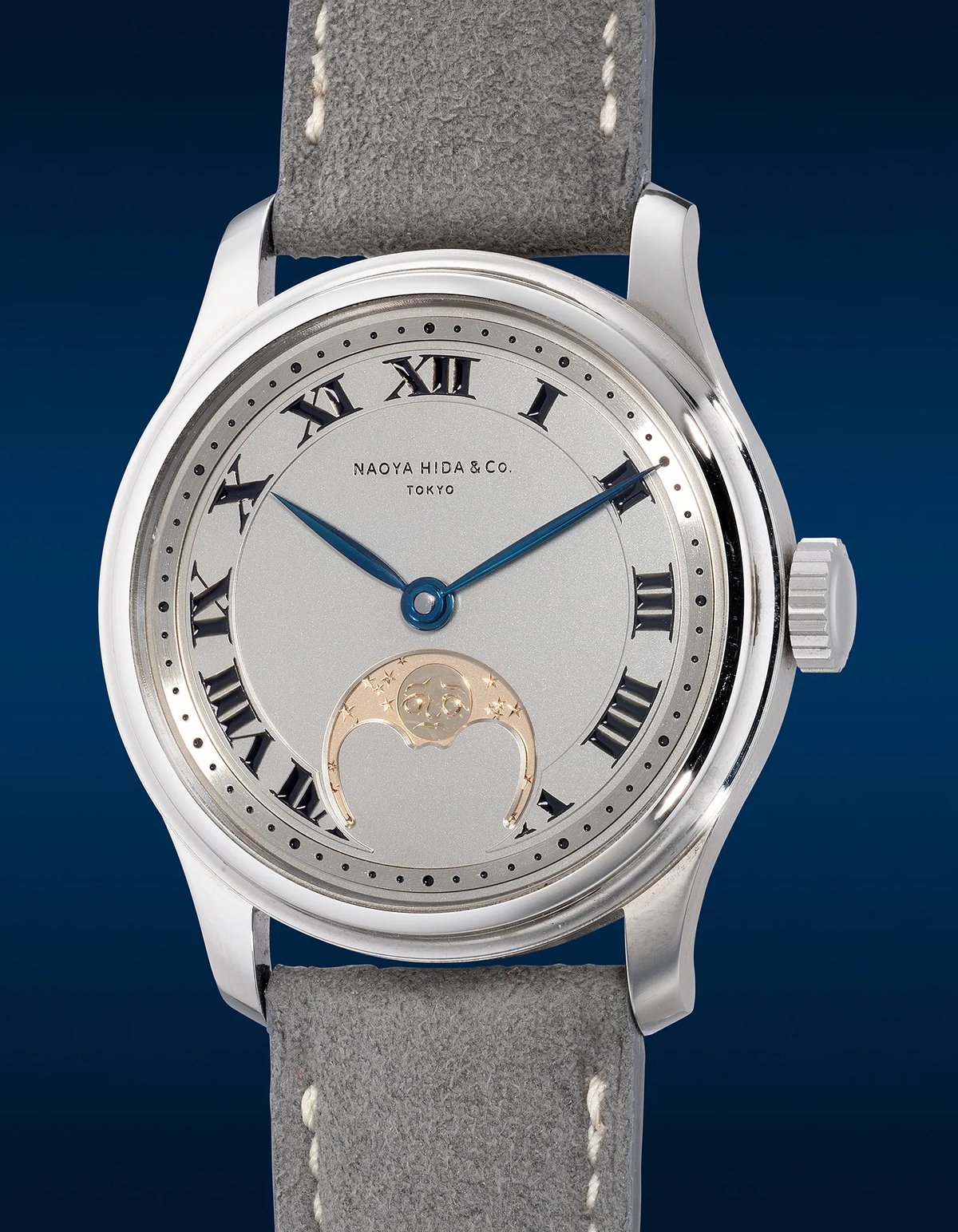
There are watches that announce themselves across a room, and watches that reward attention. The Naoya Hida NH TYPE 3B belongs emphatically to the second category. Produced in tiny numbers by a Tokyo atelier that has never pursued volume, it is a hand-wound, time-only wristwatch built around a sector dial, a Swiss ébauche finished to Japanese specification, and an almost architectural sense of proportion.
This is not an object designed to photograph well on a wrist shot. It is designed to be looked at, repeatedly, over years — the way one looks at a well-set page of type or a carefully proportioned façade. What follows is a full appraisal: the house, the case and dial, the movement architecture, real-world wearing behaviour, and where this reference sits in the wider landscape of independent watchmaking.
A studio, not a manufacture
Naoya Hida & Co. was established in Tokyo in 2018. Its founder came to watchmaking from the design side, having spent the formative part of his career inside Japan's largest watchmaking group before establishing an independent practice. That background matters, because it explains almost everything about the product: the priorities are dial legibility, hand geometry, printing quality and case proportion — the things a designer controls — rather than vertical integration or marketing-driven complication counts.
Annual production is measured in the low hundreds at most, and frequently less. Watches arrive in batches, are allocated rather than stocked, and are rarely discounted. The house does not maintain a global boutique network, which is both the source of its mystique and the practical reason its secondary market is thin and opaque. For a collector, this cuts two ways: you will not see your watch on every other wrist, but you will also need to build a direct relationship with the brand if you intend to own one and keep it running.
The Type 3 family represents the most resolved expression of the studio's aesthetic to date — a classical, mid-century-inflected time-only watch with a sector dial and a small seconds register. The 3B is the reference under review here.
Case and dial: discipline over decoration
The case is stainless steel, and the finishing is deliberately understated: a polished bezel that is kept narrow, a mid-case with a clean flank, and lugs that taper and curve away early rather than extending flat. There is no crown guard, no elaborate caseback architecture, no gratuitous beveling. The design decision that matters most is the bezel width — keeping it thin maximises the dial aperture relative to the case, which is why the watch reads larger on the wrist than its compact dimensions would suggest.
Crystal is sapphire, clear and uncoated in appearance, sitting slightly proud in the classical manner. Water resistance is not a headline figure here and the watch should be treated as a fair-weather dress piece; there is no screw-down crown and no pretence of sports capability. There is no luminescent material anywhere on the dial, which will immediately disqualify the watch for some buyers and will be a positive recommendation for others. A sector dial with painted geometry and delicate hands does not benefit from glowing compounds, and the house has sensibly declined to add them.
The dial itself is the reason the watch exists. It is built on the sector principle: concentric divisions separating an outer minute track from an inner hour register, with each zone given its own visual weight through printing density and finish. The result is a dial that reads instantly at a glance but continues to yield detail under close inspection — the crispness of the track, the way the numerals are spaced against the sector line, the depth of the applied indices.
Hands are classical in form, slender and correctly proportioned to the registers they serve, and the small seconds at six o'clock anchors the composition without crowding it. There is no date aperture interrupting the geometry, which is a deliberate and correct decision: a date window in a sector dial of this kind would break the concentric logic entirely. The dial is a closed system, and it is allowed to remain one.
The overall effect is of restraint exercised by someone with a very clear idea of what the watch should be. Nothing here is accidental, and nothing here is decorative for its own sake.
The movement: hand-wound by conviction
The TYPE 3B is hand-wound. This is not a cost compromise dressed up as philosophy; it is the reason the case is slim and the reason the watch feels the way it does on the wrist. A hand-wound calibre removes the rotor, lower the profile of the movement, and changes the relationship the owner has with the object: you wind it each morning, you feel the mainspring load, and you interact with the watch in a small ritual that an automatic quietly eliminates.
The calibre itself is a Swiss-sourced ébauche, selected and finished to Naoya Hida's specification. This is an honest arrangement and one common to small independent houses: the base architecture is proven and serviceable, and the maker's contribution is in regulation, finishing and the integration of movement to case and dial. The house does not claim manufacture status and does not need to; what matters is whether the execution justifies the specification, and it broadly does.
Finishing is classical rather than spectacular. Bridges carry striped decoration, the anglage is clean and consistent rather than aggressively wide, and the overall presentation favours restraint over the mirror-polished theatricality of high-complication watchmaking. The small-seconds train is visible through the exhibition back, and the architecture is legible in the way a good movement should be — you can follow it without a diagram.
Naoya Hida does not publish a comprehensive technical dossier for this reference, which is a frustration for specification-driven buyers but is consistent with the house's character. What can be said confidently is that the movement is regulated and finished to a standard appropriate to the price, and that the winding action — the tactile quality of the crown as it loads the spring — is one of the quiet pleasures of ownership. On a watch like this, that matters more than a jewel count.
On the wrist
The TYPE 3B wears as a deliberate anachronism, and that is precisely its appeal. The case is compact by contemporary standards, and the design clearly prioritises the relationship between dial aperture, bezel width and lug curvature over sheer presence. With no rotor adding mass or shifting the centre of gravity, the watch sits close to the wrist rather than perching above it. It feels balanced, slightly weightless, and entirely at home under a shirt cuff.
The lugs curve away early, so the strap falls vertically rather than flaring outward — a detail that makes an enormous difference to comfort on smaller wrists and to the watch's ability to disappear under a sleeve. The supplied leather strap is of appropriate thickness and does not fight the case. This is not a watch you will notice constantly. It is a watch you notice when you look down, which is a rarer and more durable quality.
Presence is modest: three out of five. At conversational distance it is legible, elegant and clearly well made. From across a table it is invisible. For a certain kind of collector, that is the entire point.
Accuracy and ownership
The watch is not chronometer certified, and the house does not market it on rate performance. In practice a well-regulated hand-wound calibre of this class should hold within roughly ten seconds a day in normal wear, with positional variation accounting for most of the spread. Because the mainspring is fully wound each morning, consistency tends to be good once the wearer settles into a routine — the watch performs to a predictable pattern rather than drifting with activity levels.
Servicing is a relationship rather than a transaction. With production this small, the maker and its appointed agents are the sensible route, and owners should establish contact before they need it. Generalist watchmakers can handle the base calibre, but the case finishing and dial work are best left to people who have seen the watch before.
The family, and the alternatives
Within the Type 3 line, references differ primarily in dial treatment rather than in case or calibre. The 3A and 3C offer alternate finishes that shift the character of the watch meaningfully — a dial change on a sector design is not a cosmetic matter, it alters how the printing reads and how the watch behaves in different light. The 3B is the most classically resolved of the group.
Siblings elsewhere in the catalogue — the Type 1 and Type 2 families — share the same design convictions: hand-wound, time-only, sector-derived, restrained. Buyers comparison-shopping within the brand are effectively choosing a dial and a proportion rather than a specification tier.
Against outside competitors, the closest analogues are other small-volume independents: Habring2's Erwin for Austrian hand-wound purity, Kikuchi Nakagawa for Japanese craft at a comparable conceptual level, Sartory Billard for dial-led design, and Otsuka Lotec for Tokyo micro-production with a strong point of view. None of these are direct substitutes; all occupy the same philosophical territory. Buyers seeking the mood at a fraction of the price will find it in the Baltic MR01, or in Japanese classics such as the Orient Bambino and the Seiko Presage line — watches that get the proportions right without the small-batch execution.
Value
Indicative pricing sits in the low-to-mid five figures in US dollars, with secondary examples trading in a relatively narrow band because so few change hands. This is not a market with a chart; it is a market with a handful of transactions a year. The watch is unlikely to depreciate meaningfully given the supply constraint, and equally unlikely to produce the speculative returns of a hyped steel sports watch. It should be bought as a watch.
What the price actually buys is attention: a dial executed by people who care about printing, a hand-wound movement finished to a considered standard, and a case whose proportions were decided rather than inherited. That is a defensible proposition for a discerning buyer, provided they accept the practical limitations — no lume, no date, modest water resistance, and a service network measured in individuals rather than countries.
Verdict
The Naoya Hida NH TYPE 3B is not a watch for someone assembling a collection by checklist. It is a watch for someone who has already owned the obvious things and has begun to care about proportion, printing and the feel of winding a movement by hand each morning. Judged on those terms it is close to exemplary: disciplined, restrained and quietly obsessive. Judged as an all-purpose daily wearer it is limited — but it never pretended otherwise, and that honesty is part of its considerable charm.