The Name That Keeps Showing Up in the Right Rooms
Walk into any serious collector's group chat and you'll hear the same complaint: heritage reissues have become the most cynical corner of watchmaking. Every brand with a 1960s catalogue has strip-mined it, bolted a vintage-tinted crystal onto a modern case, and charged a premium for the privilege of nostalgia. The result is a market where a mid-century silhouette and a Swiss automatic no longer guarantee anyone's attention.
Nivada Grenchen is different in one specific, structural way. It never became a giant, so it never became a caricature of itself. The brand's archive is thin enough to be honest and deep enough to be genuinely interesting — the Chronomaster Aviator Sea Diver, the Antarctic, the Depthmaster. When the modern operation relaunched in 2020, it didn't have to invent a heritage narrative, because there was already one sitting in the drawers of Swiss watchmaking history.
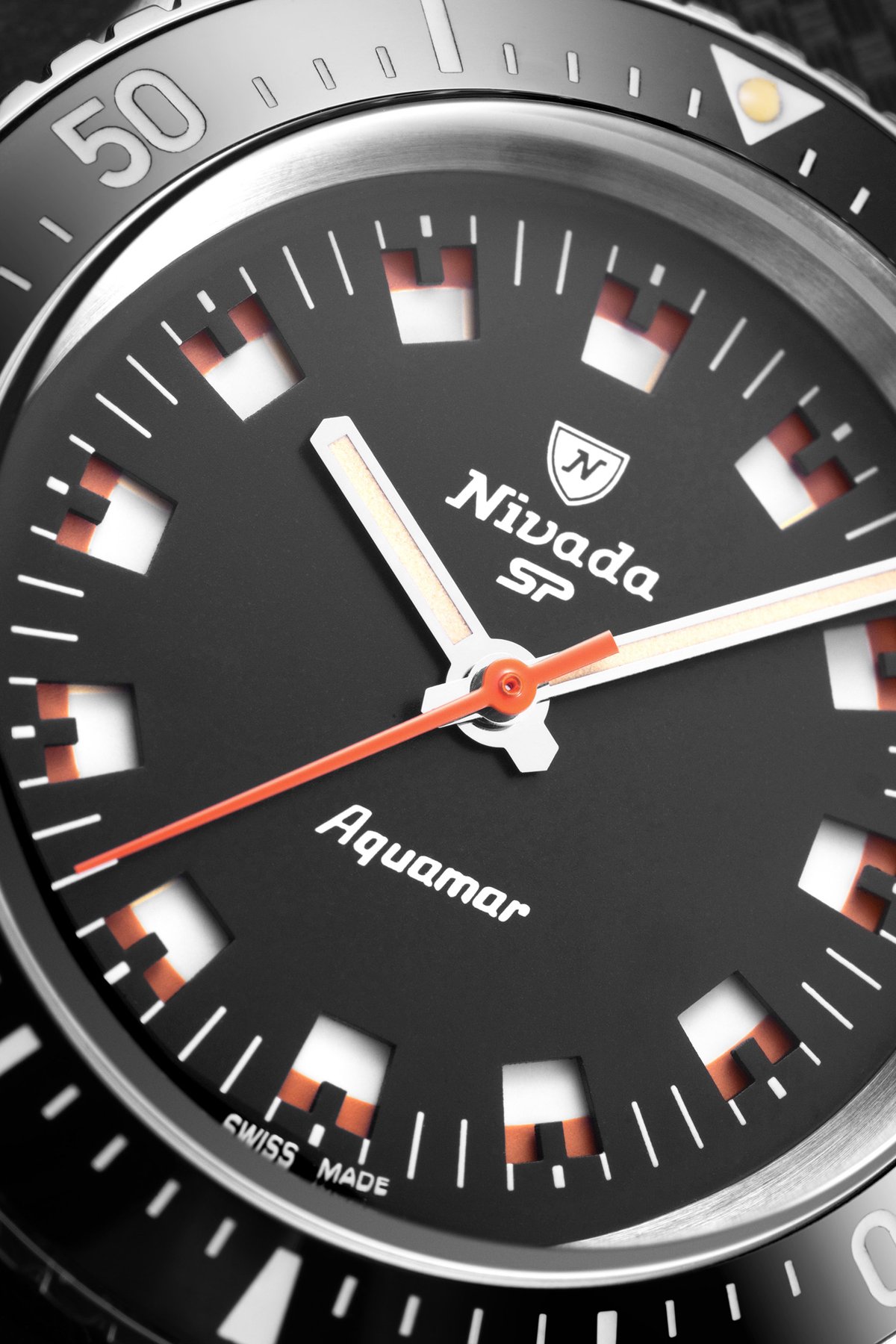
The Aquamar, reference 32077A01, is where that history meets a price that doesn't require a home equity line. It is a compact steel diver in the mid-century idiom, powered by a Swiss automatic, finished to a standard that consistently outclasses its bracket, and sold without a waitlist. It is not the most exciting release of the decade. It might be one of the most quietly correct.
Nivada Grenchen, Briefly
Nivada was founded in 1879 by Jacob Wirth in Grenchen, a town in the Swiss Jura that has spent a century and a half turning out watch components for pretty much everyone. The brand spent the twentieth century making tool watches rather than luxury objects — instruments for people who needed to know the time more than they needed to be seen knowing it.
In the United States, Nivada was distributed by the Croton Watch Company, which is why American collectors of a certain age still refer to the mid-century pieces as Croton Nivada Grenchen. That transatlantic distribution gave the brand an unusually wide footprint for its size, and it's why vintage Chronomaster Aviator Sea Divers turn up in estates from Ohio to Oregon.
The Chronomaster Aviator Sea Diver — a chronograph built for people who were actually going somewhere — became the brand's signature. The Antarctic, a slim and stubbornly understated three-hander, developed its own following. The Depthmaster gave the catalogue a proper deep-diving heavyweight. Then came the quartz crisis, and like a great many small Swiss names, Nivada went quiet.
The revival, spearheaded by Guillaume Tripet from 2020 onward, took the sensible route: reissue the archive rather than reinvent it, keep the pricing aggressive, and let the watches do the talking in a market saturated with louder marketing. It has worked precisely because it hasn't tried to be anything it isn't.
The Design: A Skin Diver With a Memory
The Aquamar reads as a mid-century skin diver, which is a different proposition from a modern dive watch. Skin divers were built for recreational swimmers and holiday snorkellers rather than saturation divers, and their design language reflects that: uncluttered dials, warm-toned markers, hands sized for legibility rather than drama, and case profiles slim enough to slide under a shirt cuff. The Aquamar sits squarely in that tradition.
The dial is the part you'll stare at, and Nivada has got the details right. Applied hour markers catch light without flashing it back at you, the handset is proportional and readable at a glance, and the whole thing is composed rather than busy. There's a restraint here that a lot of vintage-inspired watches miss — they mistake clutter for character. This one doesn't.
The sapphire crystal is the right call for a daily wearer, even if it's less romantically period-correct than acrylic. You get the crispness and the scratch resistance, and you don't spend your evenings polishing out hairlines. The Super-LumiNova on the dial and hands is applied generously enough to be genuinely useful when you wake up at an ungodly hour in a hotel room you don't immediately recognise.
And then there's the bracelet, which deserves its own paragraph. At this price point, most brands hand you a stamped afterthought that rattles like a tin of screws. Nivada's bracelet articulates properly at the first link, tapers sensibly toward the folding clasp, and has edges that have been properly broken. It doesn't pull hair. It doesn't catch on knitwear. It's the single most tactile argument for the watch, and it's the one you'll notice every morning when you put it on.
The Movement: Sellita SW200-1
Inside, the Aquamar runs a Sellita SW200-1, the Swiss workhorse that has quietly become the backbone of the accessible-luxury segment. It's automatic, it hacks, it hand-winds, and it beats at 28,800 vibrations per hour with a power reserve of around 38 hours.
None of that is exciting, and that's entirely the point. The SW200-1 is the watchmaking equivalent of a Toyota powertrain: unglamorous, endlessly serviceable, and supported by parts availability so broad that any competent independent watchmaker can look after it without a factory authorisation certificate. In a category full of brands using proprietary movements with opaque service networks, that's a genuine ownership advantage.
The finishing is industrial rather than decorative — minimal perlage, no chamfered bridges, no gold-filled rotor engraving worth photographing. If you're the sort of collector who opens the caseback with a loupe, you'll find it plain. If you're the sort who wants a watch that runs for twenty years without drama, you'll find it exactly right.
On the Wrist
The Aquamar is a watch you forget you're wearing, and I mean that as high praise. The case reads compact and slightly domed in profile, so it settles into the wrist rather than perching on top of it. The lugs curve away quickly, which means there's no overhang even on a smaller wrist — a genuine relief in a market where everything seems to have grown a size and a half since 2015.
Balance is right, too. The head isn't top-heavy, so the watch doesn't rotate forward when your arm hangs at your side, and the crown sits tucked closely enough that it doesn't dig into the back of your hand during a long day of typing. On the bracelet it's a pure daily wearer. Swap to leather and it dresses up considerably more than a dive watch has any right to, which makes it a legitimate option for a wedding or a meeting where you'd rather not be the guy in the sports watch.
It's a watch that disappears under a cuff — no small thing, given how many modern divers announce themselves from across the room. If you're the kind of person who wants their wristwear to start conversations, this isn't it. If you want something that looks correct with everything from a T-shirt to a suit and never feels like effort, it is.
Accuracy and the Reality of Daily Wear
The SW200-1 is not a chronometer and Nivada doesn't pretend otherwise, so calibrate your expectations accordingly. Out of the box, expect variance somewhere in the range of a few seconds to roughly ten seconds a day depending on position and wear pattern. Most examples settle down after the first few weeks, and they respond well to consistency — on the wrist during the day, crown-up overnight, is where the rate tends to tighten.
Is that good enough? For a watch at this price, absolutely. You will not miss a train because of it. If you're the sort of person who syncs to a reference clock every morning and keeps a spreadsheet, you'll find it a few seconds off and you'll survive. The practical reality is that once a watch is within a handful of seconds a day, you stop noticing, and this one lives comfortably inside that window.
The 38-hour power reserve means you can take it off on Friday night and put it back on Monday morning without resetting — barely. Miss a full weekend and you'll be pulling the crown. That's the honest cost of a movement this proven at this price, and it's a trade most owners will happily make.
The Value Math
Retail on the Aquamar sits in the low four figures, and the secondary market softens that meaningfully within a year of purchase. Let's be clear-eyed about it: this is a depreciating asset, like essentially every steel three-hander from a revived independent. If you're buying it as an investment, you're buying the wrong watch for the wrong reason.
But the depreciation math looks different when you factor in ownership cost. Servicing an SW200-1 is neither expensive nor difficult, and any competent independent can do it. Compare that to the five-year bills on a complicated in-house movement from a bigger name and the total cost of ownership starts to look genuinely competitive. Buy it secondhand, wear it for a decade, and the amortised cost per year is trivial.
Where the value really lands is in the finishing-per-dollar ratio. The case detailing, the dial furniture and that bracelet are all pitched well above the sticker. You're not paying for a badge or a boutique experience. You're paying for a well-made object with a real story behind it, and that's a rarer transaction in 2025 than it should be.
The Alternatives Worth Considering
If you want the vintage-diver brief with more brand recognition, the Tudor Black Bay 54 is the modern benchmark — vintage-correct proportions, superb finishing, and roughly three times the price. The Longines Legend Diver offers a more complicated case and a more famous name for a modest premium. The Oris Divers Sixty-Five is the closest philosophical rival: mid-century looks, Swiss automatic, similar value proposition.
If you're willing to go smaller and newer, the Baltic Aquascaphe delivers a similar vintage-diver brief at a lower entry price with less finishing depth. And if you simply want to test whether the shape works on your wrist before committing, the homage market will sell you a passable silhouette for a couple of hundred dollars — just don't expect the bracelet or the case detailing to hold up to scrutiny.
The Verdict
The Aquamar is what happens when a small brand with a real history decides to make a good watch instead of a marketing campaign. It wears beautifully, it's finished beyond its price, and it will cost you almost nothing to keep running for the next two decades. It won't appreciate. It won't turn heads at a dinner party. What it will do is sit on your wrist every single day and quietly be correct, which is a harder thing to engineer than hype.
Buy it because you want a well-proportioned diver with an actual archive behind it, from a brand that hasn't lost the plot. Buy it because you've stopped caring what the person next to you is wearing. Just don't buy it expecting the market to thank you — and honestly, that's the most collector-minded thing about it.