The Resurrection of a Giant
In the hierarchy of horological resurrections, Nivada Grenchen stands as the gold standard. While many brands attempt to revive their archives by bloating case sizes and adding unnecessary 'luxury' flourishes, Nivada—under the guidance of Guillaume Laidet—has taken a different path. They’ve embraced the quirks. They’ve leaned into the specific, often chaotic functionalism that defined the 1960s. Nowhere is this more evident than in the Chronomaster Aviator Sea Diver Broad Arrow Inter Bezel.
To understand this watch, you have to understand the era of its birth. In 1963, when the Chronomaster was first released, the concept of a 'lifestyle' watch didn't exist. You bought a watch because you had a job to do. If you were a diver, you needed a rotating bezel. If you were a pilot, you needed a chronograph and a GMT scale. If you were a traveler, you needed a way to track multiple time zones. Nivada’s stroke of genius was realizing that one person might do all of those things—or at least want a watch that looked like it could.
Design Language: The Broad Arrow and the 'Inter' Magic
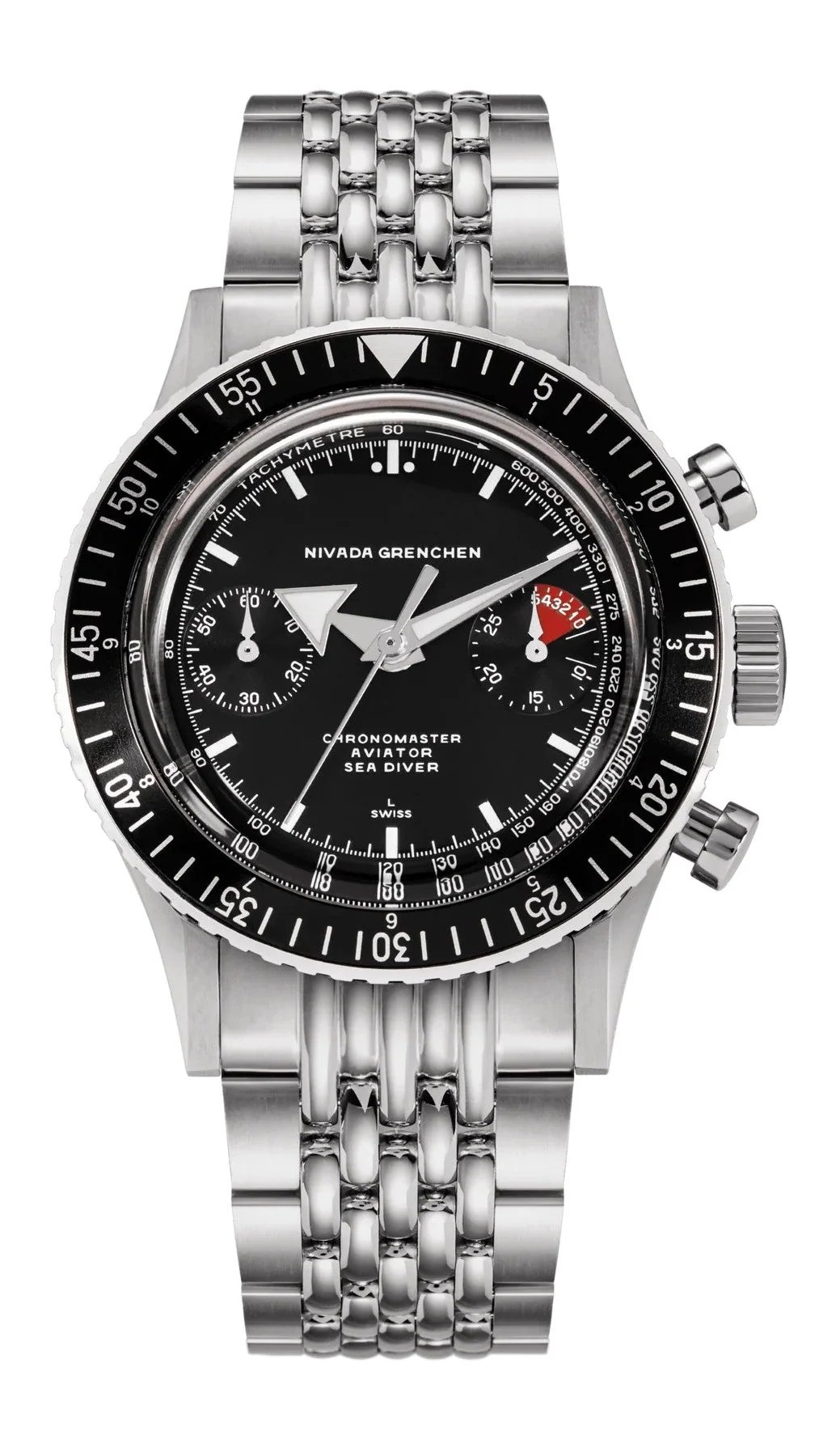
The first thing that hits you about this reference is the handset. The 'Broad Arrow' is one of the most evocative shapes in watchmaking, famously associated with the early Omega Speedmasters and Seamasters. On the Nivada, it serves a dual purpose: instant legibility and a heavy dose of mid-century grit. The lume-filled arrow points aggressively to the sub-dials, ensuring that even in low-light conditions, you aren't guessing the time.
Then there is the 'Inter Bezel.' The term is shorthand for 'International,' and it refers to the dual-scale bezel insert. Unlike a standard diver’s bezel that only tracks elapsed time (0-60), the Inter Bezel includes a secondary 1-12 scale. This allows the wearer to track a second time zone by simply aligning the bezel with the hour hand. It’s a low-tech, high-reliability solution for GMT functionality that doesn't require an extra hand or a complicated movement. When you combine this with the internal tachymeter scale on the dial, you begin to see why Nivada marketed this as 'ten watches in one.'
The Case for 38.3mm
We are currently living through a Great Contraction in watch design. The 44mm behemoths of the early 2010s are being traded in for more classic proportions, and the Chronomaster’s 38.3mm case is the 'just right' bowl of porridge. It has a presence that belies its dimensions, thanks to the relatively thick boxed sapphire crystal and the chunky, knurled bezel.
The lug-to-lug distance of 46.5mm is the unsung hero of this watch’s ergonomics. It allows the watch to sit squarely on the wrist, providing a stable platform for the chronograph pushers. Speaking of pushers, they are the classic 'pump' style, offering a tactile, mechanical click that electronic chronographs simply cannot replicate. The case finishing is a mix of brushed and polished surfaces that feels utilitarian yet refined—exactly what you want from a watch that claims to be a diver, a pilot, and a dress watch all at once.
Mechanical Soul: The Manual Wind Advantage
Choosing the manual-wind Sellita SW510 M BH B was a masterstroke. In an age where automatic movements are the default, the act of winding your watch every morning has become a cherished ritual for enthusiasts. It creates a physical connection between the wearer and the machine. Beyond the romance, there are practical benefits: the absence of a rotor makes the watch thinner and more balanced on the wrist.
The SW510 is a proven workhorse. It’s based on the architecture of the Valjoux 7750 but stripped of its automatic winding bridge and modified for a bicompax layout. This means you get the reliability and serviceability of a modern movement with the layout and feel of a vintage Valjoux 23 or 92. With a 63-hour power reserve, you can leave it off for a weekend, but given how it wears, you likely won't want to.
Cultural Context and the Vivir Verdict
Why does this watch matter in the current landscape? Because it represents the democratization of taste. A decade ago, if you wanted this aesthetic, you had to hunt for a vintage original, navigate the minefield of 'franken-watches,' and pray the movement didn't disintegrate. Nivada has removed the barrier to entry.
The Broad Arrow Inter Bezel isn't trying to be a status symbol. It isn't a watch you wear to signal your bank balance; it’s a watch you wear to signal your appreciation for design history and functional engineering. It’s at home at a vintage car rally, a dimly lit jazz club, or a morning surf session (thanks to that 100m water resistance).
In the final analysis, the Nivada Grenchen Chronomaster Broad Arrow Inter Bezel is a reminder that the best designs are often the ones that refuse to be pigeonholed. It is a tool watch in the truest sense—designed for a life lived across borders and time zones. For under $2,000, you are getting a piece of horological history that is ready for another sixty years of service. If you're a sophisticated collector looking for a daily driver with a story to tell, your search ends here.