The Renaissance of the 'Fun' Watch
For decades, the luxury watch industry was obsessed with the 'professional'—the diver who goes to 300 meters, the pilot who needs three time zones, the engineer who requires anti-magnetic shielding. But recently, a shift has occurred. Collectors are looking for watches that celebrate the joy of wearing something beautiful and perhaps a bit cheeky. The Nivada Grenchen Colorama, specifically the modern reinterpretations of the 'VII' series, sits at the epicenter of this movement. It is a watch that doesn't care about your depth rating; it cares about how you feel when you check the time at a gallery opening or a Sunday brunch.
A Dimension for the Modern Wrist
The most striking aspect of the Colorama is its size. At 36mm in diameter and a mere 39.5mm lug-to-lug, it is a direct rebuke to the 'oversized' era of the early 2000s. In my week of testing, the comfort provided by these dimensions was unparalleled. Most modern watches, even those marketed as 'mid-size,' often have lug-to-lug measurements that creep toward 45mm or 46mm, creating a footprint that can feel cumbersome during active daily use. The Colorama, however, occupies a space on the wrist that feels historically correct and ergonomically superior.
The thickness—or lack thereof—is the secret weapon of this reference. At 7.15mm, including the sapphire crystal, it is one of the thinnest watches in Nivada’s current catalog. This thinness is achieved through the use of the Ronda 762 quartz movement. While some purists may scoff at the lack of a balance wheel, the practical benefits for a daily wearer are undeniable. You can wear this watch with the tightest of bespoke shirt cuffs without a hint of snagging. It doesn't just sit on the wrist; it integrates with it.
The Seconde/Seconde/ Influence
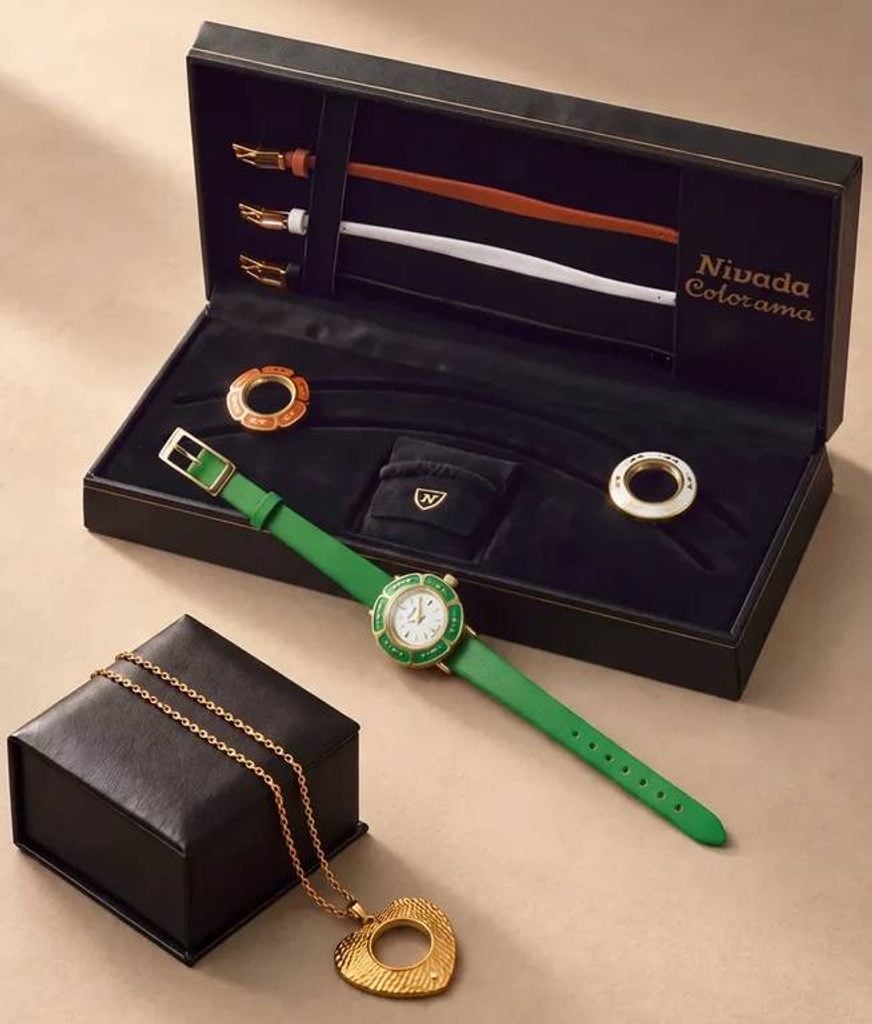
The particular version I spent time with is the collaboration with Seconde/Seconde/, an artist known for 'vandalizing' vintage designs with modern, ironic twists. In the Colorama, this takes the form of a vibrant, chaotic dial that plays with the original's color-wheel heritage. The original Colorama from the 1960s was often sold as a set with interchangeable bezels and straps, allowing the wearer to match their watch to their outfit. The modern version takes that 'color-matching' DNA and bakes it into a single, high-energy dial.
Legibility is surprisingly good despite the lack of traditional indices. The contrast between the hands and the multi-colored background is sharp enough for a quick glance, though the absence of Super-LumiNova means this is strictly a daytime or well-lit evening companion. On the wrist, the dial acts as a piece of kinetic art. It catches the light in ways that a standard matte or sunray dial simply cannot, shifting in personality as you move from the harsh fluorescent lights of an office to the golden hour of an outdoor terrace.
Movement and Practicality
Let’s talk about the Ronda 762. In the world of high horology, quartz is often treated as a dirty word. But at Vivir, we value the 'wear.' A daily watch should be reliable. There is a specific luxury in being able to pick up a watch after it has sat on your dresser for three days and know, with absolute certainty, that it is accurate to the second. The Ronda 762 is a Swiss-made, gold-plated movement with four jewels. It is not a disposable plastic engine; it is a serviceable, high-quality quartz caliber designed to last for decades.
For the young collector who may have a rotating collection of mechanical pieces, having a 'grab-and-go' option like the Colorama is essential. It fills the gap when you're running late for a meeting and don't have the two minutes required to wind, set, and sync a mechanical movement. Furthermore, the lack of a date complication—something I personally applaud—means the dial remains symmetrical and the setting process remains instantaneous.
The Week on the Wrist: Real World Performance
Monday through Wednesday, I wore the Colorama in a professional setting. It paired effortlessly with a charcoal blazer and a knit tie. Because of its 36mm size, it didn't scream for attention, but those who noticed it were immediately curious. It’s a 'conversation starter' in the truest sense. By Thursday, I took it into more casual territory—a denim jacket and a white tee. Here, the watch felt even more at home. The pops of color on the dial felt intentional and curated.
The strap quality deserves a mention. Nivada provides a supple leather strap that requires zero break-in period. The lug width is standard, allowing for easy experimentation with NATO straps or perlon, though I found the stock leather to be the most cohesive look for the case's polished finish. The 50m water resistance is adequate for daily life—it will survive a rainstorm or a splash at the sink—but this is not a watch for the pool. And that's okay. Not every watch needs to be a submarine.
Investment and Value Proposition
At a retail price of under $600, the Colorama is positioned in a competitive but accessible bracket. You aren't buying this watch for its resale value at Phillips; you're buying it for its design pedigree and the sheer joy of ownership. In the pre-owned market, these tend to hold their value well because of the limited nature of the collaborations and the growing cult following of the Nivada brand.
When compared to something like a Tissot PRX or a Seiko 5, the Nivada offers a more 'boutique' feel. You are less likely to see another one across the table at a restaurant. For the sophisticated collector, that exclusivity—combined with the genuine 1960s heritage—makes the price tag feel like a bargain.
Final Thoughts
The Nivada Grenchen Colorama is a reminder that watches are supposed to be fun. It masters the 'wear' by focusing on the fundamentals: a case that fits, a movement that works, and a design that delights. If you can move past the 'quartz vs. mechanical' debate, you will find a watch that is more than the sum of its parts. It is a vibrant, comfortable, and historically grounded piece of horology that earns its place on the wrist every single day.