The Nodus Deep Pioneer enters a microbrand dive market that is brutally competitive. On paper, many watches at this price promise sapphire, steel, strong lume, and a Japanese automatic. The differentiator is not the spec sheet. It is the case execution, the bracelet, the bezel action, and whether the watch still feels coherent after a month on the wrist. Nodus has built its reputation on those less glamorous details, and the Deep Pioneer is a clear attempt to translate that formula into a dive watch for collectors who actually wear their tools.
For a serious buyer, the Deep Pioneer should be evaluated against two benchmarks. The first is the sub-$1,000 microbrand field, where Christopher Ward, Monta, and a long list of direct-to-consumer brands compete. The second is the Japanese dive establishment, especially Seiko Prospex. The Nodus does not beat those watches on brand equity or resale, and it does not pretend to. Its case is built on wearability, honest materials, and a movement that any competent watchmaker can service. That is a legitimate value proposition, provided the price is right and the buyer is not treating a microbrand dive watch as an appreciating asset.
Brand context and positioning
Nodus was founded in Los Angeles in 2017 by Wesley Kwok and Cullen Chen. The brand came to prominence in the enthusiast space by offering tool watches with thoughtful cases, solid bracelets, and accessible Japanese movements. It has not tried to position itself as a heritage maison or a faux-Swiss luxury house. That matters for the Deep Pioneer because the watch is judged on execution rather than mythology.
The Deep Pioneer slots into the brand's dive lineup alongside models such as the Avalon II and Sector Dive. The Avalon II is the more established dive platform, while the Sector Dive serves as the entry point. The Deep Pioneer is the model that asks buyers to pay a little more for a more focused dive watch with 300m water resistance, sapphire, and a Miyota 9015. In the Nodus hierarchy, it is a step up in movement and specification without crossing into the territory of Monta or Tudor.
Movement and specifications
The Deep Pioneer runs on the Miyota 9015, a thin Japanese automatic with a date function. The movement has a 42-hour power reserve, beats at 28,800 vph, and uses 24 jewels. It is not an in-house caliber, and it is not COSC-certified. That is not a criticism at this price. The Miyota 9015 is a known quantity: it is reliable, parts are available, and most watchmakers can service it without drama. Nodus regulates the movement, but buyers should expect normal mechanical variation rather than chronometer-grade rate stability.
The movement architecture is industrial rather than decorative. There is no haute horlogerie finishing to admire through a display back, and that is the correct decision for a tool watch. The Deep Pioneer is meant to be worn, not photographed under a macro lens. The 42-hour reserve is adequate for daily wear, though it means the watch will stop if left in a drawer over a long weekend. For collectors who rotate watches, a winder or a quick reset routine is part of ownership.
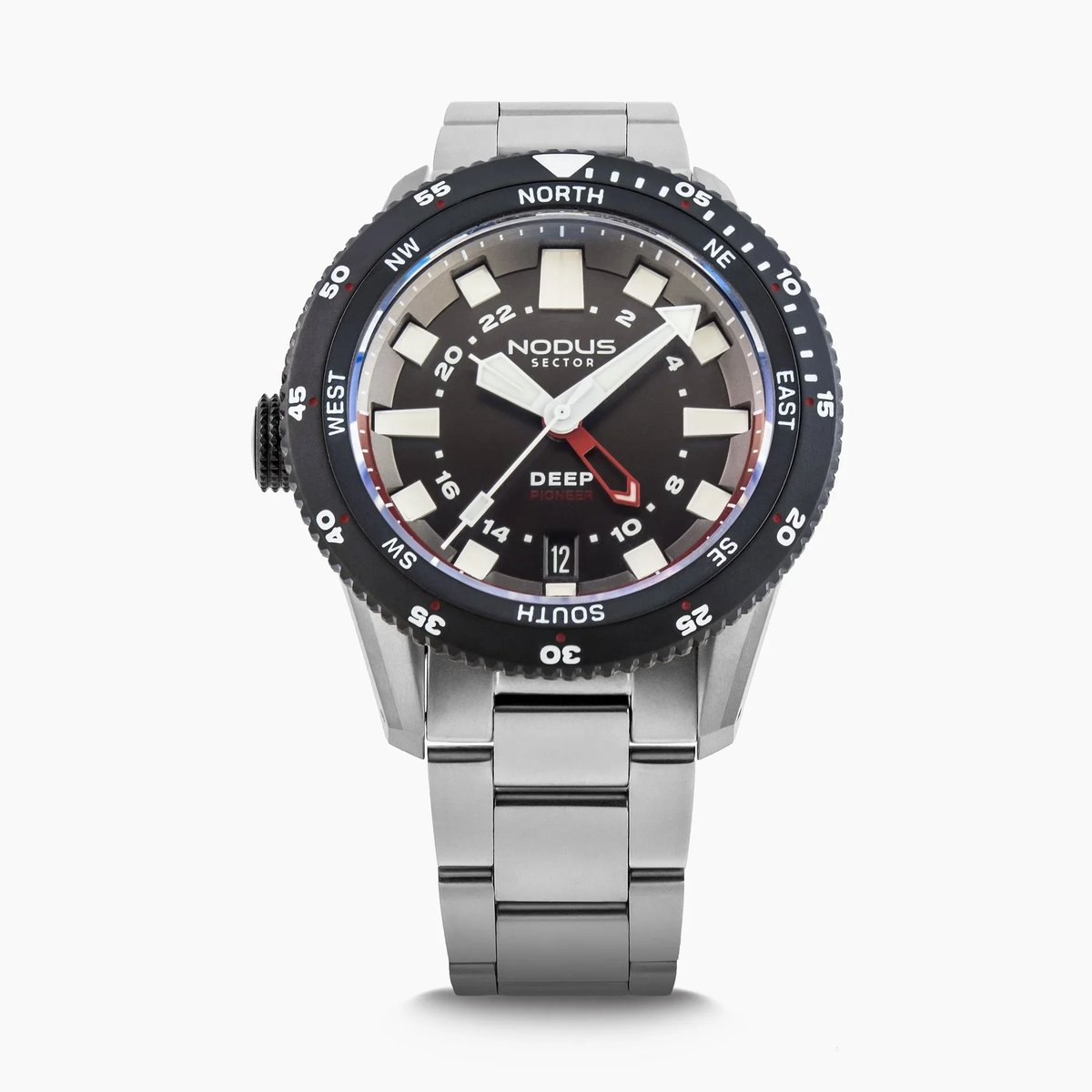
The specification sheet is strong for the segment: stainless steel case, sapphire crystal, 300m water resistance, Super-LumiNova BGW9, and a stainless steel bracelet with a folding clasp. Those are the right boxes to tick. The important question is not whether the watch has sapphire, but whether the sapphire is properly seated and the case finishing is clean. Nodus generally executes those details well, and the Deep Pioneer benefits from the brand's experience with tool-watch cases.
On the wrist
The Deep Pioneer is designed to wear like a modern dive watch rather than a vintage reissue. It sits close to the wrist, the lugs curve down naturally, and the bracelet articulates well. That combination matters more than a spec sheet because it determines whether the watch becomes a daily companion or a safe queen. The case does not feel slab-like, and the bezel does not sit so high that it catches on cuffs.
The bracelet is one of the watch's strongest arguments. Microbrand bracelets often feel like an afterthought, with stiff links and clasps that rattle. The Deep Pioneer's bracelet feels more substantial, and the folding clasp gives it a secure, finished feel. The clasp is not a piece of micro-engineering on the level of a high-end dive watch, but it is appropriate for the price and contributes to the watch's overall sense of quality.
The bezel action is another important touchpoint. A dive watch lives or dies by its bezel, and the Deep Pioneer's bezel feels deliberate without being overly stiff. The crown is easy to grip and does not dig into the wrist. These are small details, but they separate a watch that is designed by enthusiasts from one that is merely assembled to a price. On smaller wrists, the Deep Pioneer feels manageable and tidy. On larger wrists, it may read as slightly compact, which is a matter of preference rather than a flaw.
Accuracy and daily ownership
With the Miyota 9015, real-world accuracy is typically in the range of -10 to +15 seconds per day. Nodus regulates the movement, but this is not a chronometer-certified watch. Positional variation and wear habits will affect the rate. A watch that runs fast on the wrist may settle down when rested crown-up, and vice versa. Collectors who demand tighter accuracy should budget for a regulation service, but most daily wearers will find the rate acceptable.
The 42-hour power reserve is enough for daily wear but not for a large collection that sits idle. If you rotate several watches, expect to reset the Deep Pioneer when you return to it. The date function adds convenience, though it also introduces the usual caution around setting the date near midnight. The movement does not have a quickset date in the most convenient sense, so owners should consult the manual and use the crown correctly.
Water resistance is rated to 300m, which is more than most owners will ever need. That rating is not just a number on a dial; it reflects the case construction, gaskets, and crown design. The Deep Pioneer is a genuine dive watch in the tool sense, even if most examples will spend their lives near a desk or a swimming pool. That is true of almost every dive watch in this price range, and it is not a criticism.
Dial, bezel, and lume
The Deep Pioneer's dial is clean and legible, which is exactly what a dive watch should be. The date window is present and useful, though collectors who prefer symmetry may debate its placement. The hands are easy to read at a glance, and the bezel markings are clear. The overall design avoids the busy, over-styled look that afflicts some microbrand dive watches. It reads as a tool first and a fashion object second.
The Super-LumiNova BGW9 lume is a strong choice for low-light visibility. It glows blue and charges quickly under daylight or a phone flashlight. The bezel pip and hands are the critical points, and they are easy to locate in the dark. The lume is not a novelty; it is a functional part of the watch. That matters for a dive watch, even if the deepest water it sees is a hotel pool.
The sapphire crystal is another practical specification. It resists scratches and keeps the dial clear over years of wear. The crystal does not have the warm domed look of acrylic, but the Deep Pioneer is not trying to be a vintage homage. It is a modern tool watch, and sapphire is the right call. The case finishing is brushed and polished in the right places, giving the watch a purposeful look without excessive flash.
Variants and family position
The Deep Pioneer is best understood as a single focused model rather than a sprawling collection. The standard production version pairs a black dial with a stainless steel bracelet. That is the configuration most buyers will encounter, and it is the one that makes the strongest case for daily wear. Dial variations may exist across releases, but collectors should verify the exact configuration with the seller or retailer rather than assume a catalog lineup.
Within the Nodus family, the Deep Pioneer sits above the Sector Dive and alongside the Avalon II. The Sector Dive is the entry point for buyers who want the Nodus aesthetic at a lower price. The Avalon II is the more established dive platform with its own following. The Deep Pioneer offers a different balance of specifications and wearability. It is not a replacement for either model; it is an alternative for buyers who want a Miyota automatic and 300m water resistance in a package that feels at home on the wrist.
Collectors who are already invested in the Nodus ecosystem will recognize the brand's design language. The case shapes, bracelet integration, and dial typography are consistent with the broader lineup. That consistency is valuable because it means the Deep Pioneer does not feel like an orphan model. It is part of a coherent tool-watch family, and that helps with long-term ownership even if it does not help with resale.
Alternatives and homages
The most obvious alternative is the Seiko Prospex SPB143. It offers a vintage-inspired dive watch look, Japanese automatic reliability, and stronger brand recognition. The Seiko will generally hold value better and is easier to sell, but the Nodus competes on bracelet feel and case execution. Buyers who value those details may prefer the Deep Pioneer; buyers who value liquidity should choose the Seiko.
The Christopher Ward C60 Trident Pro 300 is another direct competitor. It offers a similar specification package, a strong bracelet, and a more established direct-to-consumer brand. The Monta Oceanking is a step up in finishing and bracelet execution, but it also costs more. The Tudor Black Bay 58 is the benchmark for collectors who want a mid-size dive watch with real resale strength. The Deep Pioneer does not compete with the Tudor on brand, but it offers a different value proposition: more watch for the money, less brand premium, and a movement that is easy to service.
For buyers who want the dive-watch look at a lower price, homages such as the San Martin SN008-G and Orient Kamasu are worth considering. The San Martin offers a similar vintage dive aesthetic with a Seiko-compatible automatic, though the finishing is a step below the Nodus. The Orient Kamasu is a budget Japanese dive watch with an in-house automatic and solid water resistance. The Casio Duro is the disposable beater option. None of these watches replace the Deep Pioneer, but they illustrate how much of the dive-watch experience can be had for less money. The Nodus justifies its price through better case execution, bracelet quality, and brand support.
Investment case: hold or sell?
The Deep Pioneer is not an investment-grade watch. Its MSRP is around $750, and the pre-owned range is roughly $500-$650. That means the first owner should expect depreciation, not appreciation. Microbrand dive watches generally do not develop auction momentum, and the Deep Pioneer has no major auction history. Collectors who buy it should do so because they want to wear it, not because they expect to flip it for a profit.
The hold-versus-sell decision depends on the buyer. If you already own the watch and enjoy it, there is no urgent reason to sell unless you need the liquidity. The Deep Pioneer is a competent daily wearer, and its Miyota movement is easy to service. If you are considering buying, the secondary market is the smarter entry point. At retail, you are paying for the brand's support and the assurance of a new watch. At pre-owned prices, the value proposition improves significantly.
Demand for microbrand dive watches is cyclical. Nodus has a loyal following, but the brand does not have the resale depth of Seiko or Tudor. That means a private sale may take time, and a dealer will offer less than private-party value. Collectors should factor that into their ownership cost. The Deep Pioneer is a watch to hold and wear, not a watch to trade around.
Service and long-term ownership
Service for the Miyota 9015 is straightforward. Nodus can service the watch, and many independent watchmakers are familiar with the movement. Parts are widely available, which is a major advantage over obscure in-house calibers. Owners should plan on servicing the watch when timekeeping becomes inconsistent or when the power reserve drops noticeably. A watchmaker can advise on the exact interval based on wear and amplitude.
The bracelet and case will also need attention over time. Bracelet screws can loosen, clasps can wear, and gaskets should be checked during service. The Deep Pioneer is a tool watch, so it should be maintained like one. That means avoiding harsh chemicals, rinsing it after saltwater exposure, and having the water resistance tested if the case has been opened. These are basic ownership habits, but they matter for long-term satisfaction.
Final verdict
The Nodus Deep Pioneer is a strong microbrand dive watch for collectors who value wearability, bracelet quality, and honest specifications. It is not a status symbol, and it is not an investment. It is a well-executed tool watch with a proven Japanese automatic, 300m water resistance, and a design that works in daily life. Buyers should compare it carefully against the Seiko Prospex SPB143 and Christopher Ward C60 Trident Pro 300, because those watches offer different trade-offs in brand equity, resale, and finishing.
At retail, the Deep Pioneer is a fair buy for someone who wants Nodus support and a new watch. On the secondary market, it becomes a better value. The right buyer is a collector who wants a dependable dive watch to wear hard, not a speculator looking for the next microbrand flip. Judged on that basis, the Deep Pioneer makes sense. It is a watch for the wrist, not the safe.