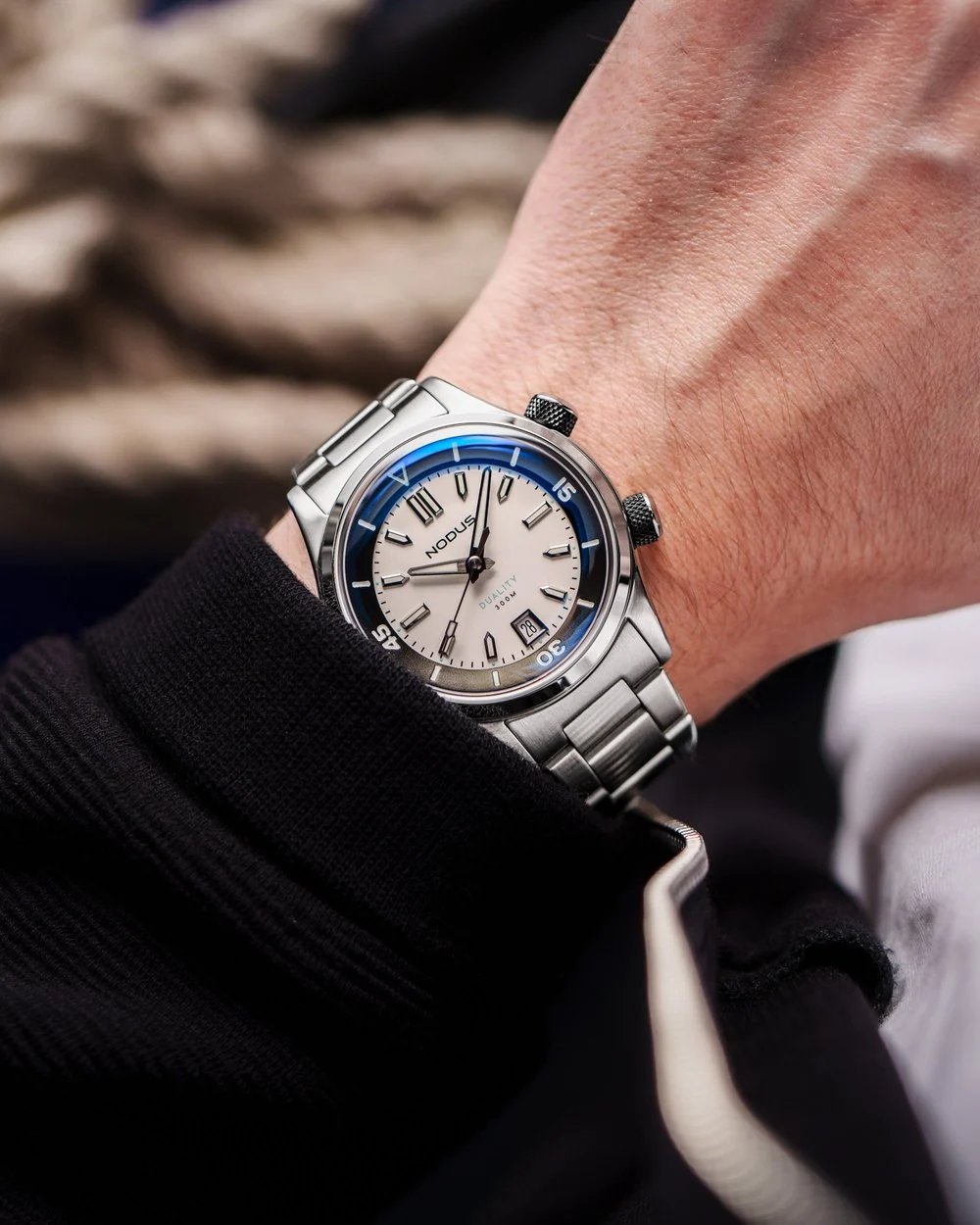
Market Context
The Nodus Duality II arrives at a moment when vintage-inspired compressor divers are enjoying a quiet resurgence. Collectors who want the look of a 1960s EPSA-cased diver without the fragility or six-figure auction price have driven demand toward microbrands like Nodus, Baltic, and Lorier. The Duality II capitalizes on that demand with a dual-crown layout, an internal rotating bezel, and a price that leaves room for a second strap or a service fund.
From a resale standpoint, Nodus occupies a sweet spot. The brand produces in small batches, often selling out pre-orders, and the secondary market reflects that scarcity. Unlike mass-market Seiko divers that depreciate immediately, a well-kept Duality II can often be resold for 70–90% of its original retail price. That is not appreciation, but it is stability—a valuable trait in a segment where most watches lose 30% the moment you size the bracelet.
This review will break down the movement, case, wrist feel, accuracy, and investment logic. The goal is to answer one question: should a serious collector buy, hold, or sell the Duality II?
Brand History
Nodus was founded in Los Angeles in 2017 by Wesley Kwok and Cullen Chen. The brand's mission was to offer regulated mechanical watches with honest materials at accessible prices. The first Duality, launched in 2019, introduced the compressor-style case that has become a Nodus signature. The Duality II refines that formula with a slimmer profile, upgraded bracelet, and the no-date Miyota 9039 movement regulated in-house.
Nodus is not a manufacturer; it sources cases, movements, and bracelets from Asian and Swiss suppliers, then assembles and regulates in California. That model keeps costs down while allowing quality control that rivals watches twice the price. The Duality II is a product of that philosophy: a watch designed for enthusiasts who care about specs and wearability, not brand heritage.
Movement
Powering the Duality II is the Miyota 9039, a no-date automatic movement with 24 jewels, a 42-hour power reserve, and a 28,800 vph beat rate. The 9039 is essentially a date-less version of the popular 9015, and it offers hacking seconds and hand-winding. Nodus regulates each movement in four positions, which is uncommon at this price and explains the tight accuracy owners report.
The movement is not in-house, but it is a smart choice. Miyota's 9000 series is thin, reliable, and easy to service. Parts are widely available, and any competent watchmaker can handle a service without sending the watch back to Nodus. That is a significant advantage over some Swiss microbrands that tie you to authorized service centers.
Case and Specs
The Duality II case measures 40mm in diameter, 12.5mm thick, and 47mm lug-to-lug, with a 20mm lug width. It is machined from 316L stainless steel with brushed surfaces and polished chamfers. The dual crowns at 2 and 4 o'clock are screw-down, and the 2 o'clock crown operates the internal rotating bezel with 120 clicks. Water resistance is 200 meters, which is more than enough for swimming and recreational diving.
The crystal is a double-domed sapphire with anti-reflective coating, and the caseback is solid steel with a laser-etched design. Lume is blue-emitting Super-LumiNova on the hands and applied indices. The bracelet is a beads-of-rice style with female end links and a machined deployant clasp with three micro-adjust positions.
Wrist Feel
On the wrist, the Duality II wears smaller than the numbers suggest. The 47mm lug-to-lug keeps the case compact, and the 12.5mm thickness slides under a shirt cuff without catching. The beads-of-rice bracelet is comfortable, with no sharp edges and a clasp that sits flat. The watch is not heavy, but it has enough presence to feel substantial.
The dual crowns are well-placed and easy to operate. The 2 o'clock crown has a textured grip and turns the internal bezel with a firm, precise action. The 4 o'clock crown sets the time and winds the movement. Neither crown digs into the wrist, even during desk work. This is a watch you can wear daily without fatigue.
Accuracy
Nodus regulates the Miyota 9039 in four positions, and the results speak for themselves. Owners report real-world accuracy between +3 and +8 seconds per day, with some examples settling to +2 after a few weeks. Day-to-day variance is typically under 5 seconds, which is excellent for a $650 watch. The 28,800 vph beat rate gives a smooth sweep, and the hacking seconds make setting the time to the second easy.
Occasions and Wrist Presence
The Duality II is a versatile watch. On the steel bracelet, it works as a daily wearer and a travel companion. On a leather strap, it can pass for a dress watch in casual settings. The blue and white dial variants lean slightly more formal, while the black is the most tool-oriented. The internal bezel adds a functional dive element without the bulk of an external bezel.
Wrist presence is strong but not shouty. The 40mm case and domed crystal catch light nicely, and the applied indices give depth. It is not a watch that demands attention, but it rewards a second glance. I would rate wrist presence at 4 out of 5—confident without being flashy.
Reference Variants
The Duality II is offered in three dial colors: black, blue, and white. All share the same case, movement, and bracelet. The black dial is matte with blue-emitting lume and offers the highest contrast. The blue dial has a sunburst finish that shifts from navy to bright blue in sunlight. The white dial is crisp and clean, wearing slightly dressier than the others. All three are limited production, and some colors sell out faster than others.
Investment Analysis
The Duality II retails for $650 on the bracelet. Pre-owned examples typically trade between $450 and $600, depending on condition and dial color. That is a remarkably tight spread for a microbrand, and it reflects both limited supply and a loyal enthusiast base. Nodus does not flood the market, and discontinued colors can command a small premium on forums and eBay.
The trend is stable rather than appreciating. You will not double your money, but you are unlikely to lose 50% either. For a collector, the Duality II is a hold—a watch you buy to wear, not to flip. If you can find one pre-owned in excellent condition for under $500, that is the smart entry point.
There is no major auction history for the Duality II, which is expected for a microbrand. Secondary sales happen on enthusiast forums, Reddit, and eBay, where transparency is high and prices are consistent.
Service and Maintenance
The Miyota 9039 is a workhorse movement with widely available parts. Service intervals depend on usage, but any competent watchmaker can service it without needing Nodus authorization. Costs are modest compared to Swiss movements, and the movement can often be replaced entirely for less than a full service on an ETA. This is a practical advantage for long-term ownership.
Pros and Cons
The Duality II's strengths are its regulated movement, 200m water resistance, comfortable bracelet, and strong value. Its weaknesses are the lack of an in-house movement, limited brand recognition, and a clasp that could be more refined. None of these are dealbreakers, but they matter if you are comparing against a Swiss watch at twice the price.
Final Verdict
The Nodus Duality II is a textbook example of a microbrand done right. It delivers a regulated Miyota 9039, a comfortable compressor-style case, and a distinct dual-crown design at a price that makes Swiss rivals look overpriced. It will not appreciate like a Rolex, but it holds value better than most microbrands thanks to limited supply and a loyal following. For a collector who wants a daily wearer with character and resale sense, the Duality II is a hold, not a flip.