Brand history: Norqain’s quick rise
Norqain was founded in 2018 by Ben Küffer in Biel/Bienne, Switzerland, as a family-owned brand aimed at younger collectors who want serious specs without the inherited baggage of older maisons. That sounds like marketing, but Norqain has been unusually consistent about it. The brand has built its identity around robust sports watches, partnerships in skiing and hockey, and its proprietary NORTEQ carbon fiber composite material. It has also been smart about movement sourcing, using proven Swiss architectures rather than pretending every caliber is born in a dedicated manufacture.
The Wild One Skeleton Spengler Cup sits at the intersection of those interests. It is lightweight, openworked, and tied to a very specific alpine-sport event. Norqain is not trying to be a heritage brand with a century of archives. It is trying to be the watch you take skiing, to the rink, and to dinner afterward without changing straps. That positioning makes the Spengler Cup edition feel less like a random logo exercise and more like a natural extension of the brand’s young collector language.
The Spengler Cup connection
The Spengler Cup is one of those events that carries more weight in hockey culture than its TV footprint might suggest. It is old, it is Swiss, and it is played in Davos at altitude with a crowd that actually cares. Norqain’s partnership with the tournament gives the brand a story that is local, sporty, and specific. The Wild One Skeleton Spengler Cup is limited to 100 pieces, which is small enough to matter to collectors but not so small that it disappears into a vault.
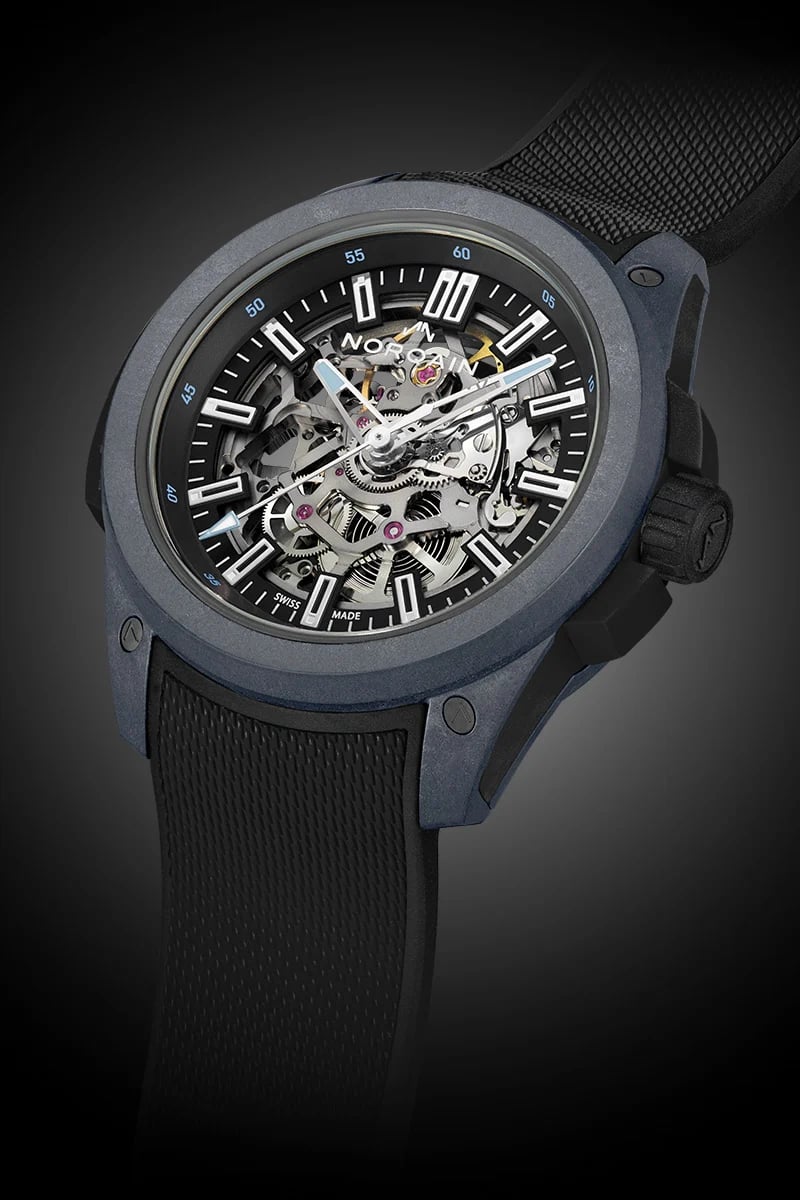
The design does not scream hockey in a cartoonish way. There is no puck-shaped rotor or skate-blade handset. Instead, the Spengler Cup identity is woven into the package through color and branding. The skeletonized dial carries red accents, the rubber strap picks up the theme, and the tournament connection is clear to anyone who knows the event. That restraint is a good thing. A watch that only makes sense during a hockey tournament would be a hard sell. This one still works as a lightweight skeleton sports watch on a random Tuesday.
Case and design
The case is the headline. Norqain uses NORTEQ, its carbon fiber composite, to create a 42mm sports watch that feels almost airy on the wrist. The case is 12.3mm thick, which is substantial enough to give the skeletonized movement room to breathe but not so tall that it dominates the wrist. Water resistance is rated to 200m, which is genuinely useful for a watch with a rubber strap and sporty ambitions. The crystal is sapphire, as it should be at this price, and the rubber strap is secured by a pin buckle.
The visual language is modern Norqain: angular, layered, and a little aggressive. The NORTEQ case has a matte, textured look that reads more technical than luxurious, which fits the Spengler Cup brief. The skeletonized dial is the main event. Openworked movements can easily become a mess of bridges and reflections, but the Wild One Skeleton keeps enough structure to feel legible at a glance. The red accents add energy without turning the watch into a toy. The Spengler Cup branding is present, but it does not overwhelm the dial.
Legibility is the trade-off you accept with any skeleton watch. In bright light, the hands stand out well enough against the openworked backdrop. In low light, the Super-LumiNova helps, but this is not a watch you buy for night-time instrument clarity. It is a watch you buy for the way the movement looks when the light catches the bridges. The 200m water resistance and sapphire crystal mean you do not have to baby it, which is more than can be said for some skeletonized dress watches.
Movement: Calibre N08
The Wild One Skeleton Spengler Cup runs on the Norqain Calibre N08, an automatic skeletonized movement with a 38-hour power reserve, 26 jewels, and a frequency of 28,800 vph. It is not COSC-certified, and it is not an in-house movement. Norqain is upfront about using a proven Swiss base, which is fine at this price point. The N08 is based on a Sellita architecture, modified and openworked for Norqain, and the result is a movement that looks more dramatic than its spec sheet suggests.
The 38-hour reserve is the weakest number here. Modern buyers have been trained to expect 70 hours or more, especially from sports watches. But the Wild One Skeleton is not a travel watch or a desk-diver rotation piece. It is a daily wearer, and a daily wearer keeps its movement wound. The 4 Hz beat is standard and reliable, and the skeletonization gives the dial the depth that makes this watch worth looking at. The finishing is industrial-modern rather than haute horlogerie, which matches the carbon case and the Spengler Cup attitude.
On the wrist
The first thing you notice is the weight, or rather the lack of it. NORTEQ gives the Wild One Skeleton a distinctly hollow, feathery feel on the wrist, and the 42mm case reads large without ever feeling like a slab. The rubber strap is pliable and sporty, the pin buckle keeps the package casual, and the case sits comfortably for a watch with this much visual business going on. It is the kind of watch you forget you are wearing until someone asks about the dial.
The openworked movement and red accents give it plenty of wrist presence, but the carbon case keeps that presence from becoming a burden. It wears best on medium-to-large wrists, though the lightweight construction makes it more approachable than a 42mm steel sports watch might suggest. The strap integrates cleanly with the case, and the whole thing feels purpose-built for movement. If you are used to steel sports watches, the Wild One Skeleton will feel like a release valve. If you are used to ultralight titanium, it will feel familiar.
Accuracy and daily use
The N08 is not COSC-certified, so do not expect chronometer paperwork. In real-world use, a healthy example should run within roughly ±10 to ±15 seconds per day, with some examples settling closer after regulation. That is entirely acceptable for a skeletonized sports watch at this price point. The 38-hour power reserve is modest by modern standards, so it rewards a daily-wear routine rather than a rotation that leaves it sitting for days.
Daily use is where the Wild One Skeleton makes the most sense. The 200m water resistance means you can swim, shower, and get caught in weather without worry. The rubber strap is easy to clean and does not mind sweat. The sapphire crystal is scratch-resistant. The carbon case is light but not fragile in normal use. This is not a watch you need to treat like a precious object. That is a big part of its appeal.
Family and variants
The Wild One Skeleton Spengler Cup is part of a broader Wild One family. The standard Wild One Skeleton offers the same NORTEQ case and N08 movement without the tournament-specific branding, and it comes in a few accent colors. The regular Wild One 42mm is the non-skeleton sibling, with a more conventional dial and the same lightweight sports philosophy. The Spengler Cup edition is the most specific of the bunch, limited to 100 pieces and aimed at collectors who want the hockey story.
Within Norqain’s wider lineup, the Independence Skeleton is the more formal openworked option, while the Freedom 60 Chrono and Adventure Sport cover vintage-inspired and outdoor-oriented buyers. The Wild One is the brand’s most modern sports platform, and the Spengler Cup edition is its most event-driven expression. If you like the Wild One case but want something less loud, the standard Wild One 42mm is the obvious alternative. If you want maximum visual drama, the skeleton is the way to go.
How it compares
Against the Zenith Defy Skyline Skeleton, the Norqain is less refined but more playful. The Zenith has a more architectural movement and a stronger luxury finish, but it also costs more and takes itself more seriously. The Bell & Ross BR-X5 Carbon Orange is a closer spiritual competitor: carbon case, skeletonized movement, motorsport energy. The Bell & Ross feels more instrument-like, while the Norqain feels more fashion-forward and event-specific. The Hublot Big Bang Unico Titanium is a different price bracket entirely, but it shares the Wild One’s appetite for visual impact.
For buyers who want the skeletonized sports look at a lower price, the homage market is active. The Swatch Irony Big Skeleton gives you an open dial for around $200, though it is a completely different object in terms of materials and movement. The Seiko 5 Sports Skeleton Style is a more serious automatic alternative at around $350, and the Orient Star Skeleton offers a traditional skeletonized automatic around $600. None of them have the NORTEQ case or the Spengler Cup story, but they scratch a similar visual itch.
Investment and ownership
The Wild One Skeleton Spengler Cup is priced around $6,250. That is a lot for a Norqain, but it is not unreasonable for a limited-edition carbon sports watch with a skeletonized automatic and 200m water resistance. The 100-piece run gives it a collector angle, but Norqain’s secondary market is still thin. Pre-owned examples tend to trade below retail, roughly in the $4,800 to $5,800 range, depending on condition and completeness. There is no major auction history to speak of.
That makes this a wearer’s watch, not an investment. If you buy it because you love the Spengler Cup connection and the lightweight case, you will get your money’s worth in wrist time. If you buy it hoping for Richard Mille-style appreciation, you will be disappointed. Service should go through Norqain authorized partners, and the skeletonized movement should be handled by trained watchmakers. Standard automatic maintenance applies, and the watch is not difficult to live with as long as you accept the modest power reserve.
Pros and cons
The pros are clear. The NORTEQ case is genuinely lightweight and comfortable. The skeletonized N08 movement gives the dial depth and drama. The 200m water resistance and rubber strap make it a true daily wearer. The 100-piece Spengler Cup edition has a specific story that separates it from the standard Wild One Skeleton. The cons are equally clear. The 38-hour power reserve is modest, the movement is not COSC-certified, the secondary market is thin, and the skeleton dial is not the most legible in low light.
None of those cons are deal-breakers if you understand what this watch is. It is not trying to be a chronometer-certified everyday office watch. It is trying to be a lightweight, openworked sports watch with a hockey story. On that brief, it delivers. The Spengler Cup edition is the most interesting version of the Wild One Skeleton because it has a reason to exist beyond color. That matters in a market full of limited editions that feel like sticker packages.
Final verdict
The Norqain Wild One Skeleton Spengler Cup is a niche watch done with conviction. It takes the Wild One’s lightweight carbon platform and adds a genuinely specific hockey story, without pretending to be a safe investment or a dress watch. If you want a skeletonized sports watch that feels different from the usual steel suspects and you like the Spengler Cup connection, this is a compelling wearer. If you need chronometer certification, a long power reserve, or proven auction performance, look elsewhere.
For the sophisticated young collector, the appeal is not that this is the most refined skeleton on the market. It is that it has a point of view. Norqain built a watch for a mountain hockey tournament and made it robust enough to wear everywhere else. That is a harder trick than it sounds, and the Wild One Skeleton Spengler Cup pulls it off.