The Genesis of a Chicago Icon
In the world of luxury horology, we often talk about 'soul.' It’s an intangible quality that separates a mass-produced tool from a piece of mechanical art. When I first strapped on the Oak & Oscar Burnham, I didn't just feel the weight of the steel; I felt the intent of its creator. Chase Fancher didn't just want to sell watches; he wanted to build a community. The Burnham was the foundation of that community, limited to just 300 pieces, each one a testament to the idea that Chicago could produce a watch capable of standing toe-to-toe with the Swiss giants.
The Burnham isn't trying to be a Rolex Explorer or a Panerai Luminor, though it shares DNA with both in terms of utility and dial construction. Instead, it occupies a space I like to call 'Urban Field.' It’s rugged enough for a weekend in the Great Lakes but sophisticated enough to sit under a cuff during a board meeting at a tech startup. In this review, we’ll break down why this watch has become a 'grail' for many young collectors and how it handles the rigors of a high-paced, daily-wear lifestyle.
Case Architecture and Wearability
Let’s talk about the numbers first, because in watch reviewing, the numbers often lie. On paper, a 42mm case with a 50mm lug-to-lug might sound daunting to those with average-sized wrists. However, the Burnham is a masterclass in ergonomic deception. The case is 12mm thick, which is the 'sweet spot' for an automatic watch with 100 meters of water resistance. It’s thin enough to slide under a shirt sleeve but thick enough to have a presence.
The real magic is in the lugs. They are short and feature a dramatic downward slope. This allows the strap to wrap around the wrist immediately, rather than jutting out. When I wore this for a week, I noticed that the watch didn't 'wobble' on the wrist. Whether I was running for a train or typing a 2,000-word column, the balance remained centered. The brushed finish on the 316L stainless steel is fine-grained, hiding the inevitable micro-scratches that come with daily life. The crown is oversized and signed with the Oak & Oscar barrel logo, making adjustments a tactile joy even if you have larger fingers.
The Dial: Depth and Legibility
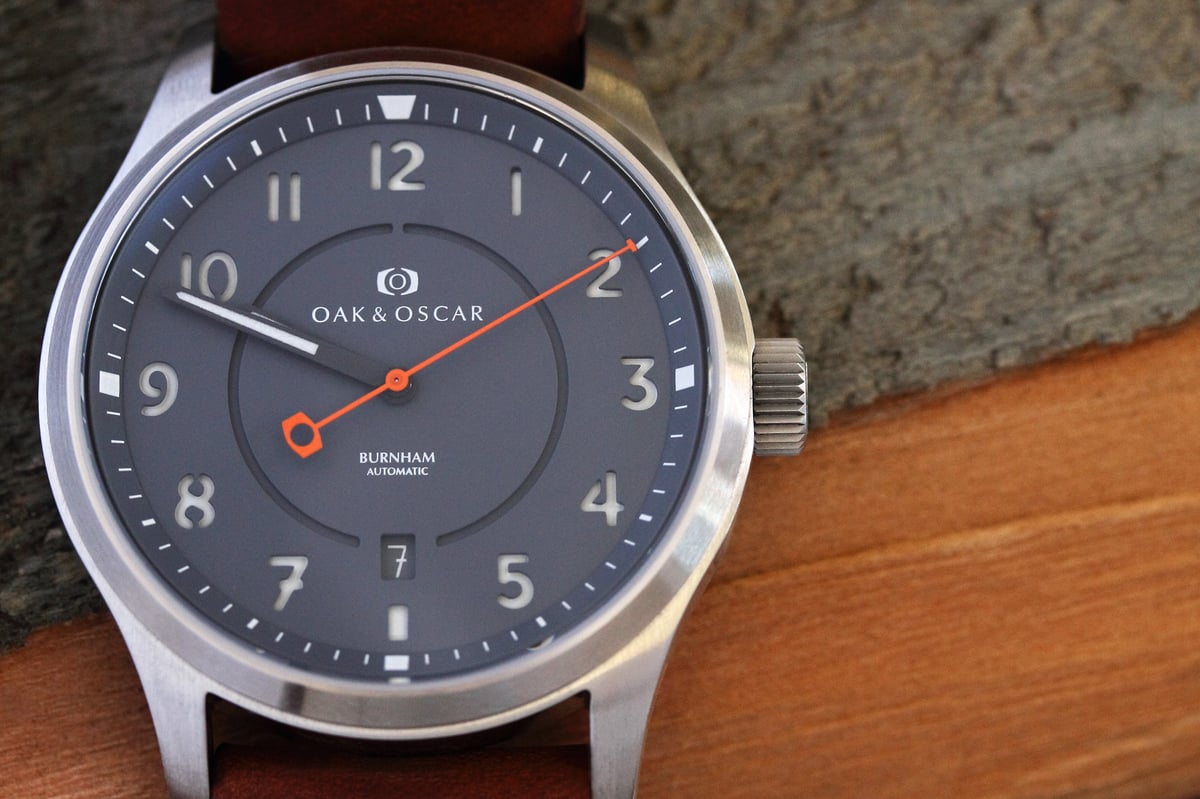
If the case is the body, the dial is the soul. The Burnham features a sandwich dial—a construction where the top plate has cutouts for the hour markers, revealing a luminescent plate underneath. This creates a wonderful sense of depth and three-dimensionality that a printed dial simply cannot match. The color is a sophisticated dark grey, which shifts in the light from a charcoal to a soft slate.
Legibility is paramount for a daily wearer, and the Burnham excels here. The custom-designed font for the numerals is modern and clean, avoiding the 'stenciled' look often found on military watches. The use of orange—Oak & Oscar’s signature color—on the seconds hand and the date wheel adds a playful, high-contrast element. Speaking of the date, the color-matched date wheel at 6 o'clock is a detail that many brands at five times this price point still get wrong. It maintains the symmetry of the dial while remaining perfectly functional.
The Soprod A10-2 Movement
Inside the Burnham beats the Soprod A10-2. At the time of its release, this was a bold choice. Most brands in this price bracket were using the workhorse ETA 2824 or the Sellita SW200. The Soprod A10-2 is often considered a step up, designed to compete with the ETA 2892. It is a slimmer movement, which allowed Oak & Oscar to keep the case profile lean.
In my week of testing, the movement was a silent partner. The winding action is smooth, lacking the 'grittiness' sometimes felt in lower-end calibers. The 42-hour power reserve is standard for this class, meaning if you take it off Friday night, you’ll need to give it a few shakes on Sunday morning. But let’s be honest: the Burnham is a watch you’ll want to wear through the weekend.
The 'Full Kit' Experience
One cannot review an Oak & Oscar without mentioning the packaging. The Burnham didn't come in a wooden box that gathers dust in a closet. It came in a stunning leather watch roll made by Defy Manufacturing in Chicago using Horween leather. This roll is actually useful for travel, holding the watch and extra straps securely. The strap itself is also Horween leather, and it is arguably one of the best OEM leather straps in the industry. It’s thick but supple, developing a beautiful patina within just a few days of wear. The inclusion of a branded strap tool and a nylon NATO strap further emphasizes the brand’s focus on the user experience.
The Verdict: A Week on the Wrist
After seven days of continuous wear, the Burnham feels less like a piece of jewelry and more like a part of my wardrobe. It survived a rainy commute, a formal dinner, and a chaotic weekend of errands. Its legibility in low light is excellent, thanks to the generous application of Super-LumiNova. While the 42mm size might be the upper limit for some, the design choices made by Fancher and his team ensure that it never feels cumbersome.
The Burnham is a rare bird in the watch world: a debut model that got almost everything right on the first try. It’s a watch for the collector who appreciates the nuances of typography, the heritage of Chicago manufacturing, and the practical needs of a modern life. If you can find one on the secondary market, do not hesitate. It is a foundational piece of modern American horology.