Oak & Oscar Wind Vintage: Chicago's Microbrand Goes Straight to the Source
There is a specific kind of credibility that comes from a dealer's eye. Not the marketing department's, not the brand ambassador's — the person who has spent a decade handling other people's watches under a loupe, writing condition reports, and watching what collectors actually reach for when nobody is filming. That is the energy behind the Oak & Oscar Wind Vintage, a collaboration that pairs a Chicago microbrand with one of the most respected names in the vintage trade.
Oak & Oscar has never been a brand that shouts. Founded in 2015 by Chase Fancher and built on direct-to-consumer sales, small production runs, and hand-assembled oversight, it has quietly become the reference point for what a modern American microbrand can be when it takes itself seriously. The Wind Vintage edition takes that foundation and filters it through a dealer's sensibility — the kind of watch that someone who has handled hundreds of vintage pieces would actually choose to strap on in the morning.
What you get is not retro pastiche or a nostalgia exercise. It is a restrained, legible, well-finished automatic with the proportions and detailing of a mid-century tool watch, made with the tolerances and reliability of something built this year. For young collectors who want the look without the servicing anxiety, that is a genuinely compelling proposition.
The Collaboration, and Why It Matters
Eric Wind is not a marketing construct. He came up through Christie's as a watch specialist and senior vice president, spent years writing condition reports on the kind of pieces that make auction catalogues collectible in their own right, and then left to build Wind Vintage into one of the most trusted independent dealerships in the business. His authority comes from the auction floor, not from a sponsorship deal.
That background is exactly why this collaboration reads differently from the standard microbrand special edition. When a brand partners with a retailer, you usually get a colourway. When a brand partners with a dealer, you get an opinion — about dial legibility, about how a bezel should catch light, about what a date window does to a perfectly balanced dial, about which details matter at arm's length and which only matter under a loupe.
Oak & Oscar makes sense as the partner here. The brand's whole model is built around short runs, direct sales, and watches that feel considered rather than crowdsourced. There is no boutique network to satisfy, no distributor margin to protect, no focus group to placate. That is precisely the kind of freedom a dealer needs to actually design something.
The Design: Restraint as a Statement
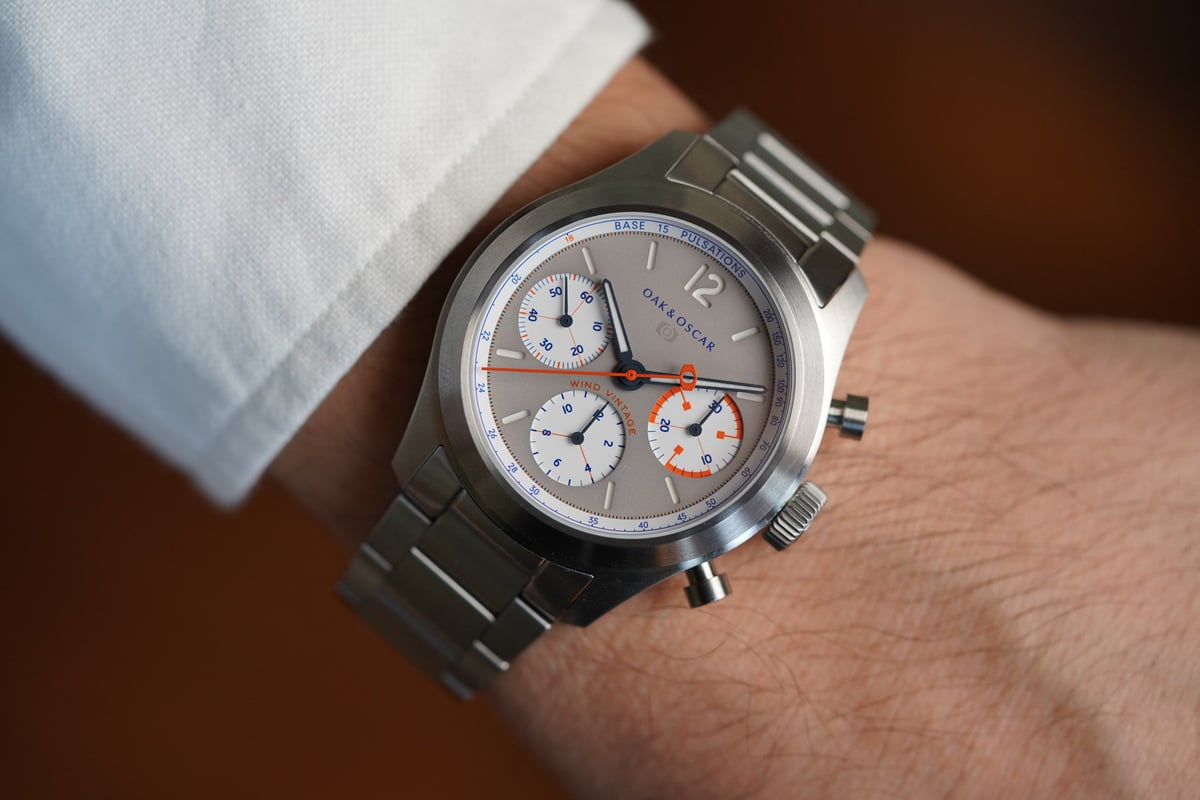
The Wind Vintage is a watch that rewards a second look. On first glance it is quiet — a brushed stainless steel case, a matte dial, applied indices, a slim leather strap. But the details start accumulating. The case has soft facets rather than flat slab sides, which is the sort of thing that costs real money to machine and is almost invisible in press images. The lugs curve away early, which is the single most underrated comfort decision a designer can make.
The dial is where the dealer's fingerprints show most clearly. There is a discipline to it that you do not see on many microbrand releases — an instinct for when to stop. Applied indices give it depth without clutter. The printing is restrained. The date, where present, is integrated rather than an afterthought. Nothing on this watch is trying to win an argument.
Sapphire crystal is the right call for a modern wearer, and the Super-LumiNova X1 keeps the watch functional after dark without turning it into a glow-stick. This is a watch designed to be worn in the world rather than photographed on a velvet tray, and the material choices reflect that.
The Movement: Honest, Serviceable, Predictable
Inside is a Swiss automatic built on the Sellita SW200-1 platform, regulated and finished to Oak & Oscar's specification, running at 28,800 vibrations per hour with a power reserve of around 38 hours. It is not an in-house calibre, not COSC-certified, and not trying to be either.
That is the correct decision for this watch at this price. The SW200-1 is one of the most widely supported automatic movements in the world — which means that five, ten, or twenty years from now, a competent watchmaker almost anywhere can service it. For a collector buying a first serious automatic, serviceability is worth far more than a speculative in-house badge.
Oak & Oscar's own rotor treatment and finishing lift it above the anonymous. It will never be a movement you flip the caseback to admire for an hour, but it is a movement you can trust to wake up on a Monday morning and do its job.
On the Wrist
The Wind Vintage is one of those watches that disappears on the wrist in the best way. The case sits down against the arm rather than perching on top of it, and the lugs curve away early enough that the watch reads as compact even on smaller wrists. The leather strap is supple out of the box, with a taper that keeps the whole package from feeling top-heavy.
Balance is the story. The dial is busy enough to be interesting and clean enough to be legible at a glance, and the case proportions keep the weight centred rather than sliding toward the crown side. It wears like a watch designed by someone who actually puts one on every morning — which, given the collaboration's origins, is exactly the point.
Where it sits in the wardrobe is equally clear. This is a daily driver that can dress up. It works under a cuff, it works with a t-shirt, and it works on a flight. It will not be the watch that gets noticed across a dinner table, and that is a feature rather than a bug.
Accuracy and Living With It
Expect the honest reality of a well-regulated workhorse: roughly plus or minus ten to fifteen seconds a day in normal wear, with variance depending on position and activity. Oak & Oscar regulates each watch before it ships, and most examples settle into a tighter band after a few weeks of consistent wear.
The 38-hour power reserve means the watch will run down over a weekend if you take it off on Friday evening. For a daily wearer that is not a problem. For a rotation of ten watches it is an argument for a winder, or for simply accepting that you will set the time each Monday.
Variants, Family and Alternatives
The Wind Vintage was produced as a single limited run rather than an ongoing production line, with strap variants offered within the same release. That scarcity is part of the appeal, but it also means sourcing a specific configuration can take patience. Buyers should expect to hunt rather than to click.
Within the Oak & Oscar family, the Burnham GMT, the Humboldt chronograph, the Sandford, the Jackson field watch, and the Olmsted all sit alongside it as the brand's core references. Each carries the same understated design language, and moving between them is a matter of complication preference rather than quality tier.
If the Wind Vintage speaks to you but you want alternatives, the Farer Lander offers a more colourful take on the same mid-century brief, the Monta Triumph delivers comparable finishing from another American direct-to-consumer brand, the Christopher Ward C63 Sealander remains the value benchmark for a Swiss-powered everyday automatic, and the Halios Seaforth matches the small-run, dealer-cult energy almost exactly.
If the budget is tighter, the Timex Marlin Automatic captures the same mood for a fraction of the price, and the Vario 1945 Field brings vintage-inflected proportions and honest specifications to entry-level money. Neither will match the finishing or the movement, but both prove that the design language is not exclusive to four figures.
Value and the Secondary Market
At around the $1,850 to $1,950 mark, the Wind Vintage buys genuine small-batch assembly, a Swiss automatic, and a dealer-grade design eye. That is fair money in a market where a mass-produced Swiss automatic from a heritage brand routinely clears $3,000.
The secondary market tells a predictable story. Limited microbrand runs occasionally spike when a brand's profile rises, but the Wind Vintage trades in a pre-owned band of roughly $1,500 to $1,850 and is best treated as a stable rather than an appreciating asset. There is no major auction history here, and there is unlikely to be one — this is not a watch that lives in safes.
Hold recommendation: wear it. The value you extract from a watch like this comes from the years on your wrist, not from a spreadsheet. Buy the strap you like, get it serviced when it needs it, and let the resale take care of itself.
Servicing
Oak & Oscar's US-based service structure means you will not be shipping the watch to Switzerland for a routine overhaul. Combined with the ubiquity of the SW200-1 platform, that makes ownership unusually low-anxiety for a small-batch watch. Any competent independent watchmaker can work on this movement, and the brand's own support network handles anything more involved.
The Verdict
The Oak & Oscar Wind Vintage is the rare collaboration that improves both parties: a microbrand gains a dealer's credibility, and a vintage specialist gets a modern watch he would actually wear. It is not flashy, not certified, and not an investment — but it is thoughtfully designed, honestly made, and genuinely pleasant to live with.
For a young collector building a first serious daily wearer, that combination is hard to beat. It is the watch equivalent of a well-cut navy blazer: it will never be the loudest thing in the room, and it will never let you down. For anyone who has spent time around real vintage and wants that sensibility without the servicing roulette, the Wind Vintage is a very intelligent answer.