The philosophy behind the Anno
Oechslin's reputation was built on astronomical complications for Ulysse Nardin and on his later work as a curator and educator. When he turned to his own brand, he did not set out to make a more complicated watch than everyone else. He set out to make a simpler one. The Anno is an annual calendar, which means it knows the difference between a 30-day month and a 31-day month. It does not know leap years, so it requires one manual correction at the end of February each year. That single adjustment is the price of admission, and it is a small one compared with the complexity of a perpetual calendar.
The genius of the Anno is not that it performs a rare function. Annual calendars exist at many price points. The genius is that it performs the function with a module that has been pared back to a startling minimum. Oechslin's approach is to use the geometry of the mechanism itself to encode the calendar, rather than adding layer upon layer of cams and levers. The result is a movement that is easier to understand, easier to service, and more robust than its complexity might suggest.
This is not minimalism as an aesthetic choice. It is minimalism as an engineering discipline. The dial reflects that discipline. There is no superfluous printing, no decorative guilloché, no attempt to mimic the codes of traditional haute horlogerie. The Anno is confident enough to be plain, and that confidence is part of its appeal.
Case and dial: reduction as a design language
The Anno is housed in a titanium case, a material that suits the watch's tool-like intelligence. Titanium is lighter than steel, warmer in tone, and resistant to corrosion. It also has a muted sheen that keeps the watch from flashing on the wrist. The case is finished with a restrained alternation of brushed and polished surfaces, but the overall impression is one of purpose rather than decoration. The sapphire crystal is domed just enough to soften the dial without distorting it.
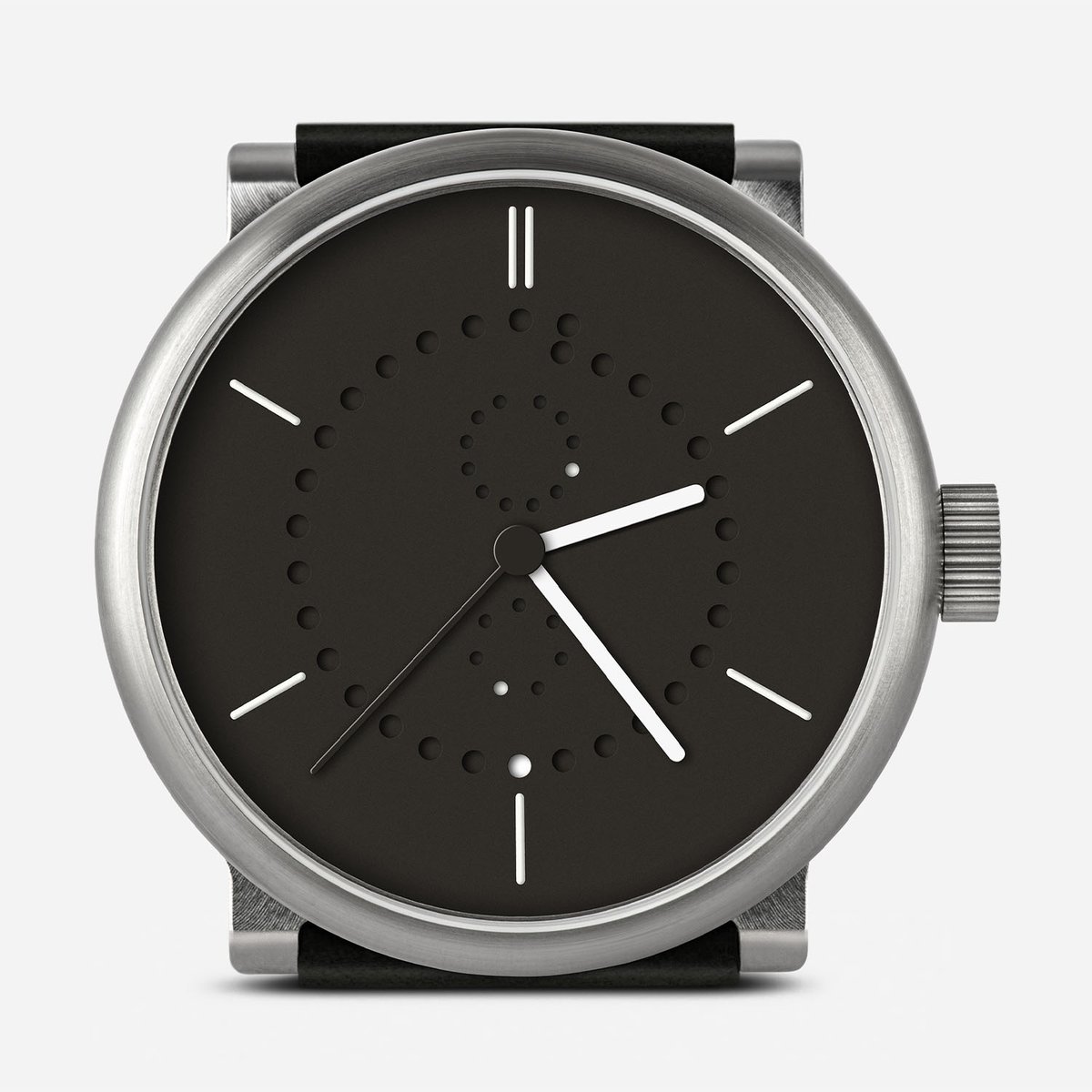
The dial is where Ochs und Junior's design language becomes unmistakable. The calendar information is presented with the brand's signature dot-and-hand vocabulary. The date and month are readable once you understand the layout, but they are not arranged in the conventional subdial format that most wearers expect. This is a watch that asks for a moment of orientation. Once that moment passes, the logic becomes clear, and the dial feels less like a puzzle and more like a diagram of the mechanism itself.
Legibility is good in daylight, though the absence of lume means the Anno is not a watch for reading in the dark. That is a deliberate choice. Lume would add visual noise and undermine the purity of the dial. The Anno is a daytime watch, a desk watch, a watch for the moments when you want to know the date without reaching for your phone. The hands are simple and precise, and the contrast between the dial and the indicators is strong enough for everyday use.
The titanium case also gives the Anno a quiet presence. It does not shout across a room, but it rewards a closer look. The edges are clean, the proportions are balanced, and the strap integrates neatly with the case. This is not a watch that needs to be handled cautiously. It is built to be worn.
Movement: Oechslin's annual calendar module
The Anno is powered by a modified ETA 2824-2, a workhorse automatic that has proven itself in countless watches. The base movement provides a familiar foundation: automatic winding, a power reserve of around 38 hours, and a frequency of 28,800 vibrations per hour. The annual calendar module is where Oechslin's work becomes visible. It is a compact assembly that adds the date and month indications while keeping the parts count low.
The architecture is functional rather than ornamental. The finishing on the base movement is industrial, with clean surfaces and no pretence of hand-bevelled grandeur. That is not a criticism. The Anno is not trying to compete with a Patek Philippe or a Lange. It is trying to deliver a specific mechanical idea at a fair price, and the movement reflects that priority. The module is the star, and it is best appreciated through the caseback, where the reduced calendar mechanism can be seen in action.
Because the base is an ETA, service is straightforward for a competent watchmaker, though Ochs und Junior recommends servicing through the brand. The annual calendar module does require someone who understands its particular logic, so it is not a movement for a generalist. But the design is robust, and the watch is not fragile. It is a mechanical object meant to be used.
On the wrist
The Anno is defined by its lightness. The titanium case all but disappears on the wrist, and the watch sits close and unobtrusive in a way that encourages daily wear. There is no excess mass to shift around, no sharp edges to catch on a cuff, and no sense that the watch is asking for attention. It is comfortable in the way a good tool is comfortable: not because it has been softened, but because it has been considered.
The leather strap and pin buckle complete the picture. The strap is supple from the start, and the buckle is simple and secure. The Anno does not feel fragile, but it also does not feel overbuilt. It feels precise, deliberate, and easy to live with. On the wrist, it reads as a dress watch with a secret, or a daily watch with a philosophical bent. It is at home under a shirt cuff, but it is also at home with a sweater and jeans.
The watch's presence is intellectual rather than visual. It will not draw compliments from strangers, but it will draw questions from people who know watches. That is the right kind of attention for a piece like this.
Accuracy, service, and ownership
The modified ETA 2824-2 is not COSC-certified. A well-regulated example should keep time within roughly -10 to +15 seconds per day in normal wear, though individual results vary with position, activity, and temperature. The annual calendar mechanism is robust when set correctly, and the watch is best treated as a mechanical companion rather than a precision instrument. Expect it to be reliable, not obsessively exact.
Service is handled directly by Ochs und Junior in Lucerne, and that is both a strength and a limitation. The strength is that the watch goes back to the people who understand it best. The limitation is that turnaround times can be longer than with a mainstream brand, and third-party options are limited. For a collector who values the relationship with an independent, this is part of the ownership experience. For someone who wants a watch that can be serviced at any mall, it is a consideration.
The Anno is not a watch that demands constant attention. It winds itself, it keeps the calendar, and it requires one adjustment a year. That is a low-maintenance ownership proposition for a mechanical object with this much character.
Value and alternatives
Ochs und Junior sells directly, and pricing is available on request. That makes the Anno difficult to compare on a simple price-per-complication basis. What the price buys is Oechslin's ingenuity, a titanium case, and a level of rarity that mainstream annual calendars cannot match. It does not buy the kind of finishing that wins beauty contests, and it does not buy the liquidity of a steel sports watch. It buys a specific idea, executed with integrity.
Compared with a Frederique Constant Slimline Annual Calendar, the Anno is far more expensive and far less conventional. Compared with an H. Moser & Cie. Endeavour Perpetual Calendar, it is a bargain in the context of independent watchmaking, though it lacks the Moser's refinement. The closest comparison is not another annual calendar but another Ochs und Junior. The brand's Perpetual Calendar is the more famous model, and the Anno is the simpler, more approachable sibling. For many collectors, that simplicity is the point.
On the secondary market, the Anno is a niche piece. It trades slowly, and there is not enough public data to call it a stable investment. Buy it because you want to wear it, not because you want to flip it. That is true of most independent watches, and it is especially true here.
Final verdict
The Ochs und Junior Anno is a watch for collectors who value ideas over ornament. Its annual calendar is reduced to the essentials, and its titanium case makes it an easy daily companion. It is not for everyone, but for the right wearer it is a quietly brilliant alternative to conventional luxury.
If you want a watch that tells you the date, the month, and something about the person who designed it, the Anno delivers. If you want a watch that announces its price from across the room, look elsewhere. The Anno is a connoisseur's piece, and it is all the better for it.