Ochs und Junior CQA Review: The Minimalist Annual Calendar Reimagined
In the often-convoluted world of high horology, where complications are celebrated for their intricate dance of gears and springs, Ochs und Junior stands as a defiant minimalist. Founded on the radical vision of Dr. Ludwig Oechslin, the brand champions simplicity in display and mechanical execution, creating watches that are as intuitive as they are technically brilliant. This philosophy finds its zenith in the calendario quattro anni (CQA), a watch that redefines the annual calendar.
The CQA isn't just another annual calendar; it's a profound reinterpretation. Instead of a traditional array of windows or sub-dials, Oechslin has distilled the complex information of date, day, and month into a series of elegantly arranged dots. But the true genius lies beneath the surface, in a mechanism so streamlined it makes other annual calendars seem unnecessarily baroque. For the sophisticated collector who values intellectual design and understated innovation over overt opulence, the CQA is a whisper in a world of shouts – a whisper that carries significant weight.
A Legacy of Ingenuity: The Ochs und Junior Story
Ochs und Junior was born in 2006, not from centuries of tradition, but from a singular, radical idea: to simplify. Dr. Ludwig Oechslin, a master watchmaker, inventor, and former curator of the Musée International d'Horlogerie, envisioned watches that were mechanically robust, visually pure, and entirely functional. His approach eschews unnecessary parts, elaborate finishing for its own sake, and complex assembly, focusing instead on elegant mechanical solutions. Based in La Chaux-de-Fonds, Switzerland, Ochs und Junior operates with a direct-to-consumer model, allowing for unparalleled customization and a direct connection between the maker and the collector. This unique model, combined with Oechslin's unparalleled ingenuity, has carved out a distinct and highly respected niche in independent watchmaking.
The Heart of the Matter: Movement and Complication
At the core of the Ochs und Junior CQA lies a robust and reliable automatic base movement – typically an ETA 2824-2 or Sellita SW200-1 – but it’s the proprietary complication module designed by Ludwig Oechslin that truly sets it apart. While many haute horlogerie annual calendars boast dozens, if not hundreds, of additional components, Oechslin’s CQA module consists of a staggering just 9 additional parts. This isn't merely a feat of engineering; it's a philosophical statement against gratuitous complexity.
The genius lies in its direct drive mechanism. Instead of intermediate gears and levers, the calendrical discs are driven directly from the base movement’s components. This minimizes friction, reduces potential points of failure, and significantly simplifies both assembly and servicing. The result is an annual calendar that only needs to be corrected once every four years (on March 1st following a non-leap year). This means it correctly accounts for 30- and 31-day months, and even the 29th of February in a leap year, for an extended period, requiring far less intervention than a standard annual calendar which needs annual adjustment in February. With a power reserve of approximately 38 hours and operating at a frequency of 28,800 vibrations per hour (4 Hz), the movement delivers consistent and dependable performance, a testament to its pragmatic design.
Design and Specifications: Understated Precision
The CQA's aesthetic is a direct extension of its mechanical philosophy: pure functionality expressed through minimalist design. Our review model, a 39mm titanium variant, exemplifies this approach.
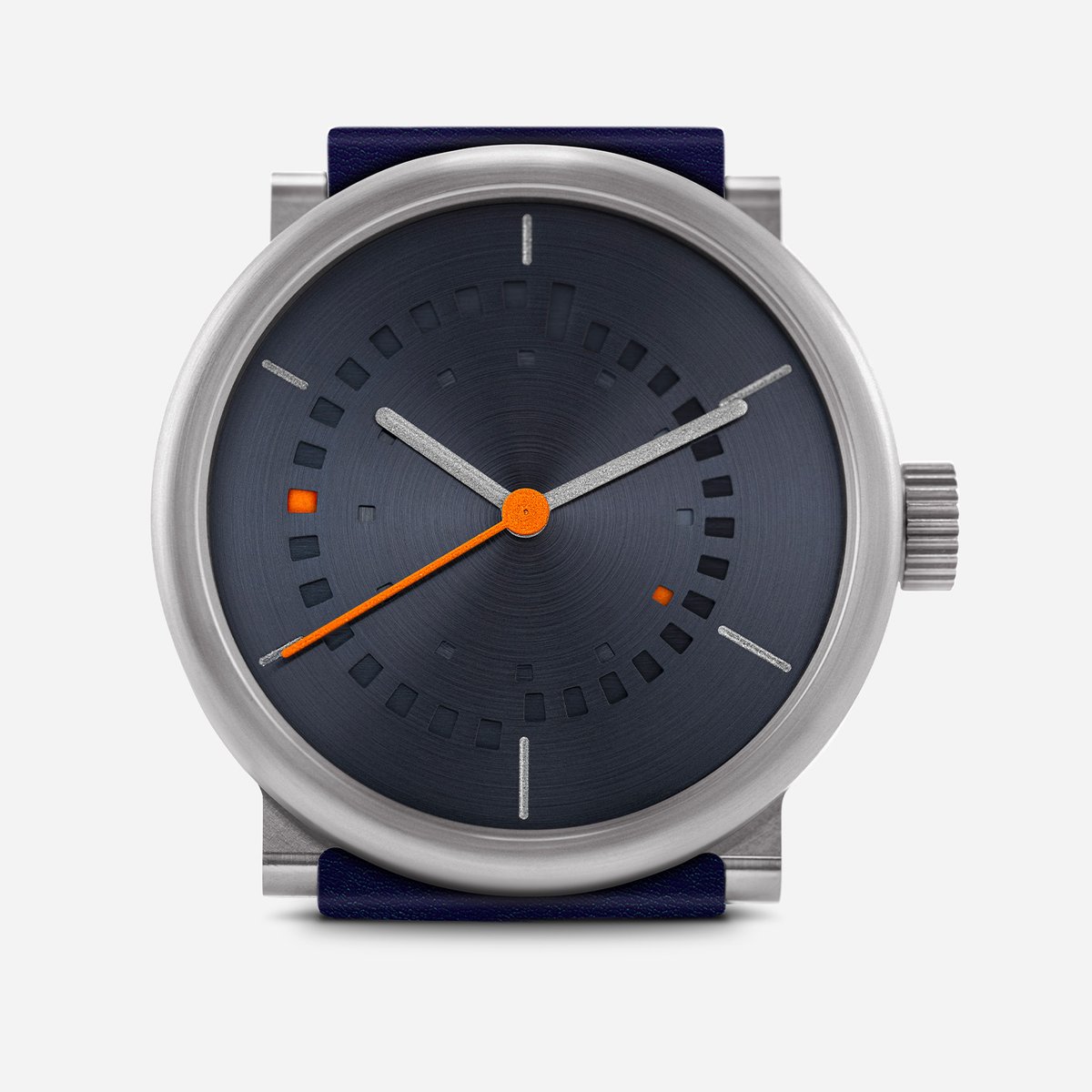
- Case: The 39mm case diameter, paired with an incredibly svelte 11mm thickness and a lug-to-lug distance of 47.9mm, makes the CQA supremely wearable. Ochs und Junior offers cases in various materials, including titanium (the most popular for its lightweight properties), sterling silver, bronze, and even platinum, allowing for deep personalization. The case finish is typically matte or brushed, further emphasizing the tool-watch aesthetic over polished glamour.
- Crystal: A flat sapphire crystal protects the dial, offering excellent scratch resistance and clarity.
- Water Resistance: A practical 50 meters of water resistance ensures the CQA can handle daily splashes and light rain, reinforcing its everyday wearability.
- Dial: This is where the CQA truly distinguishes itself. Eschewing traditional apertures, the dial employs a series of concentric circles of dots to display the calendar information. The outermost ring indicates the date (1-31), the middle ring represents the month (1-12), and the innermost ring denotes the day of the week (1-7). A single, bold dot (often in a contrasting color) moves around each ring to indicate the current information. The absence of traditional hands for the calendar functions, replaced by these moving indicators, creates an incredibly clean and abstract display that is both challenging and rewarding to read. There is no lume, aligning with the brand's focus on essential legibility and mechanical purity.
- Strap & Clasp: Our model features a high-quality leather strap, a common choice for Ochs und Junior, though rubber options are also available. The straps are often custom-made to the client's specifications, secured by a simple and reliable pin buckle, again prioritizing function and comfort.
On the Wrist: Comfort and Presence
Wearing an Ochs und Junior CQA is an exercise in subtle luxury. The titanium case, a common choice for its exceptional strength-to-weight ratio, ensures a feather-light presence on the wrist. At 39mm in diameter and a mere 11mm thick, it slips effortlessly under any cuff, its minimalist design allowing it to integrate seamlessly rather than dominate. The short lug-to-lug distance of 47.9mm further enhances its wearability, ensuring it sits comfortably even on smaller wrists, a testament to Oechslin's thoughtful ergonomic considerations.
The balance is impeccable, with the watch feeling secure and well-proportioned. The tactile experience is distinct; there's no unnecessary bulk or flash, just a pure, unadulterated connection to a finely tuned instrument. It’s the kind of watch that you forget you’re wearing until you glance down and are reminded of its quiet brilliance – a true connoisseur's choice for daily wear. Its wrist presence is a solid 4/5 – not because it's oversized or flashy, but because its unique, intelligent design commands attention from those who recognize its innovation. It's a watch that speaks volumes without ever raising its voice, a quiet confidence that resonates deeply with discerning collectors.
Real-World Performance: Accuracy and Reliability
Built on the rock-solid foundations of an ETA 2824-2 or Sellita SW200-1 movement, the Ochs und Junior CQA delivers real-world accuracy that is robust and reliable. Expect performance within standard mechanical tolerances, typically around +/- 5-10 seconds per day, consistent with well-regulated Swiss movements. While not COSC-certified, the CQA prioritizes long-term durability and consistent daily performance over chasing chronometer specs, a pragmatic approach perfectly aligned with Oechslin's engineering philosophy. This is a watch designed to be worn and relied upon, not merely admired in a safe.
Versatility and Occasions
The Ochs und Junior CQA defies easy categorization. Its understated elegance makes it perfectly suitable for formal occasions, easily slipping beneath a tailored shirt cuff. Yet, its robust construction and practical water resistance mean it's equally at home as a daily companion, whether in the office or on a casual weekend outing. Its minimalist aesthetic also allows it to pair surprisingly well with sportier attire, making it a truly versatile piece that transcends traditional dress codes. This is a watch for the collector who lives an active, sophisticated life and demands a timepiece that can adapt seamlessly to any scenario.
The Ochs und Junior Universe: Variants and Siblings
Ochs und Junior is renowned for its customization, meaning each CQA often feels like a unique piece. While there aren't traditional 'reference numbers' in the mass-market sense, variants are defined by case material, size, and dial color. Common configurations include the 39mm titanium case with a blue dial and leather strap, or a larger 42mm sterling silver case with a grey dial, perhaps paired with a rubber strap for a sportier look. The brand also offers bronze cases for those who appreciate the evolving patina. The beauty is that each watch is effectively a bespoke creation, built to the client's specifications.
Within the Ochs und Junior family, the CQA sits alongside other calendrical marvels like the standard Annual Calendar and the Perpetual Calendar, each showcasing Oechslin's unique approach to complex timekeeping. Other notable models from the brand include the Settimanale (weekly calendar), Mese (month), and Day/Night indicators, all sharing the same philosophy of mechanical simplification and aesthetic purity. These siblings highlight the breadth of Oechslin's vision, offering a spectrum of complications executed with unparalleled ingenuity.
Comparing the CQA: A Class Apart
The Ochs und Junior CQA occupies a truly unique space in the watch world, making direct comparisons challenging. However, we can look at watches that share certain philosophical or functional similarities:
- H. Moser & Cie. Endeavour Perpetual Calendar: This watch is perhaps the closest in spirit, offering a similarly minimalist approach to a complex calendrical function (in this case, a perpetual calendar). Moser's ingenious flash calendar and single sub-dial for month display are direct parallels to Oechslin's simplification, though Moser maintains a more traditional haute horlogerie finishing.
- Patek Philippe Annual Calendar (e.g., Ref. 5396): Representing the pinnacle of traditional annual calendars, Patek Philippe's offerings showcase intricate displays with multiple windows and sub-dials, along with exquisite hand-finishing. While functionally similar (both are annual calendars), the Patek is a masterclass in classical horology, standing in stark contrast to O&J's radical modernism.
- Nomos Glashütte Tangente Update: While not a calendrical complication, the Tangente Update shares a minimalist aesthetic and a unique peripheral date display. It appeals to collectors who appreciate thoughtful design and clean lines, embodying a similar spirit of innovative yet understated watchmaking.
Due to its highly unique mechanical design and proprietary complication module, the Ochs und Junior CQA has no direct homages or affordable alternatives. Its distinct engineering and aesthetic make it truly one-of-a-kind.
Investment Value and Service
The Ochs und Junior CQA, with a typical MSRP starting around $14,000 for a titanium model and rising with customization, represents a significant investment. On the pre-owned market, prices generally range from $10,000 to $18,000, indicating a stable trend. While Ochs und Junior pieces don't see the explosive appreciation of some mainstream hype watches, their rarity, bespoke nature, and the genius of Ludwig Oechslin ensure a dedicated collector base. This makes them a solid hold recommendation for those who appreciate independent horology and unique mechanical solutions. There's no major public auction history for Ochs und Junior, as their direct-to-consumer model and niche appeal mean secondary market transactions often occur within a specialized community rather than through traditional auction houses.
Servicing the CQA is surprisingly straightforward. Given its robust ETA/Sellita base movement and Oechslin's minimalist 9-part module, a service interval of 4-5 years is recommended. The approximate cost for a full service is around $700. Crucially, the simplicity of the module means that any competent independent watchmaker can service the movement, offering flexibility beyond authorized service centers – a rare advantage for a complicated watch.
The Verdict: A Masterclass in Modern Horology
The Ochs und Junior calendario quattro anni is not just a watch; it's a statement about what horology can be when stripped of pretense and focused on pure, elegant engineering. For the collector who values intellectual design, bespoke craftsmanship, and a truly unique complication over brand hype, the CQA is an indispensable piece. It's a testament to Ludwig Oechslin's genius, offering a refreshingly modern take on a classic complication that will undoubtedly spark conversation and admiration among the initiated.
This price range—typically $14,000 to $20,000+—buys an unparalleled piece of horological ingenuity and bespoke craftsmanship. It’s an investment in a unique complication and design philosophy that offers exceptional value for a discerning collector and holds its appeal through its rarity and intellectual depth. While its niche appeal and minimalist aesthetic might not resonate with everyone, for those who 'get it,' the CQA is nothing short of a revelation.
Pros:
- Ingenious, minimalist 'four-year calendar' complication with only 9 additional parts.
- Highly customizable aesthetic, allowing for true personalization.
- Robust and reliable ETA/Sellita base movement ensures longevity and easy service.
- Understated yet profoundly distinctive design, a true conversation starter.
- Exceptional comfort and wearability due to lightweight materials and thoughtful ergonomics.
Cons:
- Niche appeal may limit broad market resale, though strong within its collector base.
- Lack of traditional brand recognition might not appeal to all luxury watch buyers.
- Minimalist aesthetic and lack of traditional finishing might not satisfy those seeking haute horlogerie embellishments.
- The unique dot-based display requires a learning curve for quick time/date reading.