The Philosophy of Subtraction
When we discuss high complications, the conversation usually turns to the 'more'—more parts, more finishing, more cost. Ochs und Junior, under the guidance of Dr. Ludwig Oechslin, has spent the last two decades arguing for the 'less.' The Calendario Cent’Anni (cca) is perhaps the most potent expression of this philosophy. A 100-year calendar is a daunting task for any watchmaker. It must account for the varying lengths of months and the leap year cycle, usually requiring a complex system of cams and jumpers that are notoriously fragile. Oechslin’s solution? A system of epicyclic gearing that handles the entire logic with just nine additional components added to the base movement.
This isn't just a technical flex; it is a fundamental shift in how a watch interacts with its owner. Traditional perpetual calendars often come with a list of 'don'ts'—don't set the date between 9 PM and 3 AM, don't turn the hands backward. The cca has no such restrictions. Because it is gear-based, you can adjust everything via the crown at any time. It is a complication that respects your time rather than demanding your caution.
Case Ergonomics: The 40mm Sweet Spot
From a daily-wear perspective, the case design of the cca is a triumph of function. Measuring 40mm in diameter, it hits the contemporary sweet spot for versatility. However, the 'on-paper' specs don't tell the full story. The lugs are integrated and extremely short, resulting in a lug-to-lug distance of roughly 46mm. This allows the watch to wear much smaller than a typical 40mm piece, making it accessible for those with smaller wrists while maintaining enough presence for larger ones.
The choice of Grade 5 titanium is inspired. It provides the necessary hardness to withstand the inevitable knocks of a week in the city, yet it is light enough that the watch never becomes a burden. I wore the cca through a series of long airport transit days and several high-intensity meetings; not once did I feel the need to take it off to 'rest' my wrist. The raw machining marks left on the case are a signature of the brand. While some might find the lack of mirror-polishing jarring, I find it refreshing. It’s a watch that wears its manufacturing process on its sleeve—literally.
Decoding the Dial: Legibility and Logic
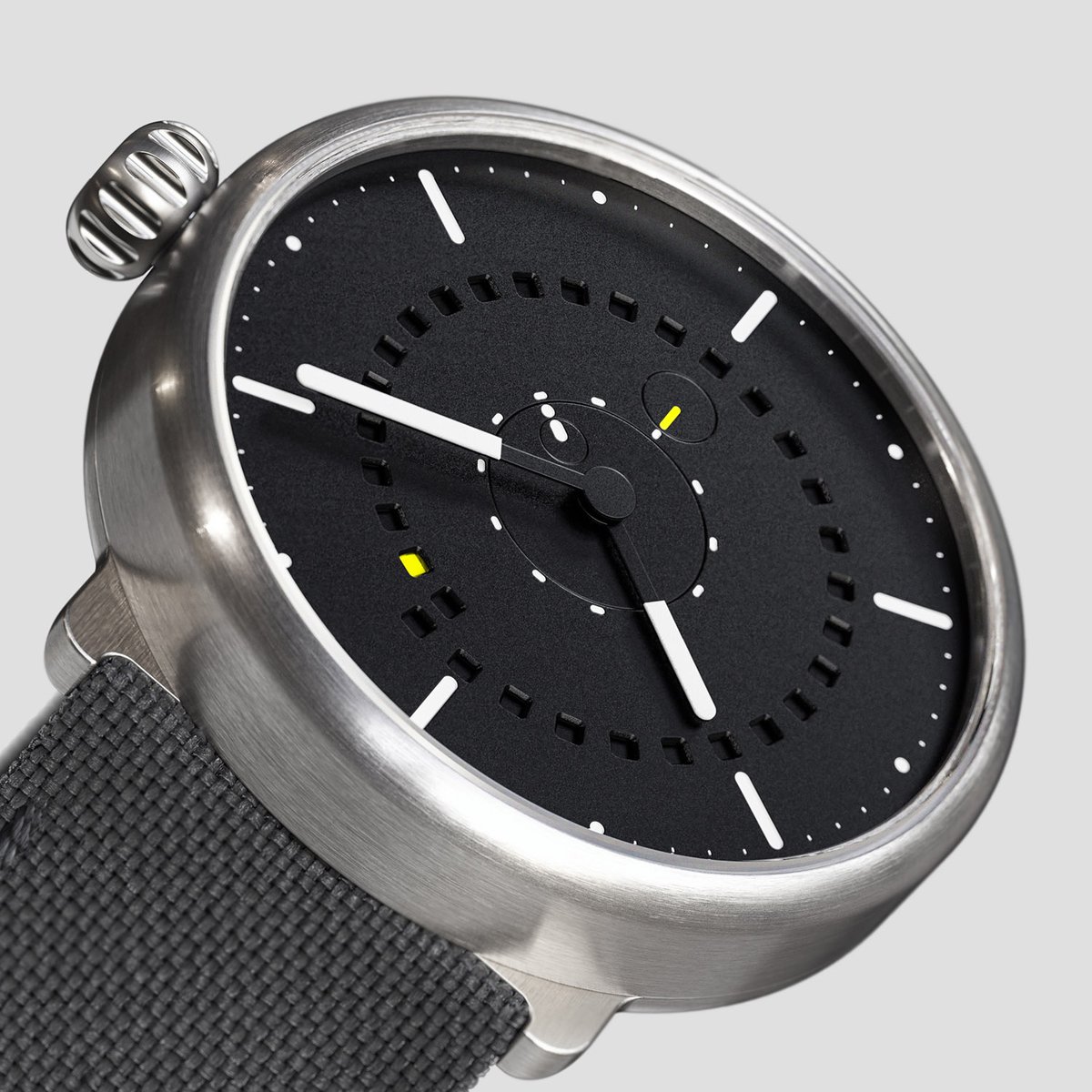
The most striking aspect of the cca is its dial, or lack thereof. There are no numerals, no sub-dials, and no traditional apertures. Instead, Ochs und Junior uses a series of perforations. The outermost ring of 31 holes indicates the date. The month is shown via a smaller ring of 12 holes, and the leap year status is tucked into another subtle display. At first glance, it looks like a piece of abstract art. Within 24 hours of wear, however, it becomes second nature.
The human brain is remarkably good at spatial recognition. You don't need to read the number '15' to know it's the middle of the month; you simply see the dot at the 6 o'clock position. This 'analog' way of reading digital information is faster and more intuitive than traditional displays once the initial learning curve is passed. The legibility is further aided by the high-contrast color schemes available through their customization program. My review unit featured a deep navy dial with orange accents, providing excellent clarity even in low-light environments.
The Engine: Ulysse Nardin UN-118
Purists might complain that Ochs und Junior doesn't manufacture their own base calibers, but that misses the point. By using the UN-118, they are starting with one of the most technologically advanced and reliable automatic movements on the market. Featuring a silicium hairspring and escapement, the UN-118 is highly resistant to magnetism and requires less lubrication over time. It offers a 60-hour power reserve, which is more than enough to get you through a weekend if you decide to switch to a different piece for a day.
The power reserve indicator on the dial is a vital addition. For a calendar watch that you intend to keep running for a century, knowing exactly how much 'juice' is left in the tank is essential. The integration of this indicator into the minimalist aesthetic is seamless, appearing as a sweeping arc that blends into the overall geometry of the dial.
Real-World Survival: The Weekly Test
During my week with the cca, I treated it as a true daily companion. It went from a formal dinner to a rainy Saturday morning at the farmers' market. The 100m water resistance is a key factor here. Most perpetual calendars are rated to 30m or 50m, making them 'splash-proof' at best. The cca is a watch you can actually swim with. This level of utility is unheard of in this category of horology.
The sturgeon leather strap deserves its own paragraph. It is incredibly tough, resisting scratches and moisture better than any alligator or calfskin strap I’ve tested. It starts out a bit stiff but molds to the wrist within 48 hours, providing a secure and comfortable fit. The simple pin buckle, also in titanium, is low-profile and doesn't dig into the underside of the wrist while typing—a common grievance with bulky deployant clasps.
The Verdict for the Modern Collector
The Ochs und Junior cca is not for everyone. If you crave the prestige of a 'Holy Trinity' logo or the glittering finish of a hand-applied anglage, you will be disappointed. But if you are part of the new generation of collectors who value intellectual depth, functional design, and the 'if you know, you know' factor, the cca is peerless.
It is a watch that solves a 100-year problem with the elegance of a mathematical equation. It is comfortable, durable, and radically different from anything else on the market. In an industry that often feels like it's repeating the same tropes, the Calendario Cent’Anni is a breath of fresh, logical air. It is the only 100-year calendar I would trust to survive not just the next century, but a standard Tuesday afternoon in the real world.