What the CQA is
CQA stands for Calendrier Quantième Annuel, which is French watchmaking shorthand for an annual calendar. The practical definition is simple: the watch automatically accounts for months of 30 and 31 days and needs a single correction at the end of February. It is not a perpetual calendar, which would also handle leap years. It is the useful middle ground: more convenient than a simple date, less expensive and less fragile than a perpetual calendar, and mechanically elegant when done well.
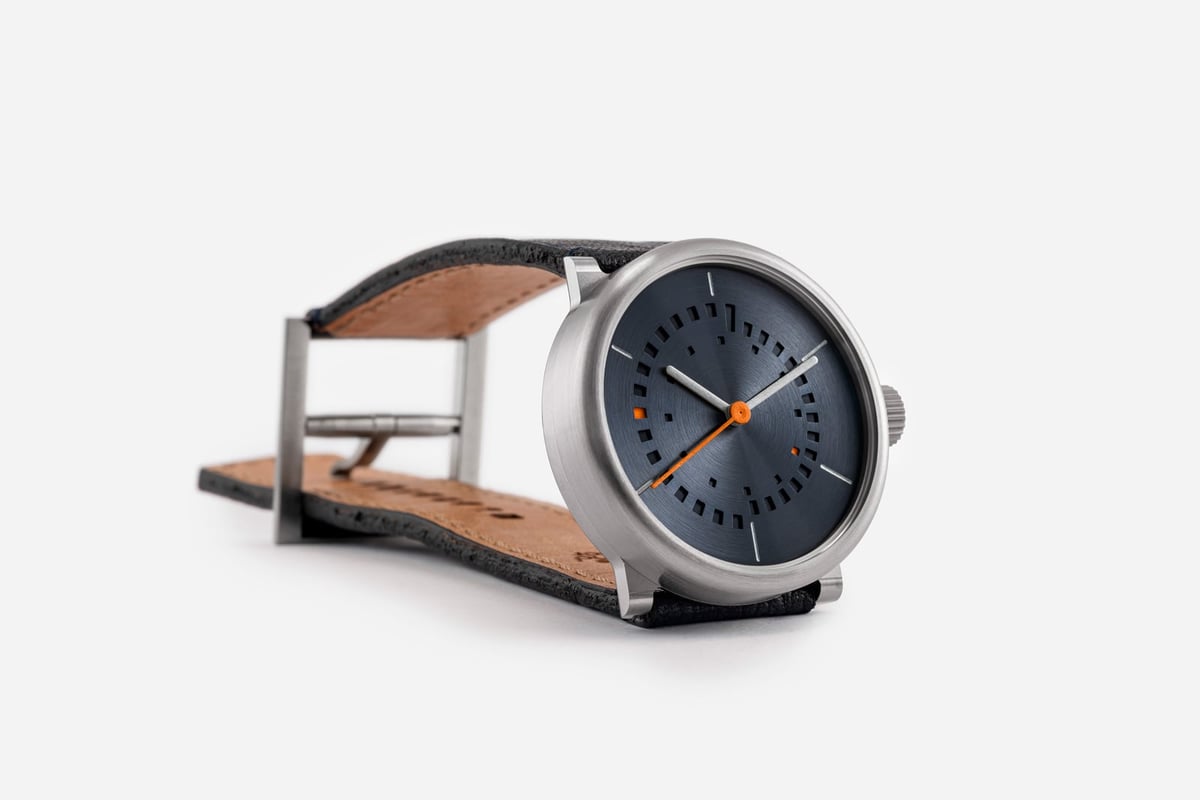
Ochs und Junior's version is deliberately stripped back. Instead of a conventional date window and month aperture, the CQA uses a display that asks the wearer to read the dial rather than scan it. The date is indicated on the perimeter; the month is indicated at the center or via a small hand depending on configuration. The exact layout is less important than the principle: the calendar is integrated into the dial, not bolted onto it. This is Oechslin's method. He does not add information for the sake of it. He removes everything that does not help the wearer understand the time or the date.
The result is a watch that looks simpler than it is. That is the highest compliment you can pay a calendar watch. The CQA does not feel like a complication showcase. It feels like a tool for people who care about dates and do not want to think about them.
Brand context: Lucerne, not Geneva
Ochs und Junior was founded in Lucerne in 2006 by Ludwig Oechslin and Beat Weinmann. Oechslin is one of the most original minds in modern horology: a watchmaker, mathematician, astronomer, and former curator at the Musée International d'Horlogerie in La Chaux-de-Fonds. His work at Ulysse Nardin, including the Trilogy of Time and the Freak, established his reputation for astronomical complications and unconventional mechanics. Ochs und Junior is a smaller, more personal project: a workshop that builds watches around his philosophy of reduction.
That philosophy is visible across the brand's family. The Settimana displays the week. The Moon Phase shows the lunar cycle with a simplified mechanism. The Perpetual Calendar reduces the perpetual calendar to a handful of parts. The CQA applies the same thinking to the annual calendar. It is not a heritage reissue or a tribute to a historical reference. It is a modern independent watch with a clear point of view.
For collectors, the appeal is not the logo. It is the logic. Ochs und Junior is a small brand with a loyal following, direct sales, and a reputation for watches that are more interesting than their specifications suggest. The CQA fits that profile exactly.
Case and dial: titanium restraint
The CQA is housed in a titanium case. That choice is consistent with Ochs und Junior's broader design language: titanium keeps the watch light, reduces the sense of bulk, and gives the case a matte, technical character that suits the reduced dial. The case is not jewelry. It is a container for an idea, and titanium is the right material for that job.
The crystal is sapphire. The strap is leather, and the clasp is a pin buckle. There is no lume. This is not a sports watch, and it does not pretend to be one. The CQA is a daily wearer for people who spend their time in offices, studios, libraries, and restaurants rather than on dive boats. The absence of lume is a deliberate choice: the dial is meant to be read in daylight and interior light, not in the dark.
The dial is where the CQA earns its keep. Ochs und Junior's calendar displays are not conventional. The date is shown around the perimeter, and the month is indicated in a way that requires a moment of orientation. The first day with the watch is a learning curve. The second day is intuitive. By the end of the week, you read it without thinking. That is the point of a good reduced display: it trains the eye rather than demanding attention.
Legibility is good in daylight, but it is not instant. This is not a watch for someone who wants a large date window at three o'clock. It is a watch for someone who enjoys reading a mechanical instrument. The contrast between the hands and the dial is strong enough for daily use, and the calendar indications are clear once you know where to look. The CQA rewards familiarity.
Movement: ETA base, Oechslin module
The CQA is powered by an automatic movement based on the ETA 2824-2, paired with Ochs und Junior's annual calendar module. The ETA 2824-2 is one of the most familiar automatic ébauches in watchmaking: robust, serviceable, and well understood. It runs at 28,800 vibrations per hour and delivers roughly 38 hours of power reserve. It is not a haute horlogerie movement in the sense of hand-finished bridges and elaborate anglage, but it is the right foundation for a watch like this.
The reason is simple. Oechslin's designs are about the module, not the base. The annual calendar mechanism is where the intelligence lives. By starting with a known automatic movement, Ochs und Junior can keep the watch reliable, relatively affordable, and easy to service. The module adds the annual calendar function with a minimum of parts. That is the architectural story: a workhorse base, a reduced complication, and a display that makes the whole thing feel inevitable.
Finishing is honest rather than spectacular. The movement is not decorated to the standards of a Geneva independent, and the CQA is not priced like one. What matters is the logic of the mechanism and the clarity of the display. The ETA base is a known quantity; the module is the reason to pay attention. If you are the kind of collector who reads movement architecture before dial color, the CQA will make sense to you.
The watch is not COSC-certified, and it is not in-house in the strict sense. The base ébauche comes from ETA; the annual calendar module is Ochs und Junior's work. That is a fair trade for this price point and this philosophy. The CQA is an independent watch, but it is not an independent movement in the way a F.P. Journe or a Kari Voutilainen is. It is an independent idea built on a reliable platform.
On the wrist: light, quiet, intelligent
The first thing you notice on the wrist is the weight, or rather the lack of it. Titanium makes the CQA feel lighter than you expect, and that lightness changes the way you wear it. It sits close, it does not swing, and it disappears under a cuff. The leather strap is comfortable from the start, and the pin buckle is simple and secure. This is not a watch that demands a break-in period or a specific wrist size.
The second thing you notice is the dial. The CQA is not flashy, but it is not boring either. The calendar display gives the dial a technical texture that rewards a glance. In a meeting, it looks like a clean three-hand watch. At dinner, it looks like a piece of independent design. That versatility is rare in calendar watches, which often lean formal or complicated. The CQA can be worn with a suit, a sweater, or a field jacket. It is not a sports watch, but it is not precious either.
The watch wears best as a daily. It is light enough to forget, legible enough to use, and interesting enough to keep. The annual calendar is a practical complication for anyone who wears the same watch every day. You set it once, correct it at the end of February, and otherwise let it do its job. That is the kind of ownership that builds affection over time.
Accuracy and ownership
The ETA 2824-2 is a known performer. A well-regulated example should hold within about plus or minus ten seconds per day in normal use, though real-world results vary with wearing habits and position. The CQA is not a chronometer, and it does not pretend to be one. If you need quartz-level accuracy, this is not the watch. If you want a mechanical calendar that is reliable and easy to live with, the CQA delivers.
The annual calendar requires one correction at the end of February. That is the defining ritual of ownership. You pull the crown or use the corrector, advance the date to March 1, and the watch is set for another year. It is a small task, but it connects you to the mechanism. A perpetual calendar is more impressive on paper; an annual calendar is more honest in daily life. The CQA leans into that honesty.
Service is straightforward in principle. The ETA base can be handled by any competent watchmaker, but the annual calendar module is best serviced by Ochs und Junior or an authorized partner. That is the trade-off of an independent module. The base is universal; the complication is specific. For owners, the practical advice is simple: keep the watch dry, avoid shocks, and plan service through the brand if the calendar acts up.
Value and alternatives
The CQA is a direct-sales independent watch, and pricing depends on configuration. That makes exact value comparisons difficult. What you are buying is not a mass-market annual calendar with a dealer network and a recognizable logo. You are buying Oechslin's logic, a titanium case, and a reduced display that is unlike anything from the large brands. The secondary market is thin, and the watch is not a liquid asset. That is normal for small independent watchmaking.
If you want a conventional annual calendar, the Patek Philippe 5205G is the benchmark. It is more formal, more expensive, and more traditional. The A. Lange & Söhne Saxonia Annual Calendar offers German finishing and an outsize date. The F.P. Journe Octa Calendrier is another independent take, with a different display and a more precious-metal case. All three are excellent. None of them feels like the CQA.
The CQA's value is in its specificity. It is for the collector who wants a calendar watch that does not look like a calendar watch. It is for the wearer who enjoys reading a dial rather than scanning it. It is for someone who appreciates titanium, independent design, and a movement architecture that prioritizes function over decoration. At its price point, it is not a bargain in the traditional sense. It is a fair price for a very particular idea.
Verdict
The Ochs und Junior CQA is a reduced annual calendar with a clear point of view. It is light on the wrist, quiet on the dial, and intelligent in the movement. It does not try to compete with Patek Philippe on prestige or with F.P. Journe on haute horlogerie. It competes on logic. That is a smaller battlefield, but it is a meaningful one.
Buy it if you want a daily wearer that rewards familiarity and celebrates Oechslin's less-is-more engineering. Skip it if you need a conventional date window, a famous logo, or instant legibility. The CQA is not for everyone. It is for the collector who understands that the best complications are the ones you stop noticing because they simply work.