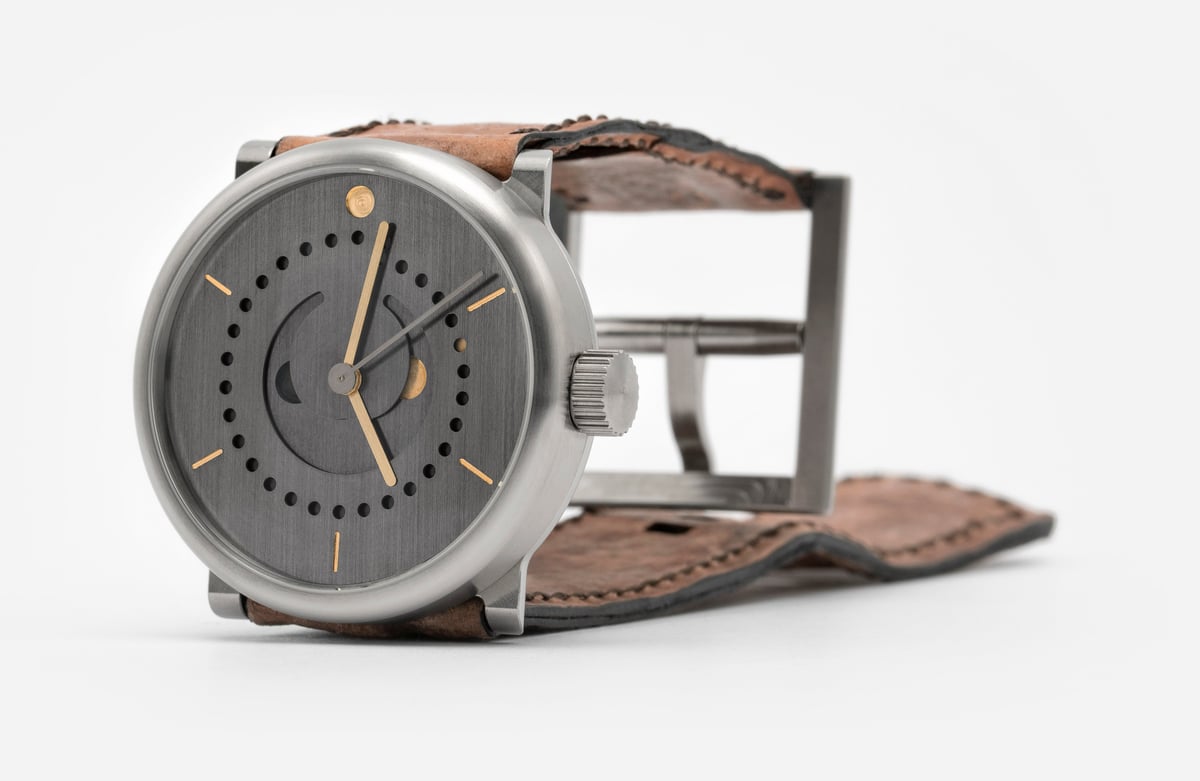
Ochs und Junior Eclittica Review: Independent Astronomy for the Serious Collector
Ochs und Junior is not a brand for collectors who need a recognizable logo on the wrist. It is a brand for collectors who enjoy the mechanics of an idea. The Eclittica, with its astronomical name and low-volume production, sits squarely in that lane. It is a watch that asks you to think about the sky rather than the spec sheet, and that is precisely why it deserves a closer look from serious collectors.
This review focuses on what matters in the current market: the Eclittica’s place in the Ochs und Junior family, how it wears, what the movement architecture suggests about ownership, and whether it makes sense as a hold. Public specifications are sparse, and Ochs und Junior does not operate like a conventional Swiss brand. That opacity is part of the experience, but it also means buyers should understand what they are getting into before they wire funds.
The brand behind the Eclittica
Ochs und Junior was founded in 2006 in La Chaux-de-Fonds, Switzerland. The brand is associated with Ludwig Oechslin, a watchmaker and astronomer whose work has long focused on reducing complex astronomical displays to a surprisingly small number of components. That philosophy is the opposite of maximalist haute horlogerie. Instead of adding bridges, levers, and decorative flourishes, Ochs und Junior tends to ask how few parts can produce the same information.
The company’s catalog includes annual calendars, perpetual calendars, moon phases, day-night displays, and two-time-zone watches. These are not conventional complications in the sense of a date window or a chronograph. They are displays that translate celestial or calendrical cycles into something a wearer can read at a glance. The Eclittica continues that tradition. Its name refers to the ecliptic, the apparent path of the Sun against the background stars. For a collector, that means the watch is less about telling time and more about locating time within a larger cycle.
Ochs und Junior also operates outside the traditional retail model. Production is small, distribution is limited, and pricing is often discussed directly with the brand rather than printed in a US MSRP list. That direct-sales approach suits the product: these are watches for people who want to speak with the maker, not just pick a reference from a display case. The trade-off is that public data is thin, secondary market liquidity is limited, and service requires planning.
What the Eclittica represents
The Eclittica is not a mass-market moonphase. It is an astronomical watch built around the idea of the ecliptic, and it fits the Ochs und Junior pattern of making a complex subject feel intuitive. The dial is designed to be read rather than decoded. That is an important distinction. Many astronomical watches become puzzles. Ochs und Junior tends to reduce the puzzle to a simple visual system, even if the underlying mechanics are unusual.
For collectors, the appeal is the combination of independent watchmaking and a complication that is genuinely different from the usual date, GMT, or chronograph. The Eclittica is a conversation piece, but not in a loud way. It rewards owners who enjoy explaining what the display does. It also appeals to collectors who have already owned the obvious pieces and want something that feels intellectually curious rather than status-driven.
The watch should be evaluated as an object of design and mechanics, not as a commodity. Ochs und Junior does not have the auction history of a Patek Philippe or the brand recognition of a Rolex. What it has is a clear point of view. The Eclittica is for the collector who values that point of view and accepts the liquidity trade-off.
Movement and architecture
The Eclittica uses a modified automatic movement based on an ETA ebauche, which is consistent with Ochs und Junior’s house practice. The exact caliber designation is not publicly emphasized, and the brand does not position the watch around chronometer certification. That is not a criticism. Ochs und Junior’s value proposition is the astronomical module and the low-component philosophy, not a decorated in-house movement with a Geneva seal.
The base runs at a modern 28,800 vibrations per hour, which is the familiar frequency for ETA automatics. The movement is automatic, so daily wear keeps it wound, and the architecture is intended to be robust rather than precious. Finishing is likely to be utilitarian, with the emphasis on function and reliability. Buyers who expect haute horlogerie decoration should look elsewhere. Buyers who want a dependable base under an unusual display will understand the logic.
Power reserve is not publicly specified in the material available for this model, and collectors should not assume a figure. The same goes for jewels and other internal details. The honest position is that Ochs und Junior does not sell the Eclittica on a spec sheet. It sells the idea and the execution. That makes a pre-purchase conversation with the brand or a knowledgeable dealer essential.
Service is another consideration. The modified base can be serviced by Ochs und Junior or by a specialist familiar with the brand’s modules. Because production is small and the complications are unusual, authorized service is the safer route. The lack of a broad service network is a real ownership cost, but it is also part of what keeps the brand independent.
Case, dial, and wrist feel
The Eclittica is offered in a titanium case, which is a sensible choice for a watch that is meant to be worn rather than stored. Titanium keeps the weight down and gives the case a muted, technical character that suits the astronomical theme. The brand does not publish case dimensions in a way that supports a precise numerical review, so it is better to describe the wearing experience rather than quote figures that may not apply to this exact reference.
On the wrist, the Eclittica feels like an intimate object rather than a sports watch. The case is designed to sit close to the wrist, and the leather strap supports that intent. This is not a watch that announces itself across a room. It is a watch that reveals itself when someone asks what the dial means. The sapphire crystal and the clean case lines keep the presentation modern, while the titanium gives it a slightly tool-like honesty.
The strap is leather with a pin buckle, which fits the brand’s understated approach. There is no lume, and that is appropriate. The Eclittica is not a dive watch or a field watch. It is a dress-adjacent astronomical piece that works best with a shirt cuff or a smart casual outfit. The lack of lume also means the dial is about legibility in normal light, not nighttime utility.
Wrist presence is moderate. The Eclittica is not a statement watch in the way a gold chronograph or a large dive watch is. It reads as an insider’s piece. That is a strength for collectors who want something personal, but it is a weakness for anyone who wants external validation. The watch is best for formal, daily, and dress occasions. It is not a sports watch, and it should not be treated as one.
Accuracy and daily performance
Ochs und Junior does not submit the Eclittica for COSC certification, so buyers should expect the performance of a well-regulated modified ETA automatic rather than chronometer-grade guarantees. In real-world use, a healthy example should run within a few seconds per day, with the usual sensitivity to position, temperature, and activity. That is perfectly acceptable for a watch of this type.
The automatic winding system means the watch is easy to live with. If you wear it regularly, it will stay wound. If you rotate it through a collection, a winder or a regular manual wind will keep it running. The lack of a published power reserve is a minor annoyance, but it does not change the ownership experience. The Eclittica is not a watch that demands constant attention.
Daily wear also depends on the strap. Leather is comfortable and appropriate, but it is not the most durable option for humid climates or heavy perspiration. Collectors who plan to wear the Eclittica frequently should consider a spare strap and avoid exposing it to water. The watch is not marketed as a water-sports piece, and there is no published water resistance figure for this reference. Treat it accordingly.
Collecting and investment case
The Eclittica is a niche independent watch, and the investment case should be framed honestly. Pricing is on request through Ochs und Junior’s direct sales network, and there is no conventional US MSRP to anchor the market. Pre-owned data is thin because the watch is produced in small numbers and trades infrequently. That means buyers should not expect the liquidity of a mainstream luxury sports watch.
From a hold perspective, the Eclittica makes sense for collectors who are buying the complication and the independent philosophy. It is not a flip. The brand’s low-volume model supports scarcity, but scarcity alone does not create a liquid market. The secondary market for Ochs und Junior is best described as stable but thin. Serious collectors may pay a premium for a well-documented example, but finding a buyer can take time.
There is no major auction history for the Eclittica to cite as a benchmark. That is not unusual for a small independent. The absence of auction data means buyers should rely on dealer relationships and private sales rather than assuming a strong resale floor. The best financial outcome is usually achieved by buying well, keeping complete paperwork, and holding for a collector who values the brand’s ideas.
My recommendation is to hold if you bought the Eclittica for its astronomical concept and independent character. Do not hold it as a short-term trade. If you need liquidity, a mainstream watch is a better asset. If you want a low-volume piece that stands apart from the usual collector checklist, the Eclittica has a defensible place in a long-term collection.
Alternatives and comparisons
Collectors considering the Eclittica often look at other astronomical or independent watches. The Ulysse Nardin Moonstruck is a more complex and much larger take on celestial display, but it operates in a different price and size universe. The Arnold & Son HM Perpetual Moon is a more decorative lunar watch with a classical aesthetic. The Czapek Moonphase offers an independent alternative with a traditional moon display. The Sarpaneva Korona Moonshine is another independent moon-focused piece with a strong personality.
There are no direct homages to the Eclittica worth recommending. The watch is too niche, and its value lies in the original module and the brand’s philosophy. A cheap moonphase might scratch the visual itch, but it will not deliver the same ownership experience. Collectors who want the Ochs und Junior idea should buy the Ochs und Junior, not a substitute.
Final verdict
The Ochs und Junior Eclittica is a serious collector’s watch for people who value independent thinking over brand recognition. It combines an astronomical concept with a modified automatic movement, a titanium case, and a deliberately understated design. It is not a liquidity play, and it is not for everyone. But for the right collector, it is a rewarding object that offers something the mainstream market rarely provides: a genuinely different way to think about time.