The House of Oechslin
Ochs und Junior is not a manufacture in the sense that Glashütte or Vallée de Joux uses the word. It is a workshop of a few people above a Lucerne courtyard, producing a few hundred watches a year, sold largely direct and through a handful of partners. What it manufactures is not ébauches but ideas — and the ideas are almost entirely Oechslin's.
His reputation rests on a specific kind of mechanical asceticism. Where a conventional perpetual calendar consumes dozens of components and a small forest of levers, Oechslin's constructions achieve the same result with single digits of parts. The same discipline governs his annual calendar, his week display, his two-time-zone mechanism, and the moon-phase work for which the brand is best known. Nothing is added for the sake of a fuller specification sheet. If a display can be achieved with one wheel instead of four, it is achieved with one wheel.
That philosophy explains both what the Luna Sole is and what it is not. It is not a watch designed to survive a comparison with a Patek Philippe on a dealer's tray, where hand-finishing and weight and the soft click of a corrector pusher carry the argument. It is a watch designed to be understood by someone who has spent enough time with movements to recognise when a solution is elegant.
The Movement: Reduction as Method
The Luna Sole runs on a modified ETA 2824-2, beating at 28,800 vibrations per hour with roughly 38 hours of autonomy. On paper, that base calibre is unremarkable — it is the most widely used automatic ébauche in Swiss watchmaking, dependable and thoroughly understood by every watchmaker in the world, and it appears in watches costing a tenth of this one.
The honesty of that choice is worth stating plainly, because it is central to how the brand thinks. Oechslin has never pretended that inventing a new base calibre is the highest use of a small workshop's resources. What matters is what sits on top: the astronomical module that turns a standard automatic into a two-body sky display, and the fact that it does so with a component count that would embarrass most complications departments. Where a conventional moon phase needs a reduction train, a jumper, a corrector and a cam, Oechslin's geometry folds the function into a smaller number of slower-moving parts with fewer interfaces to wear.
Finishing is where Ochs und Junior parts company with Geneva convention, and buyers need to decide early whether they are comfortable with that. There is no anglage to photograph. Plates are blasted or grained rather than circular-grained for effect, screws are plain, and the overall impression through a display back is of a well-made industrial object rather than a jewelled landscape. The quality is real, but it lives in tolerances, in the quietness of the winding, and in the way the mechanism's geometry can be read at a glance without explanatory text. If your pleasure in a movement comes from decoration, this is not your watch. If it comes from construction, it very much is.
Case and Dial: The Sky Without a Logo
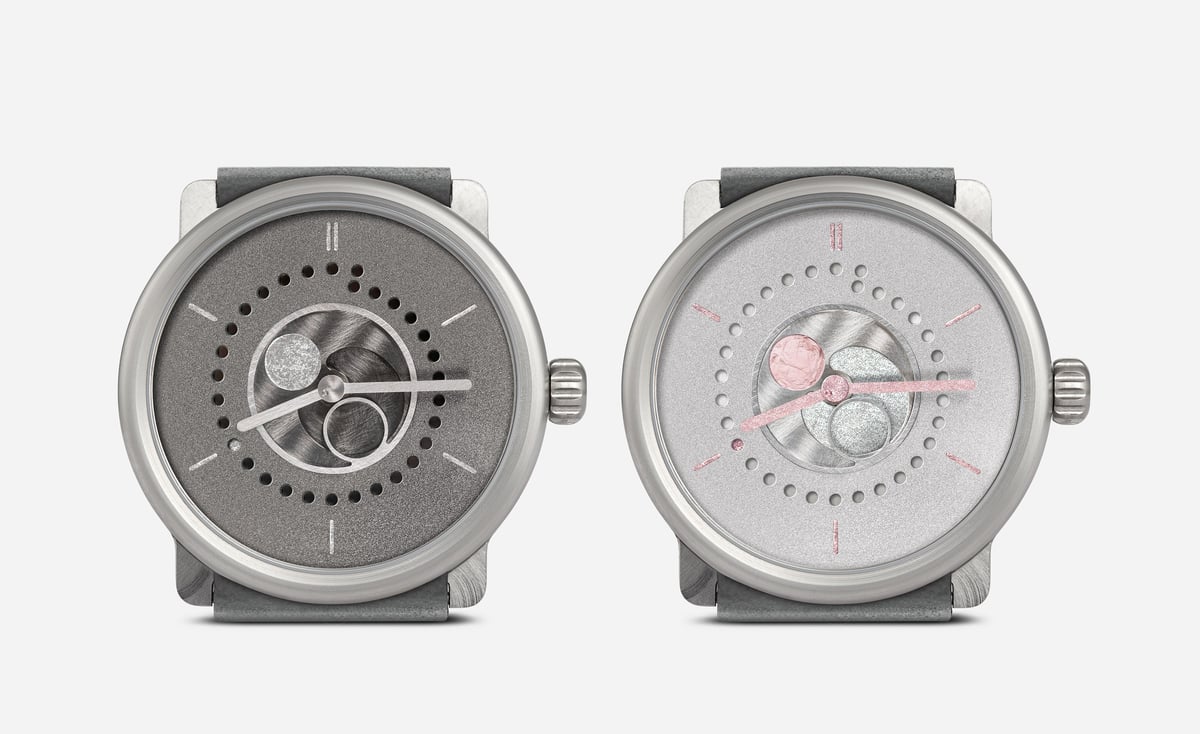
The case is titanium, bead-blasted to a uniform matte grey that absorbs light rather than throwing it. It is a shape that reads as machined — clean surfaces, decisive transitions, no decorative beveling — and it is the correct container for a dial this quiet. There is no lume, no crown guard theatre, no superfluous geometry. The crystal is sapphire, the strap is leather on a titanium pin buckle, and the whole package is conceived for a life spent indoors and at dinner rather than at altitude.
The dial is the argument. Ochs und Junior has never been interested in putting its name where a client's eye should be, and the Luna Sole carries no logo at all. What it carries instead is a rendering of the moon with photographic fidelity — cratered, shadowed, lit from the correct side — together with a solar indication that places the sun in the same visual field. Both are presented without ornamentation, without applied indices competing for attention, and without a date window interrupting the composition.
The effect is unusual in person. Most astronomical dials treat the sky as a subject for engraving; this one treats it as data, presented as cleanly as a chart. It is the visual equivalent of the movement: nothing added, nothing decorative, everything legible. Collectors who have spent years looking at guilloché and enamel sometimes find it stark on first acquaintance and indispensable six months later.
On the Wrist
Titanium does most of the work here. The Luna Sole all but disappears on the wrist — there is none of the cold heft that makes a steel sports watch announce itself with every hand movement, and the bead-blasted surface never flashes. What you notice instead is balance: the case sits flat and low against the arm, the strap runs straight off the lugs without a pronounced curve, and the whole assembly reads as machinery rather than jewellery.
The strap is the one place where the house's utilitarianism shows a seam. It is good leather, comfortable from the first day, but it is not the equal of what you would find on a watch at twice the price, and the pin buckle is honest rather than elegant. Budget for a replacement strap within a couple of years of daily wear; the case, meanwhile, will look exactly as it did on day one, because bead-blasting hides scratches the way a matte finish always does.
Presence on the wrist is a three out of five: quietly distinctive rather than loud. Nobody at a dinner table will ask about it. The one person who does will know exactly what they are looking at, and that is a better ratio than most watches manage.
Accuracy and Daily Behaviour
The ETA base is regulated before it leaves Lucerne, and in practice a Luna Sole will hold comfortably inside chronometer tolerances in normal wear — expect something in the region of a few seconds a day, with the usual caveat that automatics are sensitive to how you wear them. There is no COSC certificate and no rate guarantee framed as marketing; the brand's position is that a watch showing the position of celestial bodies is not primarily a stopwatch. If you need a daily reference for timing trains, this is not the tool, and Oechslin would be the first to say so.
What matters more day to day is that the mechanism is set-and-forget. Astronomical displays of this kind are designed to be adjusted rarely, and the reduction in component count is precisely what makes that reliability plausible: fewer parts, fewer interfaces, fewer things to drift.
Ownership, Service and the Second-Hand Market
Servicing is a straightforward proposition in principle. The ETA base is the most serviceable automatic calibre in the world, and any competent watchmaker can regulate and overhaul it. The astronomical module is another matter, and it should go back to Lucerne for anything beyond routine work — a sensible rule for any independent with proprietary geometry. Ask the brand directly for current intervals and costs rather than relying on general guidance; a small workshop's schedule is its own.
On value, honesty is required. The Luna Sole is a roughly seven-thousand-dollar watch at retail, depending on configuration and exchange rates, and it will not appreciate. Pre-owned examples trade at a discount, in a thin market, to a small pool of buyers who already understand the brand. That is exactly what you would expect of a low-production independent with no advertising budget and no boutique network, and it is not a criticism — it is the structural cost of buying something genuinely original rather than something liquid. The collector who buys one should be the collector who intends to keep it, and who takes pleasure in the fact that the person sitting next to them at dinner is almost certainly wearing something else.
Alternatives Worth Considering
If the idea appeals but the execution does not, the Sarpaneva Korona Moonshine offers the same independent spirit with sculptural drama instead of restraint. H. Moser & Cie.'s Endeavour Perpetual Moon delivers a minimalist moon with traditional finishing and a much larger aperture, at a considerably higher price. De Bethune's DB25 Lune is the high-horology endpoint of the same concept — a three-dimensional spherical moon with finishing to match. And for anyone testing whether the appeal is genuine before committing, the Christopher Ward C1 Moonglow provides a photorealistic lunar display at a fraction of the cost, and answers the question quickly.
What none of them offer is Oechslin's particular economy: the sense that the mechanism has been reduced until only the necessary remains. That is the thing you are actually buying.
Verdict
The Luna Sole is not the most beautiful watch Oechslin has made, but it may be the purest statement of his method: take an ancient astronomical problem, strip the mechanism to its irreducible geometry, and let the dial explain itself without a logo or a caption. It rewards a collector who reads movements the way others read dials, and it punishes anyone buying it as an asset. Wear it for a year and it becomes difficult to argue with.