What the Selene Is
The Selene is Ochs und Junior's moon-phase model, named for the Greek goddess of the moon. It sits within the brand's broader family of reduced astronomical watches, alongside the Perpetual Calendar, Annual Calendar, Day/Night, and Two Time Zones. Where many brands use moon phases as a romantic flourish, Ochs und Junior treats the moon as a mechanical problem worth solving cleanly. The dial is spare, the display is legible, and the watch avoids the usual decorative clutter that surrounds high-end moon phases.
That does not mean it is austere in a brutalist way. Ochs und Junior has a recognizable design language: exposed screws, modular case construction, a certain handmade asymmetry, and dials that feel more like instruments than canvases. The Selene fits that language. It is a watch for someone who enjoys looking at a dial and thinking about how the thing works, rather than simply admiring how it shines.
Brand History: Oechslin's Laboratory
Ochs und Junior was founded in 2006 in Switzerland by Ludwig Oechslin and Kurt König. Oechslin is the intellectual engine. His reputation was built on ambitious astronomical complications, including work associated with Ulysse Nardin's Trilogy of Time and the Freak, and he has long been interested in the mathematics behind calendars and celestial displays. Ochs und Junior became his laboratory for a different kind of watchmaking: fewer components, simpler architecture, and complications that are easy to live with.
That philosophy matters for the Selene. This is not a watch that tries to overwhelm you with finishing or rarity. It tries to make a moon phase feel inevitable. The brand's small scale is part of the appeal. Ochs und Junior is not a mass manufacturer, and its pieces are often configured to order. That makes the Selene a very personal object, but it also means the buying experience is more boutique than big-box. You are not just buying a watch; you are buying into a specific way of thinking about complications.
Design and Dial
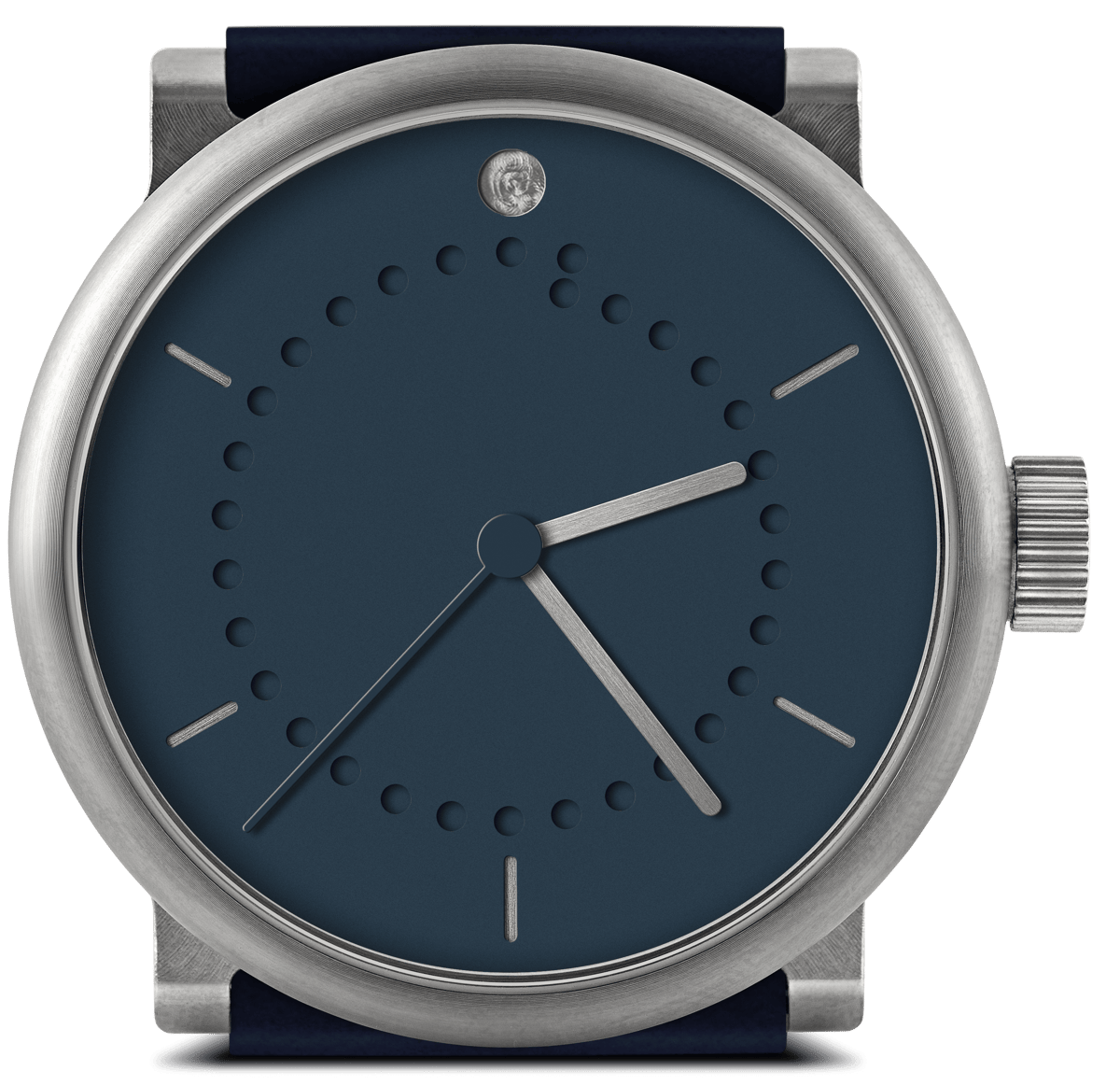
The Selene's design is defined by restraint. The case is titanium, which gives it a light, almost tool-like presence, and the dial is built around the moon display without adding unnecessary layers. Ochs und Junior's signature exposed screws and modular construction are part of the visual language, so the watch reads as a mechanism rather than a polished jewel. That is a deliberate choice. The brand wants you to see the logic of the object.
The moon display is the focal point. Ochs und Junior's moon phase is known for its long adjustment interval—the brand states that the display is engineered to need correction only once every 347 years. That is the kind of detail that appeals to collectors who like their romance backed by math. The dial keeps things readable, and the absence of lume reinforces the idea that this is a thinking watch, not a tactical one. It is a piece for daylight, desks, and dinner, not for diving or running.
The overall effect is understated but distinctive. People who know Ochs und Junior will recognize it immediately. People who do not may simply see a clean, slightly unusual watch. That is part of the charm. The Selene does not shout its price or its provenance. It waits for the right conversation.
Movement and Moon Phase
The Selene runs on an automatic movement based on the ETA 2824-2, modified by Ochs und Junior with its own moon-phase module. This is not an in-house caliber in the modern marketing sense, and it is not COSC-certified. What it is, however, is a sensible, serviceable base with a complication that has been engineered by a watchmaker who cares about part count. The power reserve is approximately 38 hours, and the frequency is 28,800 vph. Those are familiar numbers, and that familiarity is the point: Ochs und Junior is not trying to reinvent the base movement. It is trying to make the complication smarter.
The moon phase itself is the star. Ochs und Junior's approach is to reduce the number of parts while maintaining long-term accuracy. The result is a display that feels mechanically honest. You do not get a theatrical, jewel-encrusted moon; you get a clean astronomical indication that is designed to stay correct for a very long time. For collectors who have grown tired of moon phases that need frequent correction, the Selene's approach is a quiet flex. It is the kind of engineering decision that matters more after a few years of ownership than it does on the first day.
The movement finishing is not the point of this watch. Ochs und Junior's appeal is architectural rather than decorative. The brand's cases and dials often show their construction, and the movement is meant to be reliable rather than exhibition-grade. That is not a criticism. It is a different value system. If you want Geneva stripes and hand-engraved bridges, this is not your watch. If you want a moon phase that feels like a well-resolved mechanical idea, it is.
On the Wrist
The Selene wears lighter than its visual presence suggests, thanks to the titanium case. Titanium is a smart choice for a watch like this because it keeps the piece comfortable without making it feel precious. The case has a sculptural, modular quality that sits close to the wrist, and the leather strap is supple enough for daily wear. The pin buckle is simple and functional, which fits the brand's overall ethos. This is not a watch that demands constant adjustment or fussing.
Balance is good. The Selene does not feel top-heavy, and the strap integrates cleanly with the case. It is the kind of watch you can wear to a meeting, to dinner, or on a trip without feeling like you are carrying a museum piece. It is not a sports watch, and it does not pretend to be. The lack of lume and the dressier strap mean you should think of it as a daily-wear piece for people who spend their days in cities, not on trails. But within that brief, it is very comfortable.
The wrist presence is understated. This is a four-out-of-five in the sense that it has a strong identity to people who know watches, but it is not a flashy object. It rewards close looking. The exposed screws, the moon display, and the slightly irregular handmade quality give it a cult-watch energy. It is the opposite of a hype watch, which is exactly why some collectors love it.
Accuracy and Daily Life
Because the Selene uses a modified ETA base and is not COSC-certified, you should expect solid but not obsessive timekeeping. A well-regulated example should run within a handful of seconds per day, and the automatic movement is robust enough for regular wear. The moon phase is the more interesting accuracy story. Ochs und Junior's long adjustment interval means you are not resetting the moon every few months. That is a practical advantage, even if you rarely look at the moon display as a timekeeping tool.
In daily life, the Selene is a watch that asks very little of you. It is automatic, it has a simple strap, and it is comfortable enough to forget you are wearing it. It is not the watch you take to the beach or the gym. It is the watch you wear when you want a quiet reminder that watchmaking can be an intellectual pursuit. That is a specific pleasure, and it is one that the Selene delivers consistently.
Specs and Variants
Ochs und Junior does not run its business like a conventional Swiss brand. Many pieces are configured to order, and the brand does not publish a fixed reference number for every dial variation. The Selene is typically offered in titanium with a sapphire crystal, a leather strap, and a pin buckle. It has no lume. Water resistance is not the headline spec, and the brand's focus is clearly on the dial and the moon phase rather than on sports utility.
Variants tend to revolve around dial color and custom configuration. Some collectors will choose a more subdued dial; others will want something more expressive. Because the brand works closely with clients, the exact spec of any given Selene can vary. That makes the model feel personal, but it also means the secondary market is less standardized than it is for a Rolex or an Omega. If you are buying pre-owned, ask for the original configuration details and service history.
Similar Watches and Alternatives
The Selene occupies a narrow space. It is more intellectual than most moon phases, but it is also less decorative than the high-horology moon phases from the big independents. If you are shopping in this zone, a few alternatives are worth considering. The Arnold & Son HM Perpetual Moon offers a larger, more dramatic moon display with a very different aesthetic. The H. Moser & Cie. Endeavour Perpetual Moon is cleaner and more minimalist, with a focus on dial purity. The Christiaan van der Klaauw Real Moon Joure is a small independent astronomical piece with its own cult following. The De Bethune DB25 Moon Phase is a more sculptural, high-horology take on the complication.
What sets the Selene apart is its reductionist philosophy. It is not trying to be the most luxurious moon phase or the most complicated. It is trying to be the most sensible one. That makes it a compelling alternative for collectors who have already owned the obvious pieces and want something that feels more like a personal discovery. There are no direct homages to the Selene that are worth recommending. The brand's design language is too specific, and the market for copies of Ochs und Junior is essentially nonexistent.
Investment and Service
Pricing for the Selene is generally on request, and the brand's configuration-based model makes it difficult to quote a single number. That is normal for small independents, but it means you should approach the purchase with a collector's mindset rather than a flipper's. Ochs und Junior pieces are niche. They have a devoted following, but the resale market is thin. If you need liquidity, this is not the watch for you. If you want a piece that feels like a private club, it is.
Service is best handled by Ochs und Junior or a qualified independent with access to parts. The service interval and cost are not publicly standardized in the way they are for larger brands, so confirm the details directly before you buy. The good news is that the base movement is a known quantity, which should make long-term ownership easier than it would be with a highly proprietary caliber. The bad news is that the brand's small scale can mean longer lead times. Plan accordingly.
Auction history for the Selene specifically is minimal. Ochs und Junior pieces appear rarely at auction, and when they do, they tend to trade within a niche collector pool. There is no meaningful public auction record that would support an investment thesis. That is fine. The Selene is not an investment piece. It is a wearer's watch for people who value ideas.
Pros and Cons
The pros are clear. The Selene has a distinctive independent design, a moon phase with real astronomical thinking behind it, and a lightweight titanium case that makes it easy to wear. It is the kind of watch that rewards ownership over time because its appeal is intellectual rather than visual. The cons are equally clear. The service network is limited, pricing and references are opaque, and the watch lacks the lume and sports utility that some collectors expect at this price point. It is also not a liquid asset. If those trade-offs sound acceptable, the Selene is a very special object.
Final Verdict
The Ochs und Junior Selene is a moon phase for people who like their watches with a side of mathematics. It is quiet, clever, and deliberately understated. It does not try to be everything to everyone, and that is why it works. If you want a moon phase that feels like a piece of ideas rather than a marketing exercise, the Selene deserves a place on your shortlist. If you want flash, liquidity, or a watch that can do everything, look elsewhere. The Selene is for the collector who already knows what they like.