The proposition
Most dual-time watches are sold as travel tools and worn as desk jewellery. The Ochs und Junior Two Time Zones + Date inverts that. Functionally it is one of the most genuinely useful watches in the independent space — two time zones, a date, nothing else — but it is designed and finished for a life that includes a suit more often than an airport lounge.
What you are buying is not finishing in the Grand Seiko sense, or history in the Patek sense. You are buying a design argument: that a watch can display everything a traveller needs and nothing they do not, with a component count that would embarrass a Swiss manufacture's complication department.
That argument only works if the watch is pleasant to live with. Plenty of clever watches are not. This one is, and that is the more interesting story.
Lucerne, not Geneva
Ochs und Junior was founded in 2006 in Lucerne by Ludwig Oechslin and Beat Weinmann. Oechslin's CV is the reason the brand has credibility with people who do not normally care about small independents: he is a mathematician, an astronomer and a trained watchmaker, and he built Ulysse Nardin's Trilogy of Time, the brand's Perpetual Calendar and the Freak. He also restored the Farnese clock, and he has spent a career arguing that most complications are over-engineered.
That argument is the brand's entire aesthetic. Ochs und Junior movements and modules are designed to achieve their function with dramatically fewer parts than the industry norm — Oechslin's annual calendar, for instance, uses a fraction of the components a conventional annual calendar requires. Fewer parts means fewer things to fail, less friction, and a service story that is simpler than the complication list implies.
Production is small and the brand does not chase volume. That has two consequences for a buyer. First, you will almost never see another one on a wrist, and when you do, the owner will probably want to talk to you about it. Second, the secondary market is thin enough that liquidity matters more than headline value, which we will come back to.
The dial: subtraction as a design language
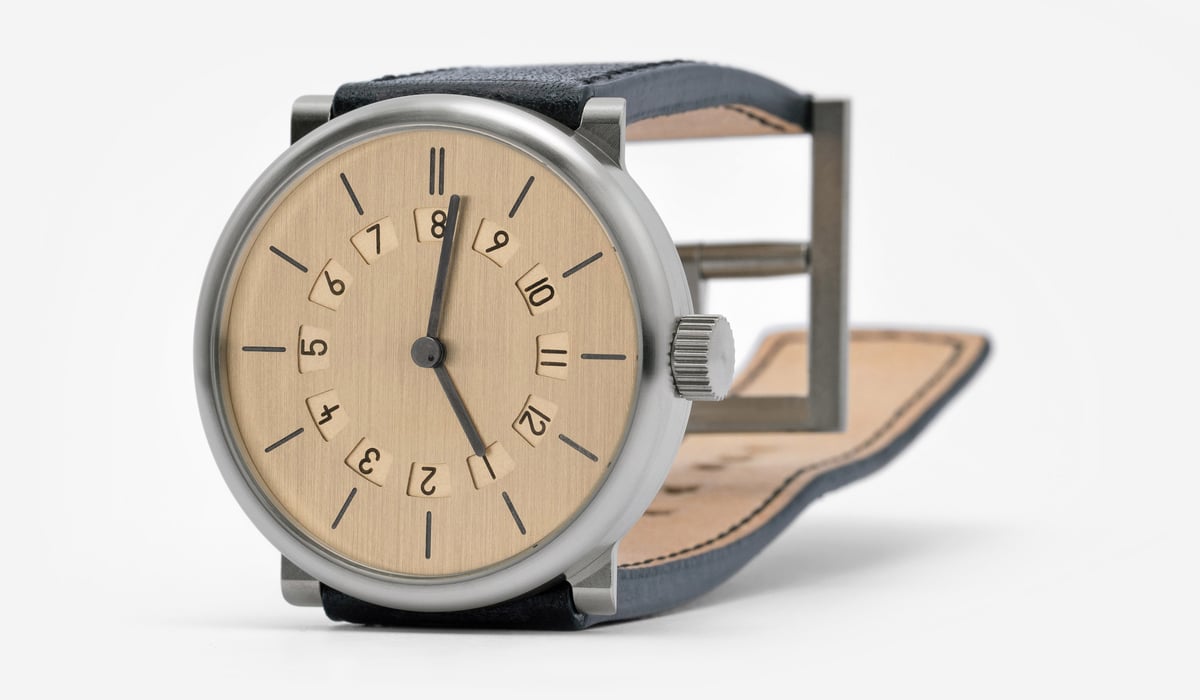
The first thing that strikes you is what is missing. No logo. No indices. No minute track crowded with type. No date magnifier. No applied markers catching light at the wrong angle. The dial has been edited down to the information you actually asked for.
What remains is a two-zone display and a date, laid out so each reads instantly without competing for attention. The second time zone is presented with enough context that you know whether the person you are about to call is asleep — a detail that separates a real travel watch from a watch with a fourth hand. The date is handled the Oechslin way: legible at a glance, absent any aperture-and-frame theatre.
The dial surfaces are where the brand's small-batch nature shows. Ochs und Junior offers configuration choices covering dial colour, hand treatment and strap, so the resulting watch reads as yours rather than as a catalogue item. The palette runs from near-white through black to blue and green, and hands are typically rendered in a contrasting tone so the two zones stay distinguishable at a glance.
It is, deliberately, a watch that photographs indifferently and wears beautifully. Flat lighting flattens it. On the wrist, in a room, with a sleeve pulled back, the restraint does the work.
Movement: an ETA base with an Oechslin brain
The Two Time Zones + Date runs on an ETA 2892-A2 base, with an Ochs und Junior module handling the second time zone and the date. This is worth being honest about: the base is not in-house, and the brand does not pretend otherwise. What is in-house is the thinking — the module, the component reduction, the layout.
The 2892 is the right choice for this watch. It is thin, proven, serviceable and accurate. Beat rate is 28,800 vph and power reserve sits in the region of 42 hours. The architecture keeps the case from becoming a slab, which matters more than it sounds on a watch with a minimalist dial: a tall case would undo the entire design premise.
Finishing is functional rather than exhibition grade. There is no display-back theatre here, because the point of the watch is the front. If you are the sort of collector who removes the caseback to count anglage, this is not your watch. If you care that the thing is engineered to do its job with the fewest possible failure points, it very much is.
The one caveat is that the module is proprietary. The base will not frighten any competent watchmaker, but if the second-zone or date mechanism needs attention, the watch realistically goes back to Lucerne or an authorised partner. That is the price of a genuinely small brand.
On the wrist
Titanium changes the calculus. The watch is noticeably lighter than a steel equivalent and that lightness is what makes it a genuine daily wear rather than a weekend piece. It disappears under a cuff and never becomes a burden across a long day.
The case is round and restrained, with lug geometry that sits down onto the wrist rather than perching above it. On the leather strap the balance is neutral; there is no top-heaviness and no tendency to rotate. The absence of a bracelet is not a limitation — it is part of the design brief, and the straps the brand offers are cut to suit the case rather than to fill a catalogue page.
Legibility in good light is excellent. After dark it is simply adequate, because there is no lume at all. That is a deliberate choice consistent with the watch's character, but it is the one place where the design philosophy costs you something practical. If you need to read the time at 3 a.m. in a hotel room without switching a light on, this watch will not help you.
Accuracy and daily life
An ETA 2892-A2 in good health will run comfortably within roughly -5 to +10 seconds a day, and Ochs und Junior does not pursue chronometer certification. That is the honest expectation: a precision instrument in the sense of being well regulated, not in the sense of being a COSC certificate with a marketing budget attached.
In practice the movement's real virtue is stability. The 2892 is one of the most thoroughly understood automatics ever built, which means parts exist, service is straightforward, and a competent watchmaker knows exactly what they are looking at. For an owner planning to keep the watch for a decade, that is worth more than a marginally better rate out of the box.
Two zones, one date, and the question of the third function
The argument for a two-time-zone watch over a world timer is simplicity: you fly between two places, mostly, and you want both times visible without pressing anything. The argument for it over a GMT with a 24-hour bezel is legibility: the Ochs und Junior layout does not require you to decode a scale in a hurry.
The date is what makes this the practical member of the family. A pure two-zone watch is a travel tool; adding the date turns it into a daily wear that happens to travel well. It sounds like a small thing. It changes the ownership experience substantially, because it removes the reason most people stop wearing their travel watch on a Tuesday.
The market reality
Ochs und Junior is a cult brand, and cult brands have a specific secondary-market profile: extremely thin trading, prices that hold reasonably well because supply is small, and almost no auction benchmark. There is no meaningful public auction record to point to. These watches trade through the brand, through a small number of specialist dealers, and through private collectors who know each other.
That is simultaneously the risk and the appeal. The risk is liquidity: if you need to sell in a hurry, you will take a haircut and you will wait. The appeal is that the price is not driven by hype cycles, so it does not collapse when a trend turns.
Pricing sits in the low-to-mid five figures in US dollars depending on configuration and timing, with pre-owned examples typically trading below current retail. Configuration matters more than you would expect — the brand's colour and strap options mean two superficially identical watches can sit at noticeably different points, and a well-chosen colour can be the difference between a slow sale and no sale at all.
The honest framing is this: this is a stable-value watch, not an appreciating one. It will not lose half its value the way a fashion-driven release might, and it will not double the way a hyped steel sports watch occasionally does. It behaves like what it is — a small-production object with a small, committed buyer pool.
Buying used
Because trading is thin, condition and completeness matter disproportionately. Ask for the original invoice and configuration details; the brand's build-to-order nature means provenance is the only reliable way to confirm exactly what a given piece is. Check that the second time zone sets and adjusts cleanly, that the date changes crisply rather than dragging, and that the case has not been polished — the flat surfaces and clean transitions are the whole design, and a heavy-handed refinish is difficult to reverse.
Strap wear is a non-issue; straps are consumables and the brand will supply replacements. Case and module condition are the things that cost real money.
What it competes with
At the practical end, a NOMOS Tangomat GMT offers an in-house dual time with a similarly disciplined dial for materially less money, and it is the obvious rational alternative. A Grand Seiko GMT brings finishing in a different league and a movement with a different philosophy behind it. Higher up, Moser's dual-time watches make the same argument about restraint with more expensive materials and a different kind of hand finishing. A Reverso Duoface offers two time zones with a century of design history attached.
None of them are the same object. The Ochs und Junior is the only one in that group that is genuinely a design statement first and a watch second — and the only one that almost nobody will recognise.
Verdict
Buy the Two Time Zones + Date because you want a genuinely useful dual-time watch that does not look like anyone else's, and because you are comfortable owning something with a thin resale market and no auction record. Do not buy it as an investment. Do not buy it if you need to read the time in the dark.
Do buy it if Oechslin's component-count philosophy appeals to you at the level of how you actually live with a watch rather than how you talk about it at a dinner. It is not the most impressive object in its price bracket. It may be the most honest.