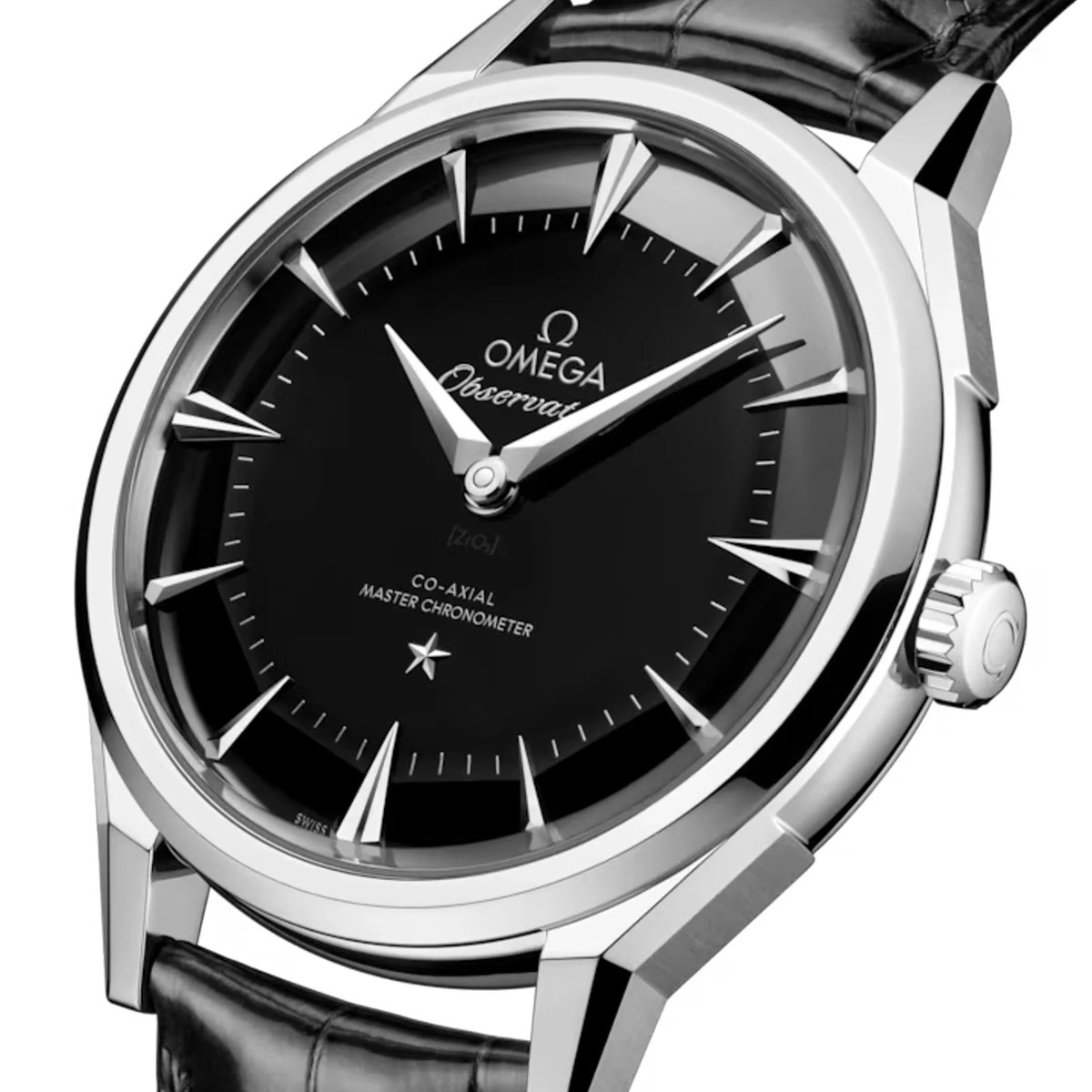
The flex has changed. Five years ago a young collector's first serious purchase was a steel chronograph with a waiting list and a group chat. Now it's something quieter — a watch you have to explain, because the explanation is the point. The Omega Constellation Observatory Collection is built entirely around that shift. It is a watch for people who would rather tell you what a METAS test actually measures than what they paid.
And it has the receipts, which is more than most heritage reissues can say. The Constellation launched in 1952 as the consumer face of Omega's observatory competition programme — the era when Swiss brands submitted stripped movements to Geneva, Kew-Teddington and Neuchâtel to be timed in every position and temperature for weeks on end. Omega won so consistently through the 1930s, 40s and early 50s that "Constellation" was less a name than a trophy. The Observatory Collection is that trophy, recut for a generation that grew up reading spec sheets instead of adverts.
One honest caveat before we go deep: Omega has not published a standalone catalogue data card under the Observatory Collection name, and no serious outlet should be quoting you exact dimensions for it. What is documented and verifiable is the platform it draws from — the Constellation Globemaster, introduced in 2015 as the world's first Master Chronometer, developed jointly with METAS, the Swiss Federal Institute of Metrology. Anchor everything to that and the review holds up. Invent the rest and you're writing fiction.
The Observatory Myth, and Why It Still Sells
Observatory trials were the original leaderboard. Before chronometers went to the Moon, they went to a granite cellar in Neuchâtel and got timed in six positions across wildly different temperatures for forty-five days. Brands staked their reputations on the results, and Omega staked more than most. That history is why the word "Constellation" still carries weight with people who collect precision rather than logos — and it's why the modern revival doesn't feel like a costume.
What makes the Observatory framing more than nostalgia is that the certification philosophy is a direct descendant. The old trials tested movements, stripped and hand-tuned, in laboratory conditions. The Master Chronometer standard tests the finished watch on your wrist's terms — fully cased, fully assembled, then subjected to a magnetic field strong enough to stop most mechanical watches dead, and only then measured for accuracy. It's the observatory trial with better instrumentation and a much harder question.
From 1848 to the Pie Pan
Louis Brandt founded Omega in La Chaux-de-Fonds in 1848; the company moved to Biel/Bienne in 1880 and spent the next seven decades turning precision into a brand asset. The 1952 Constellation was the payoff — a dress watch with a faceted, stepped dial that caught light like a coin under a jeweller's lamp. Collectors call it the pie pan. It is arguably the most underrated dial design in Swiss watchmaking, and it has never really been out of production since.
The 2015 Globemaster did something clever with that inheritance: it kept the pie pan and the fluted bezel, and dropped the claw-like griffes that had defined the Constellation since the 1980s Manhattan era. The result is a watch that reads as heritage without reading as retro. Then Omega went further and made it the launch vehicle for Master Chronometer certification — a decision that turned a dress watch into a technical statement. If you want to understand why the Observatory Collection exists at all, that's the moment: a quiet, fluted, pie-pan watch became the proof of concept for the entire modern brand.
The Engine: Master Chronometer, Explained Without the Brochure
The calibre is the 8900, or the 8901 in gold-cased variants — same architecture, gold rotor and balance bridge. Twin barrels, 60 hours of reserve, co-axial escapement, Si14 silicon balance spring, free-sprung balance. It runs at 25,200 vibrations per hour, which is a deliberate middle path: smoother than 4 Hz, more stable than 3 Hz, and a signature Omega has committed to across the family.
But the calibre isn't the story. The certification is. Master Chronometer means COSC first, then eight additional METAS tests on the cased watch, including exposure to 15,000 gauss and a 0 to +5 seconds per day accuracy band measured afterwards. Read that again: after. Most magnetic resistance claims are theoretical. This one is a post-trauma measurement. The reason Omega can do it without a soft-iron cage is that the escapement and balance spring are non-magnetic silicon, so the caseback stays open and you get to look at the movement. That's engineering as aesthetics, which is the only kind that ages well.
What It's Actually Like on the Wrist
The first thing you notice is the absence of drama. No lume to catch the light, no crown guards, no bezel grip that wants attention. The fluted bezel and domed sapphire do all the work, and the pie-pan dial throws light at angles rather than at you. It reads as a dress watch across a table and as a tool under a loupe — a combination almost nobody gets right.
The second thing you notice is balance. The bracelet tapers properly, the links articulate without a break-in period, and the deployant sits flat rather than tenting under the wrist. Because there's no soft-iron cage or chunky bezel adding bulk, the whole thing carries closer to a vintage piece than to a modern luxury-sports watch. You forget it's there the way you forget a well-cut jacket is there. The trade-off is psychological: with no luminescence and a polished fluted bezel, this is not a watch you wear to change a tyre. It's a watch you wear to the meeting that decides something.
Accuracy: The 0/+5 Promise
Owners of the platform consistently report it settling tighter than the certificate requires — frequently inside two seconds a day, with positional variance doing more work than temperature. That's the practical reality of twin barrels and a silicon escapement: consistent torque, almost no thermal drift, and a rate that barely notices you've been sitting at a desk for nine hours.
What to actually expect day to day: correct the date once every couple of months, correct the time almost never, and don't obsess over a timegrapher reading taken in one position on a Tuesday. The 0/+5 window is a floor on performance, not a ceiling. If your example runs at +1.5 seconds averaged across a week of normal wear, that's the platform working as designed.
Where It Fits: Occasions
Dress and formal are obvious — the pie-pan dial under a cuff is the whole point. Daily is more defensible than it looks: 60 hours of reserve, a silicon escapement that shrugs off laptops and airport scanners, and a bracelet that can take a desk. Travel is fine, though the date-only complication means it's not a GMT substitute. Sport is the one honest gap: no lume, polished bezel, domed sapphire. Wear it to the gym and you'll find out what a rubber hex dumbbell thinks of Swiss finishing.
The Variants That Matter
Four configurations define the family. Steel on the bracelet with the silver pie-pan dial is the purist's pick and the one worth buying first — no gold flash, no compromise, and the one that will look least dated in a decade. Steel on leather is the dress-watch conversion and the value entry point. Two-tone with Sedna gold steps up to the 8901 and the wedding-season audience. Full Sedna gold is a different room entirely: same certification, entirely different conversation.
The honest advice: buy the bracelet. Omega's steel bracelets are properly finished and the deployant is genuinely good, and buying on leather and sourcing a bracelet later is a more expensive path than the reverse.
Family Tree
The direct ancestor is the 1952 Constellation and its pie-pan descendants through the 1960s and 70s. The disruptive middle child is the 1980s Manhattan with its claw griffes and integrated bracelet — the version most people picture when they hear the name, and the one this collection deliberately steps away from. The modern siblings are the Globemaster itself, the Globemaster Annual Calendar, and the current Co-Axial Constellations in smaller dress sizes. If you're shopping the family, the Globemaster is the intellectual centre of gravity.
Alternatives, Honest Ones
The Rolex Datejust 41 is the default answer and the reason you should look elsewhere first — it's superb, but it's certified to Rolex's own standard, not to a protocol that includes post-magnetic accuracy. The Grand Seiko Heritage 'Snowflake' offers Spring Drive's glide and dial finishing that embarrasses watches at twice the money. The Jaeger-LeCoultre Master Control Date is quieter and more traditionally finished, with less magnetic armour. The Chopard Alpine Eagle brings integrated-bracelet energy for people who want the case to talk.
At the entry level, the Tissot PRX Powermatic 80 delivers the steel-and-brushed mood for a fraction of the ticket, the Orient Star Classic covers the pie-pan silhouette with an in-house Japanese automatic, and the Frederique Constant Classics Index is the restrained Swiss stand-in. None of them carry the certification, which is precisely the point.
Money: What It Costs and What It Holds
Steel examples sit in the high four figures to low five figures depending on configuration, with gold variants materially above that — treat any single number you see online as indicative rather than gospel, because Omega's regional pricing and bracelet-versus-strap splits move it around. On the secondary market, steel pieces trade below retail, which is normal for a watch that isn't scarce and isn't hyped.
Which is exactly why it's a good buy. The Master Chronometer premium hasn't been priced in as collectibility because the market still rewards scarcity over specification. That won't last forever — certification transparency is becoming a buying criterion, and Omega got there first. Hold recommendation: buy the steel-on-bracelet, wear it hard, and don't expect to flip it. The upside is that in ten years you'll own one of the few watches from this era whose technical claims still look credible.
Auction history is thin, honestly. The modern Globemaster hasn't had time and isn't rare. Vintage Constellations surface at Phillips and Antiquorum regularly without headline results — the money is in the dial and the case, not the reference number.
Service
Omega's service network is unusually wide for a luxury brand, which is a real ownership advantage. Independents increasingly handle co-axial calibres, but confirm METAS re-certification capability before handing over a Master Chronometer — you want the certificate to survive the service, not just the watch. Budget for it as you would for a good suit's annual upkeep: infrequent, meaningful, and worth doing properly.
Verdict
The Constellation Observatory Collection is the smartest thing in Omega's catalogue that nobody is queuing for — a certified-precision dress watch with a real historical argument and no hype premium attached. It won't win a dinner-party argument against a Submariner. It will win every argument afterwards, when you explain what METAS actually tests and why the answer matters. Buy the steel one on the bracelet, wear it to things that matter, and let the people who bought the trend worry about the resale.
Pros: METAS certification on the cased watch including 15,000-gauss resistance; genuine observatory-trial heritage; pie-pan dial that reads vintage without vintage fragility; 60-hour twin-barrel practicality.
Cons: No lume at all; the collection naming is loose enough to require homework; polished fluted bezel scratches; sits in a price band that Datejust and Grand Seiko buyers both skip.