The Dive Watch That Refuses to Be a Status Symbol
There is a certain kind of watch collector who buys a Rolex Submariner because everyone else does, and there is another kind who buys an Omega Planet Ocean 600M because they want the same technical credibility without the waiting list. The Planet Ocean has always been the thinking person's diver — overbuilt where it matters, unfussy where it doesn't, and priced as though Omega actually wants you to take it into the water.
Launched in 2005, the Planet Ocean extended the Seamaster family's maritime heritage into full professional-diver territory. Where the Seamaster Diver 300M stayed a lifestyle-adjacent sports watch, the Planet Ocean went straight for 600 metres of water resistance and a case built like a bank vault. Two decades on, the current Master Chronometer generation is the most refined expression of that idea — and the 43.5mm steel reference with caliber 8900 is the version most people actually end up buying.
Heritage: From Biel to the Bottom of the Sea
Omega's ties to the ocean run deep — literally. Founded in 1848 by Louis Brandt, the brand built its early reputation on precision marine chronometry before the Seamaster line debuted in 1948. The Planet Ocean arrived in 2005 as a modern reinterpretation of that heritage, with a name that nodded to the Seamaster 300 of 1957 while pushing the spec sheet well beyond it.
The Planet Ocean also carries Omega's relationship with professional diving and ocean conservation — most visibly through its longstanding partnership with explorer and documentary work around the world's oceans. That's not just marketing: the watch's 600m rating, helium escape valve, and unidirectional bezel are real tools, not decoration.
Case and Design: Substance Over Signaling
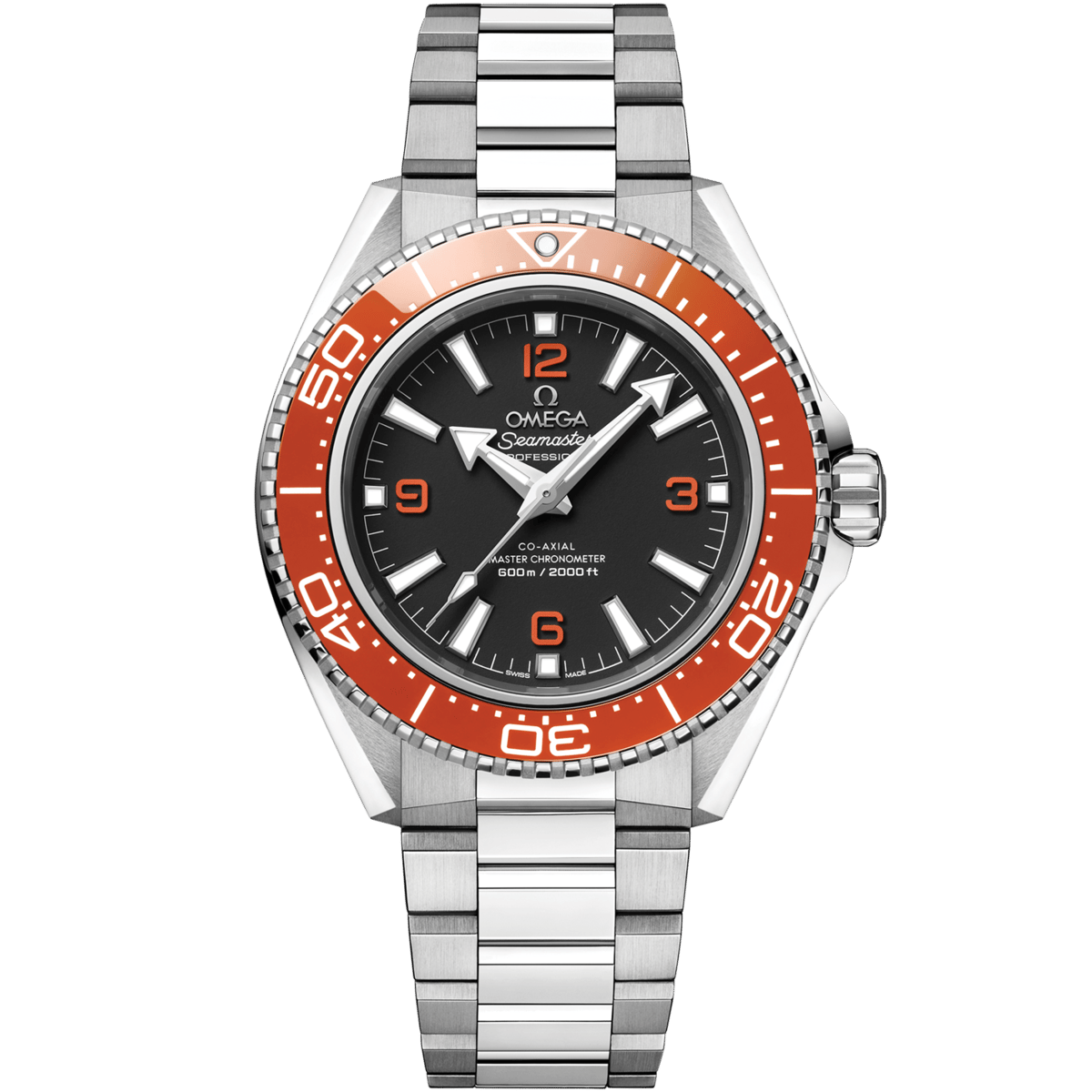
The 43.5mm stainless steel case is the Planet Ocean's defining feature. It's broad, confident, and unapologetically heavy in the hand — the kind of watch that reminds you it's there every time you pull a jumper sleeve over it. The domed sapphire crystal sits slightly proud, a deliberate design cue that echoes vintage dive watches while improving legibility at angles.
The ceramic bezel insert is glossy and resistant to fading, with a diving scale that's crisply filled and easy to read in low light. The arrow-shaped hands and applied indices are heavily lumed, and the Super-LumiNova glow is generous — a full charge will easily run through a night dive or a red-eye flight.
The design language is unmistakably Planet Ocean: the broad arrow hands, the 6-9-12 layout, the scalloped bezel edge. It's not a watch that disappears into a room, but it's also not trying to. If the Submariner is a tailored blazer, the Planet Ocean is a well-worn field jacket — practical, rugged, and quietly confident.
The Movement: Caliber 8900 and the Master Chronometer Standard
The heart of the 43.5mm Planet Ocean is Omega's in-house caliber 8900 — a co-axial automatic that represents the brand's current technical high-water mark. It's a Master Chronometer, meaning it has passed METAS certification at 0/+5 seconds per day across five positions, after exposure to magnetic fields of 15,000 gauss, and after a full power-reserve cycle.
Twin barrels deliver 60 hours of power reserve, and the movement runs at 25,200 vph with 39 jewels. The co-axial escapement has been refined across generations to the point where service intervals are longer than they once were, and the silicon balance spring ensures both magnetic resistance and long-term stability. The finishing — arabesque Geneva stripes, blackened screws, and a rotor decorated with Omega's own aesthetic — is attractive without being exhibition-grade, which suits a tool watch perfectly.
What matters most is that the 8900 is genuinely over-engineered for daily life. You can leave it on a nightstand next to a laptop and a pair of speakers without worrying about magnetization. You can swim, dive, and shower with it. The movement's job is to be invisible, and it does that job beautifully.
On the Wrist: How It Actually Wears
The Planet Ocean 600M wears exactly as its spec sheet reads: substantial, planted, and honest about its mass. The 43.5mm case lands squarely on mid-size wrists without overhang, and the broad, sloping lugs keep the watch from feeling tippy. The domed sapphire and ceramic bezel insert pull the eye inward rather than outward, so the watch can read slightly smaller than the numbers suggest.
The bracelet is where Omega has quietly pulled ahead of its price bracket. The screw-and-pin links articulate cleanly, the half-link adjustment is genuinely useful, and the folding clasp with diver extension is a reminder that this is still first and foremost a piece of equipment. On a tropical rubber strap it becomes a different watch entirely — lighter, more casual, and honestly the way most owners will live with one day to day.
It is, however, not a small watch. If you're used to a 38mm dress piece, the Planet Ocean will feel like a commitment. For wrists above 6.5 inches it's comfortable; below that, try before you buy.
Accuracy: Boring Precision, in the Best Way
Master Chronometer certification means expectations should be high — and they are. In real-world ownership, most caliber 8900 examples settle into 0/+3 seconds per day, and plenty of owners report near-zero deviation once the movement is fully broken in. The 60-hour power reserve means you can take it off Friday night and find it running Monday morning without fuss.
This is exactly the kind of accuracy a dive watch should deliver: consistent, predictable, and utterly unremarkable in the best possible sense. You don't think about it, which means Omega has done its job.
The Lineup: Which Reference to Choose
The 43.5mm steel case is available in a few configurations, and the choice mostly comes down to dial colour and bracelet versus strap.
- 215.30.44.21.01.001 — Black ceramic dial on the stainless steel bracelet. The volume leader and the safest long-term pick.
- 215.30.44.21.03.001 — Blue ceramic dial on the steel bracelet. The most photogenic of the lineup and a favourite among collectors who want something less severe than black.
- 215.32.44.21.01.001 — Black dial on the rubber strap. Lighter on the wrist and the better warm-weather daily.
Smaller-wristed buyers should also look at the 39.5mm Planet Ocean, which shares the design language but uses caliber 8800 with a 55-hour reserve. It's a genuinely compelling alternative and often the smarter buy for anyone under a 6.5-inch wrist.
Collecting and Value: A Wearer, Not a Vault Piece
At retail, the 43.5mm Planet Ocean on steel lands around the $7,000 mark — a meaningful premium over a Seamaster Diver 300M, but still well below a Submariner Date. On the secondary market, clean examples typically trade between roughly $3,800 and $5,600 depending on age, condition, and box/papers, which makes it one of the better value propositions in serious dive watches.
That said, the Planet Ocean is a wearer's watch, not a collectible. It doesn't have auction history, and it's unlikely to appreciate. But depreciation flattens quickly — a well-kept example bought at three years old typically tracks the market rather than falling through it. Buy it to dive, swim, and travel with, not to flip.
Service and Ownership
Omega recommends servicing roughly every 5-8 years depending on wear, and a full service with METAS recalibration runs around $600 at an authorized center. Independent watchmakers familiar with the co-axial movement can do the work for less, though the Master Chronometer certification is best preserved through Omega's own network. Parts availability is excellent, and the watch is designed to be serviceable for decades.
Alternatives Worth Considering
The obvious rival is the Rolex Submariner Date, which offers stronger resale and a slightly smaller footprint but also a substantial premium and a waiting list. The Tudor Pelagos 39 is a titanium, 200m-rated alternative with a more modern, tool-focused aesthetic. Blancpain's Fifty Fathoms is the heritage play, at a price that reflects its status as the original 1953 dive watch. And if you're drawn more to design than spec, IWC's Aquatimer Automatic 42 is a quieter, more architectural take on the same brief.
For buyers on a budget, the Christopher Ward C60 Trident Pro 600 offers a genuine 600m rating and Swiss movement at a fraction of the price — arguably the most honest homage in the segment. Seiko's Prospex SPB185 and Orient's Kamasu round out the entry-level options, each delivering real dive-watch capability without pretence.
Final Verdict
The Omega Planet Ocean 600M is the dive watch for people who actually dive — and for collectors smart enough to see that a METAS-certified 600m Master Chronometer at this price is a genuinely serious instrument. It isn't flashy, it isn't hyped, and it isn't trying to be a Submariner. It's simply one of the most complete steel divers on the market, and after twenty years it remains the benchmark Omega keeps quietly raising.
If you want a watch that signals status, look elsewhere. If you want a watch that works — in the water, on a plane, and at dinner — the Planet Ocean 600M is the answer.