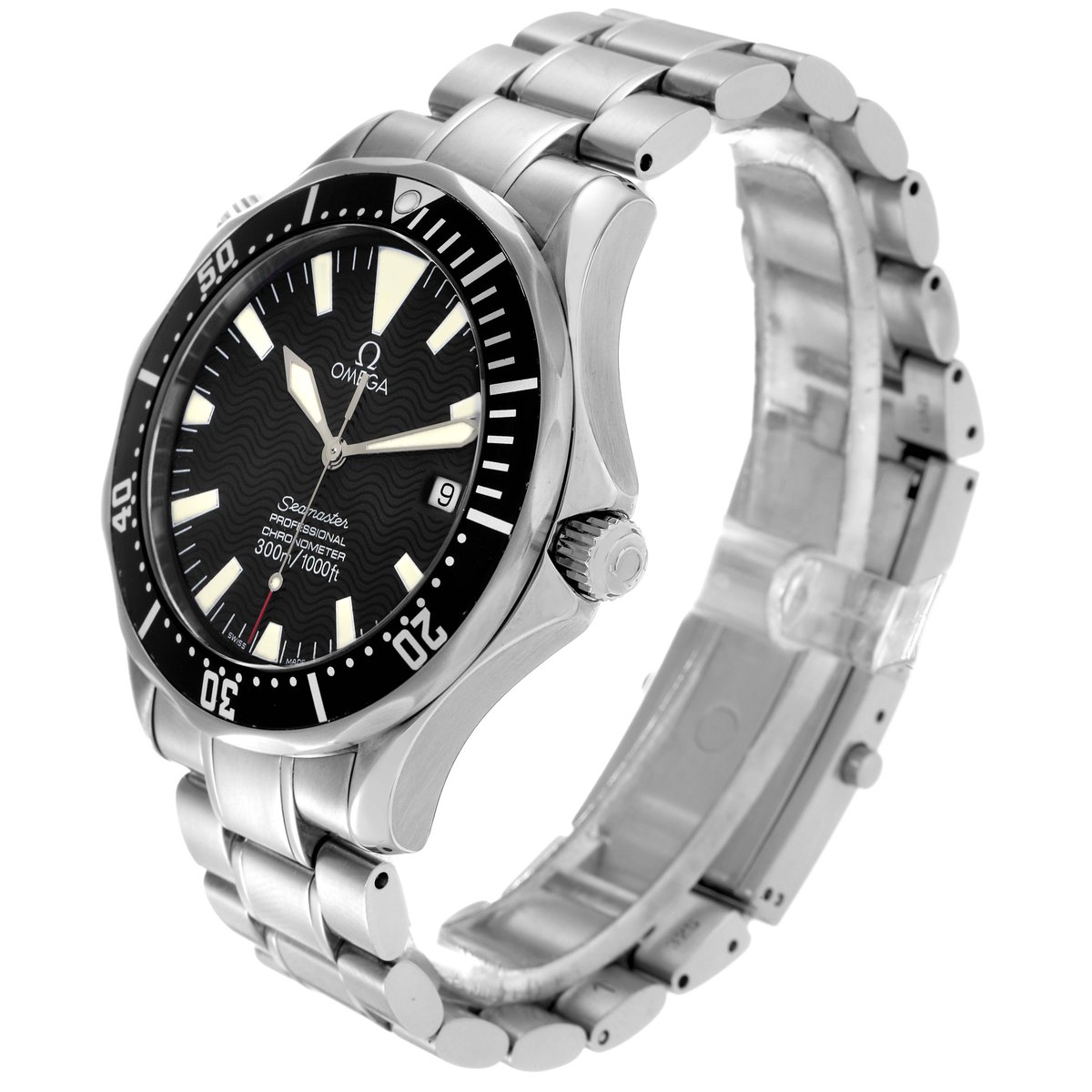
Why the 2254.50 matters right now
For most of the last two decades, the Omega Seamaster Professional 300M reference 2254.50.00 was the sensible answer to an unfashionable question: what if you wanted a Submariner but refused to pay Submariner money? It was the diver you bought used for four figures, wore into salt water, and forgot about. That era is finished.
Since around 2020 the 2254.50 — known to basically everyone as the Peter Blake — has migrated from entry-level beater to genuine neo-vintage target. Sharp, complete examples now trade in the low-to-mid four figures, and the spread between a polished-out survivor and a crisp full set has widened dramatically. That widening is the classic signature of a reference graduating from cheap to collected.
The case for it: sword hands, a wave-textured dial, no helium escape valve, a COSC-certified automatic, and proportions that read as a tool watch rather than jewellery. The case against: a pressed-steel clasp, an aluminium bezel insert, and a movement that is not in-house. Both lists are accurate. Which one wins depends on why you are buying.
Omega, the Seamaster, and the reference that cleaned up the line
Omega was founded in 1848 in La Chaux-de-Fonds, Switzerland, by Louis Brandt. By the middle of the twentieth century it was one of the most technically ambitious watchmakers in the world — the calibre that won NASA's 1963 chronograph trials, the first watch worn on the Moon, the industrialisation of the co-axial escapement. The Seamaster name arrived in 1948 as a water-resistant family, and in 1957 Omega added the Seamaster 300, reference CK2913, a proper dive watch with a rotating bezel and a screw-down caseback.
The modern Seamaster Professional 300M landed in 1993 and became a household object two years later when Pierce Brosnan wore one in GoldenEye. That watch — reference 2531.80.00, blue wave dial, skeleton hands, helium escape valve at ten o'clock — defined the line for a decade and still defines it in the public imagination.
The 2254.50.00 is the quieter sibling. It keeps the 300-metre case architecture but deletes the helium valve, trades skeleton hands for broad sword hands, and gives the dial a wave texture that reads as structure rather than decoration. The result is a cleaner case flank, a more legible dial, and a silhouette that photographs like a far more expensive watch than it is. Omega built it for roughly a decade from the late 1990s into the mid-2000s, then replaced it with the co-axial 2220.80 generation — a decision the secondary market has spent twenty years second-guessing.
The movement: Caliber 1120
Behind the solid caseback sits Omega Caliber 1120, an automatic chronometer built on the ETA 2892-A2 architecture. It runs at 28,800 vibrations per hour with roughly 44 hours of power reserve, and it is COSC-certified — every example left Biel having averaged between -4 and +6 seconds per day across five positions and three temperatures.
Purists will point out that the 1120 is not in-house, and they are correct. What they usually omit is that this is a feature. The 2892-A2 is one of the slimmest, most robust and most universally serviceable automatic movements ever produced. Any competent independent watchmaker can strip, clean, regulate and reassemble one. Parts are obtainable. You will not be shipping the watch to Switzerland and waiting six months for it to come home.
Finishing is period-appropriate: rhodium plating, circular graining, Omega's signature on the rotor. It is not haute horlogerie and never pretended to be. It is a workhorse with a certificate, and in a watch you intend to actually dive with, that is the correct trade.
Case, dial and bracelet
The case is stainless steel, 41mm across, rated to 300 metres with a screw-down crown and a solid engraved caseback. Because there is no helium escape valve, the left flank is a clean continuous curve — a small detail that makes the 2254.50 look noticeably more refined in profile than the Bond-generation 2531.80.
The bezel is the classic scalloped Seamaster design with an aluminium insert, matte black on this reference, with the first fifteen minutes marked in Arabic numerals. Aluminium fades, scratches and occasionally chips in a way ceramic never will. On a twenty-year-old watch that patina is part of the charm; if you are buying to flip, it is a deduction, and you should price it accordingly.
The dial is the headline. A black wave-textured surface with applied round lume plots, a triangle at twelve, and the broad sword hands that give the reference its nickname. There is a date aperture at three with no cyclops, which keeps the dial balanced and, frankly, looks better than the magnified alternative. Legibility is outstanding in every light condition, which is the entire point of a dive watch and something a surprising number of luxury divers forget.
The crystal is sapphire with anti-reflective coating applied to the underside, so it stays clear without the blue sheen that plagues coated crystals.
The bracelet is a stainless-steel three-link design with a folding clasp and a diver's extension. This is the weakest element of the package. The clasp is pressed rather than milled, there is no micro-adjust beyond the extension, and the end links do not seat as tightly as a modern Omega's. Plenty of owners solve it with a rubber strap or a mesh bracelet. Others accept it as period-correct and move on.
On the wrist
This is where the 2254.50 quietly outperforms its price bracket. At 41mm with a relatively slim case profile, it sits flat and low on the wrist rather than perching on top of it. The lugs curve down steeply enough that the watch hugs even a modest wrist, and the weight distribution is neutral — no top-heaviness, no tendency to rotate. On a 6.5-inch wrist it reads as a substantial but entirely manageable tool watch; on a 7.5-inch wrist it looks exactly right.
The bracelet deserves a second mention because it defines the ownership experience. It is comfortable, it tapers properly, and it looks far more expensive than it is — but the clasp is the one place where you can feel the era. If you are coming from a modern Seamaster or a Submariner, the difference is immediate. If you are coming from a Seiko, you will not notice.
The other thing you notice is the bezel action. It is crisp, well-damped and aligned — assuming the watch has not been abused. On a used example, check for back-play and for a bezel that turns too freely; both indicate a hard life.
Accuracy in the real world
COSC certification promises -4/+6 seconds per day, and that is a fair expectation for a healthy 1120. In practice, most well-serviced examples settle into a comfortable range of roughly +2 to +8 seconds per day depending on position and wear pattern. A watch that has not been serviced in a decade will drift wider — sometimes considerably — and a tired 2892-A2 can lose amplitude and start running slow.
If you are buying, ask when it was last serviced. If the answer is never and the watch is twenty years old, budget for a service immediately and factor that into your offer. If the seller cannot tell you the amplitude or the daily rate, assume the worst and negotiate accordingly.
When to wear it
This is a genuine go-anywhere watch, which is precisely why it has held its value. It works with a t-shirt and it works with a blazer. It is at home in the water, on a plane and at a desk. It is not a dress watch and it does not pretend to be one, but on a leather strap it can pass in most rooms where a steel sports watch is acceptable.
Where it excels is the category collectors underrate: the single-watch collection. If you own one watch and you want it to survive a decade of everything, the 2254.50 is close to an ideal answer.
The market: pricing, trend and the hold-or-sell call
The 2254.50 has been one of the strongest performers in the sub-$5,000 neo-vintage segment. Pre-owned pricing now sits broadly in the $2,400 to $4,200 band, with the spread driven almost entirely by condition, completeness and service history. A watch-only example with a polished case and a stretched bracelet sits at the bottom. A full set — box, papers, correct bracelet, unpolished case — sits at the top, and those are the ones that move fastest when the market softens.
The trend is appreciating, but with an important caveat. The steepest gains happened between roughly 2020 and 2022, when the entire neo-vintage diver category re-rated. Since then the market has been more selective: the top 20% of examples keep climbing, while the bottom 30% have flattened or slipped. This is not a reference where you can buy any example and assume the tide lifts it.
My hold recommendation is straightforward: hold. If you own a clean, complete example, there is no compelling reason to sell into a market that has not yet fully priced the reference against its modern successors. If you own a watch-only beater, you are holding a watch, not an asset, and you should treat it accordingly. If you are buying, buy the best example you can find rather than the cheapest — the delta in exit liquidity is enormous.
There is no meaningful auction history for this reference. It trades in the dealer and private markets, not on the block, and you should not expect that to change. The 2254.50 is a collector's watch, not a trophy.
Variants and family
Three references matter most. The 2254.50.00 is the black-dial steel-bracelet watch reviewed here. The 2255.80.00 is the same watch with a blue wave dial — same case, same movement, same bracelet — and it trades at a modest premium or discount depending on which dial the market is chasing that quarter. The 2264.50.00 is the quartz version, which looks nearly identical on the wrist and costs meaningfully less; it is the right answer for someone who wants the look and does not care about the movement, and the wrong answer for anyone thinking about resale.
Within the broader Seamaster Professional 300M family, the key siblings are the 2531.80.00 (the Bond watch, with helium valve and skeleton hands), the 2220.80.00 (the co-axial successor that replaced this generation), and the current production Diver 300M, reference 210.30.42.20.01.001, which takes the wave dial into the ceramic-and-co-axial era.
Alternatives worth cross-shopping
Three watches come up in every conversation about this reference. The Rolex Submariner 14060M occupies the same neo-vintage no-date diver space with better finishing and dramatically higher pricing — it is the aspirational version of the same idea. The Tudor Black Bay 58 offers a modern, in-house, well-finished alternative at a similar or slightly higher price, with the trade-off that it has no neo-vintage story. The Seiko Prospex SPB143 delivers a comparable 1960s-diver aesthetic at a fraction of the cost, with a modern movement and a far better bracelet, but without the Omega badge or the collector base.
Homage territory is crowded and worth understanding if only to avoid overpaying for one by accident. San Martin's SN008-style Seamaster diver delivers the sword-hand, wave-dial look for around $250 with a Seiko-derived automatic and a surprisingly decent bracelet. Heimdallr's Seamaster 300 NTTD-style titanium diver does the same for the modern film watch at roughly $220. Neither is a substitute for the real thing — the case finishing, the dial depth and the movement are all a tier below — but they are honest value, and they explain why the genuine article holds its price.
What to check before you buy
- Bezel: alignment at twelve, back-play, and whether it turns too freely. All three signal abuse.
- Bracelet: stretch at the clasp and end links. A stretched bracelet is expensive to replace and hard to source correctly.
- Case: sharp lug bevels and crisp caseback engraving. Heavy polishing erases both and kills value.
- Dial: the wave texture should be crisp and the lume plots evenly aged. Mismatched plots suggest a replacement dial.
- Service history: documented work is worth a premium; silence is worth a discount.
- Completeness: box, papers and spare links. On this reference, completeness is the single biggest driver of the price spread.
Living with it: service and ownership
The 1120 is one of the easiest chronometer-grade automatics in the world to maintain. Because it is built on the ETA 2892-A2, independent watchmakers can service it without factory parts restrictions in most markets, and the job is routine rather than specialist. That matters enormously for a watch at this price point: it means ownership costs stay predictable and turnaround times stay short.
Omega itself will service the watch, and for a collectible example with original parts you may prefer that route. But you are not forced into it, and that flexibility is a genuine advantage over in-house alternatives at the same money.
Verdict
The Omega Seamaster 2254.50 is the rare neo-vintage diver that is both a legitimate tool watch and a defensible purchase. It is not perfect: the clasp is dated, the bezel insert is aluminium, and the movement is outsourced. But it is 300 metres water resistant, COSC-certified, beautifully proportioned, and it carries a design language Omega has spent two decades trying to recapture.
Buy the best example you can find, wear it hard, and do not sell it into a soft market. This is a hold.