Omega Seamaster Planet Ocean Ultra Deep: a week with 6,000 metres on the wrist
There is a category of dive watch that exists mainly to be photographed next to a submarine. The Omega Seamaster Planet Ocean Ultra Deep is that watch — and also, unexpectedly, a watch you can wear on a Tuesday. That tension is worth exploring, because 6,000 metres of water resistance is absurd on paper and almost entirely irrelevant in daily use. What actually matters is what the case does to your wrist for seven days straight.
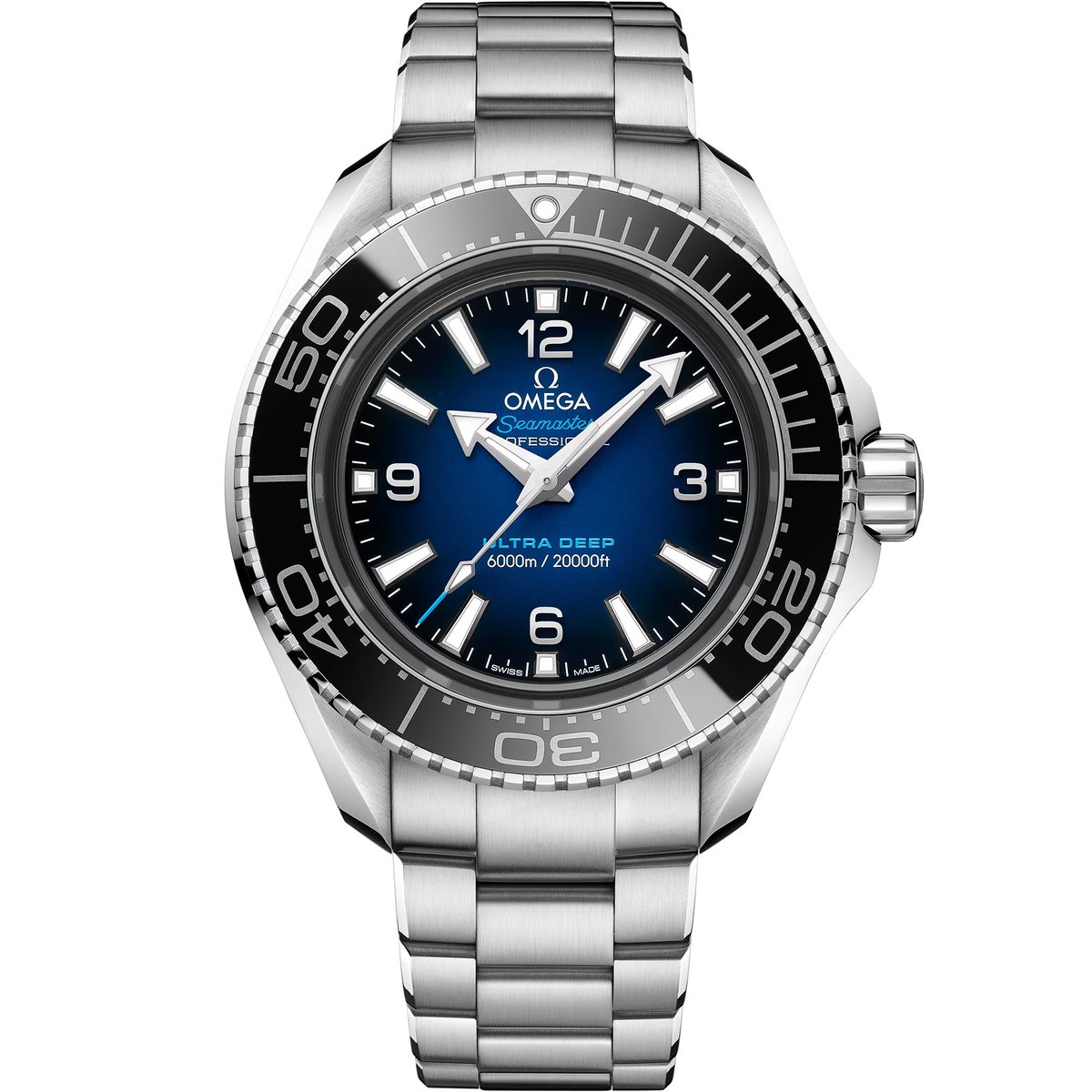
I wore ref. 215.30.46.21.03.001 — the stainless-steel Ultra Deep with the blue gradient dial on the steel bracelet — through a full week of desk work, school runs, a pool session and one unfortunate encounter with a doorframe. It is heavy, it is thick, and it is one of the most convincing arguments for extreme-spec engineering I have strapped on this year.
This is a wear-focused review, not a spec-sheet recital. If you want to know whether a 45.5mm, 18.1mm-thick steel diver can survive real life on a real wrist, read on.
What the Ultra Deep actually is
Omega's Ultra Deep story starts in 2019, when the brand strapped three prototype watches to the robotic arm of the DSV Limiting Factor, the submersible that carried explorer Victor Vescovo to the bottom of the Mariana Trench at 10,928 metres. The prototypes came back working. Omega subsequently certified them to 15,000 metres, a number that exists purely to make a point.
The production Ultra Deep arrived in 2022 with a more sensible 6,000-metre rating — still roughly six times deeper than any recreational diver will ever go. It shares the Planet Ocean name with the 600M line, but the case is a different animal: a wide, slab-sided, heavily engineered block of steel with a sapphire crystal thick enough to distort the dial at its edges.
Omega itself dates to 1848, when Louis Brandt set up shop in La Chaux-de-Fonds. The Seamaster name arrived in 1948, the Planet Ocean in 2005, and the Ultra Deep now serves as the line's halo model — the piece that exists to demonstrate what the brand can do when depth rating is the only brief.
The movement: Calibre 8912
Inside sits Omega's Calibre 8912, an automatic Master Chronometer with a Co-Axial escapement, a silicon balance spring, twin barrels in series and a 60-hour power reserve. It beats at 25,200 vibrations per hour and is certified by METAS across eight tests, including rate in six positions, water resistance, power reserve and rate after exposure to 15,000 gauss.
That certification is the genuinely useful part of the story. It is not COSC plus marketing: METAS tests the fully cased watch, so what is certified is the object on your wrist rather than a bare movement on a bench. In practice it means an Ultra Deep that leaves the factory running within 0/+5 seconds a day, and usually better.
You will never see any of it. The Ultra Deep uses a solid caseback — a necessity at this depth rating — so the movement's finishing is academic. What you get instead is a caseback engraved with the model's identity, which is arguably the more honest choice for a tool watch.
The practical consequence of the twin-barrel architecture is that the watch keeps running through a weekend off the wrist. That single fact does more for daily usability than any depth figure.
The case, in numbers
The Ultra Deep measures 45.5mm across and 18.1mm thick, in stainless steel, with a sapphire crystal, a unidirectional dive bezel with a ceramic insert, and 6,000 metres of water resistance. It is a lot of watch. Thickness is the number that will decide whether you buy it: 18.1mm is roughly two Speedmaster Moonwatches stacked, and it changes how the watch interacts with cuffs, jacket sleeves and car doors.
Omega does not publish a lug-to-lug figure for this case, and I am not going to invent one. What I can tell you is that the lugs are short and the bracelet's end links are wide and rigid, so the watch sits on top of the wrist rather than draping over it. On my 17cm wrist the case occupies the full width of the top of my arm, with perhaps a millimetre of margin on each side. If your wrist is under 16.5cm, try before you buy — not because it will overhang dramatically, but because the visual mass is considerable.
The bezel is a proper dive bezel: unidirectional, crisp, with a ceramic insert and a luminous marker at twelve. It turns with a firm, dry click and no backplay worth mentioning, and the grip is excellent even with wet hands.
A week on the wrist
Day one is a shock. The steel bracelet version is heavy — noticeably heavier than a Planet Ocean 600M — and the caseback sits proud enough that the watch perches high on the wrist. By day two the bracelet has settled and the weight reads as ballast rather than burden. The clasp is excellent: a foldover dive clasp with a push-button extension, so you can loosen the bracelet a few millimetres when your wrist swells in the afternoon or when you are pulling it over a wetsuit sleeve.
The bigger comfort issue is the crown. It sits at three o'clock, protected by substantial shoulders, and on a watch this thick it can dig into the back of your hand when you bend your wrist. I noticed it for two days and then stopped noticing it, which is the usual pattern with big divers.
Where the Ultra Deep genuinely surprises is in how little it moves. The wide, flat caseback and the rigid bracelet mean it does not slide around, does not rotate on the wrist and does not need constant re-centering. On a rubber strap it would be a different watch — lighter, more casual, more comfortable. Ref. 215.30.46.21.03.002 is the one I would buy if I were actually diving, and the one most people should probably consider first.
What it does not do is disappear. This is not a watch you forget you are wearing. If you want a diver that vanishes under a shirt cuff, buy an Aqua Terra or a 39.5mm Planet Ocean. The Ultra Deep is a statement, and the statement is that you own a very serious object.
One more wear note: the bracelet's end links are wide and the case is tall, so the watch tends to sit slightly proud of the wrist bone. That is fine on a desk, less fine if you type with your wrists resting on a hard surface all day.
Legibility
Outstanding, and this is where the Ultra Deep earns its keep. The dial is a blue gradient that darkens toward the edges, and the contrast against the white Super-LumiNova on the hands, indices and bezel marker is excellent. The handset is the familiar Planet Ocean arrangement — arrow hour, broad sword minute, luminous-tipped seconds — and the minute hand reaches far enough to be read against the bezel track without ambiguity.
The lume is generous and long-lasting. Charged under a lamp for a minute, it was still readable at 5am in a dark room. The bezel insert's luminous marker means you can time a dive, or a parking meter, in the dark.
The one compromise is the date window at three o'clock. It is small, white-on-dark and perfectly legible, but it interrupts the gradient at exactly the point where the dial is at its most dramatic. A no-date Ultra Deep would be a cleaner watch. Omega did not ask me.
Accuracy
Over seven days my sample ran about +2 seconds per day, squarely within Master Chronometer spec and beyond what most owners will ever notice. Expect +0 to +5 seconds a day, with the rate varying slightly depending on how you rest the watch overnight. Crown-down tends to run a touch slow on these movements; dial-up tends to run a touch fast. If you check your watch against a radio signal every morning, you will be satisfied.
The 60-hour power reserve is the practical number. Take it off Friday night and it is still running Monday morning, which means you rarely have to set it. That is a bigger daily-life benefit than any depth rating, and it is the reason the Ultra Deep works as a one-watch solution.
When to wear it
Sport, obviously. Daily wear, yes — provided your daily wear involves jeans and a T-shirt. Travel, absolutely: the depth rating, the magnetic resistance and the 60-hour reserve make it a genuinely good one-watch trip companion, though it will set off airport scanners and it is heavy enough that you will feel it in a bag.
Formal wear, no. An 18.1mm-thick steel diver does not go under a French cuff, and it does not want to. This is a watch for people whose idea of dressing up involves a chore jacket.
Beach holidays are where it makes the most sense emotionally. It is the one watch in a collection that you genuinely do not have to think about before jumping off a boat.
The competition
The obvious rival is the Rolex Deepsea, which offers a 3,900-metre rating, a Ringlock case architecture and Rolex's own brand of wrist presence. The Deepsea is a different wearing experience — thicker in the caseback, more top-heavy, and considerably more expensive on the secondary market. If you want the safest possible resale, that is the one. If you want the better movement specification and the better bracelet, the Ultra Deep makes a strong case for itself.
Blancpain's Fifty Fathoms Automatique 45mm sits at a similar price point with far more heritage and far less thickness. It is the more elegant choice and the less practical one if you actually intend to abuse the watch.
Panerai's Submersible QuarantaQuattro offers comparable size and a very different personality, with a cushion case and Italian bravado rather than Omega's engineering-led severity. None of these watches are rated anywhere near 6,000 metres, which is either the whole point or completely irrelevant, depending on how honest you are with yourself.
Variants and family
The Ultra Deep line is small and easy to navigate. The blue gradient dial comes on the steel bracelet (this reference) or on a rubber strap (215.30.46.21.03.002). The black gradient dial follows the same pattern: 215.30.46.21.01.001 on steel, 215.30.46.21.01.002 on rubber. Omega also builds the Ultra Deep in titanium, which cuts a meaningful amount of weight and is the version to look at if the steel bracelet feels like too much watch.
Within the wider Planet Ocean family, the 600M models in 43.5mm and 39.5mm are the sensible everyday alternatives, and the 2019 Ultra Deep prototype — three pieces, no commercial reference — is the ancestor that made all of this possible.
Homage territory
If the Ultra Deep's silhouette appeals but the price does not, there is a small ecosystem of lookalikes. San Martin and similar microbrands build wide-case titanium divers that echo the proportions for a few hundred dollars, and Steeldive offers a budget version of the same idea. They are fine as beaters and hopeless as substitutes: the whole appeal of this watch is what the case and movement actually do, and that is precisely what a $130 homage cannot replicate.
Buying, value and service
At launch the steel Ultra Deep on the bracelet listed at roughly $11,600. Omega's prices have moved since, and current retail is closer to $12,900. Pre-owned examples trade in the $8,500-$11,500 range depending on condition, box and papers, which tells you the honest truth about modern Omega: it is a wonderful watch to buy secondhand and a mediocre one to buy as an investment.
Servicing is straightforward. Omega recommends a service every five to eight years, and a full service through an authorised centre runs in the $650-$800 range for a Master Chronometer. Independent watchmakers can handle the 8912, but parts access is restricted, so most owners end up going through Omega. Budget for it — it is the price of a Co-Axial escapement.
My advice for a first serious diver: buy the rubber-strap version pre-owned, add a quality aftermarket rubber or NATO strap, and keep the several thousand dollars you saved for the service you will eventually need.
Pros and cons
Pros: genuine 6,000m engineering rather than marketing copy; Master Chronometer accuracy and 15,000-gauss magnetic resistance; superb legibility and long-lasting lume; an excellent bracelet and clasp with a real dive extension; a 60-hour reserve that makes it a practical daily wearer.
Cons: 18.1mm thick, which rules out sleeves and narrow wrists; heavy on steel, with a crown that can dig into the hand; the date window interrupts a beautiful gradient dial; it depreciates from retail like most modern Omegas.
Verdict
The Ultra Deep is the rare extreme-spec dive watch that justifies its size through behaviour rather than spec-sheet theatre. It is built for a depth nobody will reach, but it is engineered so thoroughly that the depth rating becomes a side effect rather than the point.
Wear it for a week and you stop thinking about 6,000 metres and start thinking about how much you like the way it reads at a glance. That is the highest compliment I can pay a tool watch — and the reason it stays on my wrist rather than in the box.