The Zenith of Professional Diving: The Ultra Deep Story
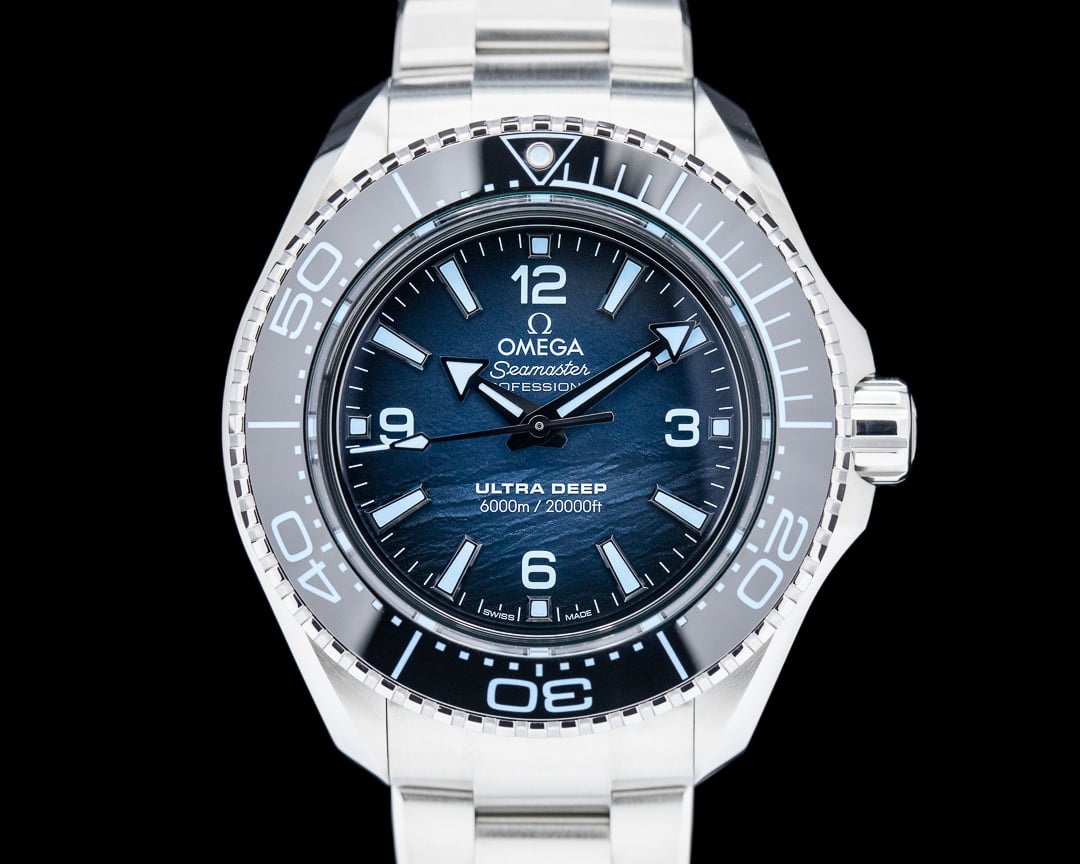
In the world of luxury horology, there are watches that tell time, and then there are watches that make statements. The Omega Seamaster Planet Ocean Ultra Deep is firmly in the latter category. To understand the Ultra Deep, one must look back to the 2019 Five Deeps Expedition. While Rolex had long held the record for the deepest dive with the 1960 Trieste mission and the 2012 James Cameron expedition, Omega’s 2019 prototype shattered that record, reaching 10,928 meters. The watch we see today is the commercial realization of that extreme achievement.
Material Science: The Introduction of O-MEGASTEEL
Perhaps the most significant innovation in the production Ultra Deep is the debut of O-MEGASTEEL. For years, the industry has relied on 316L or 904L stainless steel. Omega’s new high-performance stainless steel alloy provides a yield strength that is twice as high as conventional steel, a hardness of 300 Vickers (vs. ~200 for 316L), and a noticeably whiter, more brilliant hue. From a collector's standpoint, this material choice is vital. It resists scratches more effectively and maintains its 'showroom' luster longer than a standard Seamaster. This durability is a key component of its value retention over time.
The Calibre 8912: A Master of Magnetism
Powering this beast is the Calibre 8912. While it lacks a date complication—a choice made to ensure the structural integrity of the dial under extreme pressure—it features a 'time zone' function that allows the hour hand to be moved independently. This makes it an excellent travel companion for the jet-setting collector. The METAS certification is the gold standard here, ensuring that the watch is not only accurate to chronometer levels but also entirely impervious to the magnetic fields found in modern environments, from MRI machines to iPad covers.
Market Dynamics and Investment Outlook
At Vivir, we track the 'MSRP-to-Secondary' ratio closely. The Ultra Deep launched with a retail price of approximately $12,300 for the steel model. On the secondary market, we are seeing these trade between $9,200 and $10,500 depending on condition. This ~20% drop is standard for modern Omega professional models. However, the Ultra Deep is a 'halo' piece. Unlike the mass-produced Seamaster 300M, the Ultra Deep is produced in lower volumes. As the watch world moves back toward larger, more technical pieces—a cycle we see every 15 years—the Ultra Deep is positioned to become a future classic for those who value the 'Spec War' era of the 2020s.
The Wearability Paradox
Can you actually wear an 18.1mm thick watch? The answer depends on your wrist anatomy. The lug-to-lug distance of 51.9mm is actually shorter than many smaller-diameter watches, thanks to the integrated lug design. On a 7.5-inch wrist, it looks purposeful and powerful. On a 6.5-inch wrist, it looks like a piece of equipment strapped to a person. It is a watch that demands confidence. If you are a collector who enjoys the 'wrist presence' of a Panerai or a Breitling Avenger, the Ultra Deep will feel right at home.
Conclusion: Hold or Sell?
For current owners, my recommendation is a **Hold**. We are currently in a softening market for luxury goods, and selling now would mean realizing the maximum depreciation. Given the technical milestone this watch represents, it is a piece that will likely find a stable floor and eventually appreciate as a landmark in Omega's history. For prospective buyers, the secondary market currently offers a fantastic entry point to own a 6,000m-rated Master Chronometer for under $10,000—a value proposition that Rolex simply cannot match in this category.