Manufacture History: Omega and the 321 Legacy
Omega was founded in 1848 in La Chaux-de-Fonds, Switzerland, by Louis Brandt. Over the decades, it grew into one of the world’s most innovative watchmakers, known for precision, durability, and a pioneering spirit. The Speedmaster line debuted in 1957 as a racing chronograph, but its destiny changed in 1965 when NASA qualified it for spaceflight. The Calibre 321 was the movement inside those early Speedmasters. It was a manual-wind column-wheel chronograph with a horizontal clutch, designed for smooth operation and reliability. It powered the Speedmaster through the Gemini and Apollo programs, including the Apollo 11 moon landing in 1969. When Omega replaced it with the 861 in 1968, the 321 became a legend. Its revival in 2019 was a triumph of reverse engineering and modern watchmaking, and the steel 321 is the most accessible way to own this piece of history.
Movement: Calibre 321
The heart of this watch is the Omega Calibre 321. It is a manual-winding chronograph movement with a column wheel and horizontal clutch. The modern version is not a refurbished vintage movement; it is a completely new production caliber, built to the original specifications but with modern tolerances and finishing. It operates at 18,000 vibrations per hour (2.5 Hz), a frequency that may seem low by today’s standards, but it is authentic to the original and contributes to the smooth, sweeping motion of the chronograph seconds hand. The power reserve is 55 hours, which is generous for a manual-wind chronograph. The movement has 17 jewels.
The architecture is a direct descendant of the original 321. The column wheel is visible through the sapphire caseback, and the horizontal clutch ensures a gentle engagement of the chronograph. The finishing is exemplary: rhodium-plated surfaces, circular graining, and polished bevels on the bridges. The movement is not COSC-certified, nor is it a Master Chronometer. Omega does not submit the 321 for certification, preferring to regulate each movement individually. In practice, a well-regulated 321 can keep excellent time, but it is not intended to be a high-accuracy quartz alternative. It is a mechanical experience, and the winding action is smooth and precise.
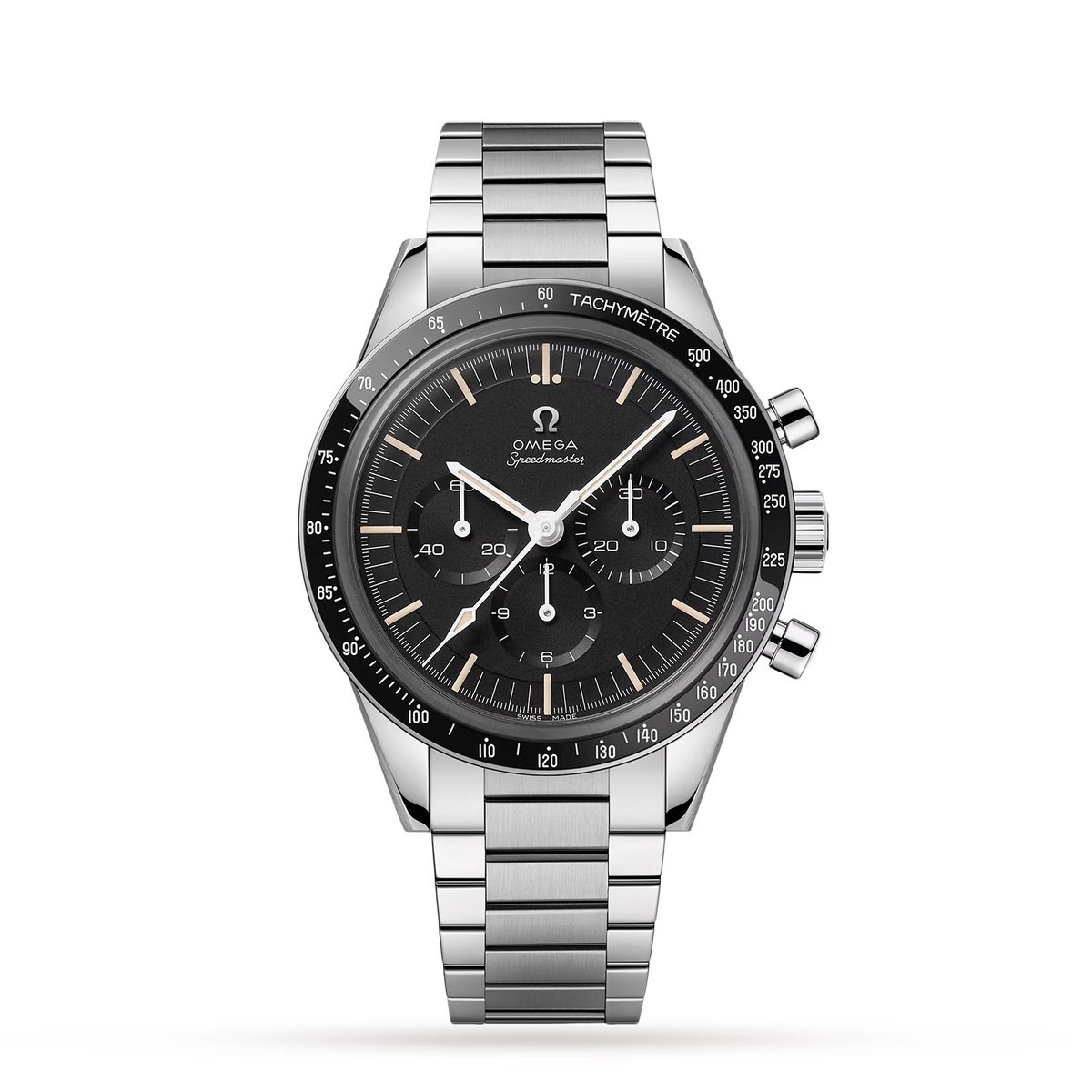
Complications are limited to the chronograph: central chronograph seconds, a 30-minute counter at 3 o’clock, a 12-hour counter at 6 o’clock, and small seconds at 9 o’clock. There is no date, no GMT, and no other modern conveniences. This is a purist’s chronograph.
Specifications
The steel 321 measures 39.7mm in diameter, 13.9mm in thickness, and 48mm from lug to lug. The case is stainless steel, with a mix of brushed and polished finishes. The crystal is sapphire, with anti-reflective treatment on both sides. The caseback is also sapphire, allowing a clear view of the movement. Water resistance is rated at 50 meters, which is sufficient for daily wear but not for swimming. The bezel is black ceramic with a white enamel tachymeter scale, and it features the vintage dot over 90 detail. The dial is black with applied indices and hands in 18k white gold, filled with vintage-colored Super-LumiNova. The watch comes on a black leather strap with a stainless steel pin buckle.
Wrist Feel and Wearability
On the wrist, the 39.7mm case is a joy. It is smaller than the current 42mm Moonwatch, and that makes a significant difference. The lug-to-lug of 48mm is compact enough to fit a wide range of wrists, from 6.5 inches to 7.5 inches, without overhang. The thickness of 13.9mm is noticeable but not cumbersome; the watch sits close to the wrist, and the leather strap curves comfortably. The weight is moderate, thanks to the steel case and the relatively thin movement. The manual winding is a daily ritual that connects you to the watch. The crown is easy to grip, and the chronograph pushers have a crisp, satisfying action.
The balance is excellent. The watch does not feel top-heavy, and the strap keeps it secure. The 50-meter water resistance means you should not swim with it, but it is fine for everyday wear. The leather strap is supple and comfortable from the start, though some collectors may prefer to swap it for a steel bracelet or a NATO strap. The pin buckle is simple and secure. Overall, the 321 is a watch you can wear daily, but it is also special enough for formal occasions.
Accuracy
The Calibre 321 is not a Master Chronometer, so you should not expect quartz-like accuracy. However, a well-regulated example can run within a few seconds per day. The 18,000 vph frequency means the seconds hand beats at 5 times per second, which is slower than modern 4 Hz movements but perfectly acceptable. The chronograph function is smooth, and the horizontal clutch avoids the jolt of a vertical clutch. In real-world use, you can expect accuracy in the range of -5 to +10 seconds per day, depending on position and temperature. If you need greater precision, Omega can regulate it, but the 321 is more about mechanical purity than chronometric certification.
Occasions
The Speedmaster Calibre 321 is versatile. It is a formal watch, thanks to its clean dial and elegant proportions. It is a sport watch, with its chronograph function and racing heritage. It is a daily wearer, comfortable and understated. It is a dress watch, in the sense that it pairs well with a suit. It is not a travel watch in the GMT sense, but it is a perfect companion for any journey. It is not a dive watch, so leave it on the shore.
Wrist Presence
4/5. The 321 has a strong presence without being oversized. Its historical significance and the visible movement through the caseback give it a gravitas that few watches can match. It is not flashy, but it commands respect from those who know. On the wrist, it feels important, but not ostentatious.
Reference Variants
Omega has released several versions of the modern Calibre 321. The platinum version, reference 311.93.42.30.99.001, features a 42mm platinum case, a black onyx dial, and a leather strap. It was the first modern 321 and is significantly more expensive. The Canopus Gold version, reference 311.50.40.30.01.001, has a 39.7mm Canopus Gold case, a silver dial, and a Canopus Gold bracelet. It is a precious metal alternative for those who want more flash. The steel version reviewed here, reference 311.30.40.30.01.001, is the most understated and, in our view, the most wearable.
Family References
The 321 family includes the original CK2998, the 105.003 (Ed White), the 105.012, and the 145.012. These are the vintage Speedmasters that collectors chase. In the current lineup, the closest sibling is the Speedmaster Professional Moonwatch, reference 310.30.42.50.01.001, which uses the Calibre 3861. The Moonwatch is larger, but the 321 is the purist’s choice.
Other Notable Omega Models
Omega’s catalog is deep. The Seamaster 300M is a dive watch icon. The Aqua Terra is a versatile everyday watch. The Planet Ocean is a modern diver. The Constellation is a dress watch with a distinctive bezel. Each has its own following, but none carries the historical weight of the Speedmaster 321.
Similar Watches
If you are considering the 321, you might also look at the Rolex Cosmograph Daytona 126500LN. It is the other iconic steel chronograph, but it is automatic and far more expensive on the secondary market. The Zenith Chronomaster Original is a high-frequency automatic chronograph with a vintage soul and a similar 38mm case. The Breitling Navitimer B01 is a pilot chronograph with a slide rule bezel, more complex but less historically significant to the moon. The Heuer Carrera 39mm is a clean vintage racing chronograph, but with an automatic movement. None of these offer the 321’s unique combination of manual winding, column wheel, and moon heritage.
Homages
For those who love the look but not the price, there are homages. The Seagull 1963 is a manual-wind column-wheel chronograph with a vintage military look, around $250. The Bulova Lunar Pilot is a quartz chronograph with a genuine moon-watch connection, around $500. The Pagani Design Speedmaster Homage is a budget quartz lookalike for around $100. These are not replacements for the 321, but they can satisfy the aesthetic urge.
Investment Value
The MSRP of the steel 321 was $14,100, and the current retail price is around $15,600. On the pre-owned market, they trade between $12,000 and $15,000, depending on condition and completeness. The trend is appreciating, as the 321 is produced in limited quantities and demand remains strong. Our hold recommendation: buy it to wear, but it should hold value well. There is no major auction history yet, as the modern 321 is still relatively new. However, given the original 321’s auction performance, the modern version is likely to be a future collectible.
Service Interval
Omega recommends periodic servicing, though the exact interval depends on usage. The 321 is a specialized movement, so authorized service is recommended. Costs vary by service center. It is not a movement that every independent watchmaker can service, so choose your watchmaker carefully.
Price Range and Verdict
The price range for the steel 321 is $14,100 to $16,500. It is a meaningful acquisition: a recreated legendary movement in a wearable steel case, though not a bargain. It is an heirloom piece that combines history, mechanical purity, and modern reliability.
Pros and Cons
Pros: Legendary Calibre 321 movement; faithful vintage design; wearable 39.7mm case; exhibition caseback. Cons: Manual winding; 50m water resistance; premium price; leather strap only.
Final Verdict
The Omega Speedmaster Calibre 321 is not just another Moonwatch. It is the Moonwatch movement, reborn with modern precision and finishing. For the collector who values history and mechanical purity, it is a compelling, wearable masterpiece. It is a watch that will reward daily wear and careful ownership, and it stands as one of the most significant modern Omega releases in decades.