The Genesis: From 2915 to 2998
To understand the significance of the CK 2998, one must first look back to 1957. The original Speedmaster, reference 2915, was a revolutionary tool designed for racing drivers and engineers. However, it was the second iteration, the CK 2998, launched in 1959, that truly solidified the Speedmaster’s identity. It was during this era that Omega replaced the steel bezel with a black aluminum insert for better legibility and transitioned from Broad Arrow hands to the more refined Alpha hands. These changes were not merely aesthetic; they were functional improvements that enhanced the watch's utility as a precision instrument.
The CK 2998 was produced in several sub-references (from -1 to -6), each introducing minor variations in the bezel scales and hand sets. It was a 2998-4 that Wally Schirra purchased for personal use and wore during the Mercury-Atlas 8 mission. This organic connection to space exploration—predating NASA's official certification—gives the CK 2998 a unique level of 'street cred' among horological historians. The modern tribute we see today is a love letter to this specific period of Omega's history, capturing the pre-Professional essence of the brand.
Case Architecture: The Beauty of Straight Lugs
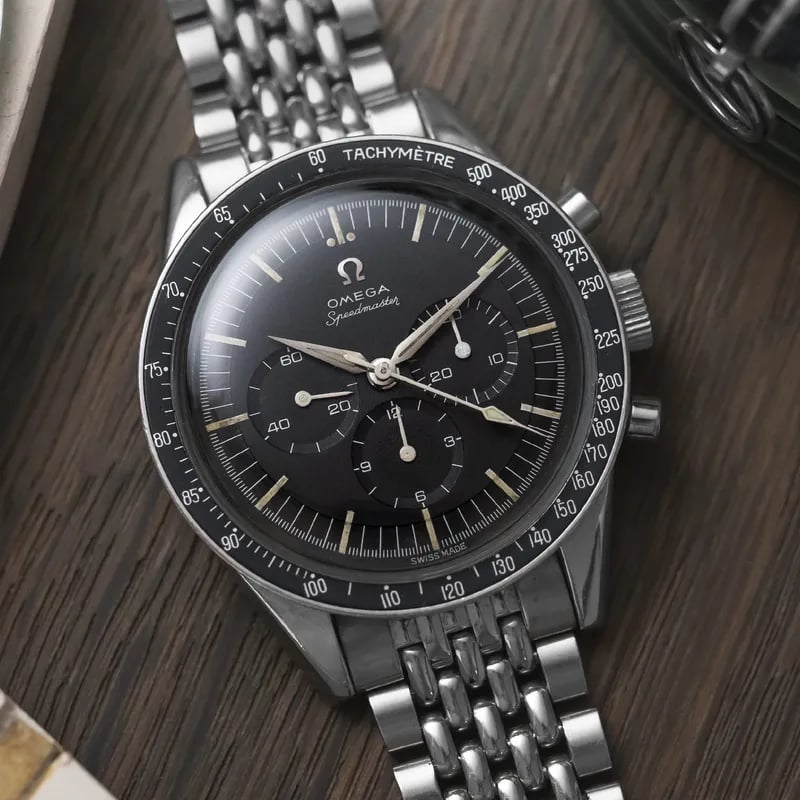
The most defining characteristic of the CK 2998 is its case. Unlike the standard Speedmaster Professional, which features the 'lyre' or twisted lugs and integrated crown guards introduced in the mid-1960s, the CK 2998 utilizes a 'straight-lug' case. This design is characterized by its sharp, angular lines and a lack of protective shoulders around the crown and pushers. The result is a case that feels significantly more vintage and 'instrument-like' on the wrist.
Measuring 39.7mm in diameter, the case is a departure from the modern trend of oversized sports watches. This diameter, combined with a 48mm lug-to-lug distance, ensures that the watch fits perfectly on a wide range of wrist sizes. The finishing is exemplary, featuring a mix of polished and brushed surfaces that highlight the sharp transitions of the case geometry. The 2016 Limited Edition adds a modern touch with a polished blue ceramic bezel featuring a tachymeter scale, providing a level of scratch resistance and color depth that the original aluminum inserts could never achieve.
The Dial: A Study in Chromatic Balance
The 2016 CK 2998 (Ref. 311.33.40.30.02.001) features what is colloquially known as a 'Panda' dial, though with a sophisticated twist. The central dial is a shimmering silver-white, while the three sub-dials and the outer minute track are finished in a deep, matte blue. This color scheme is echoed in the ceramic bezel and the leather strap, creating a cohesive visual identity that feels both nautical and athletic.
The use of Alpha hands for the hours and minutes is a direct nod to the vintage 2998. These hands are rhodium-plated and filled with Super-LumiNova, offering excellent legibility in low-light conditions. Perhaps the most charming detail is the 'lollipop' chronograph seconds hand—a feature found on some early 2998 references—which adds a touch of whimsical character to an otherwise serious technical instrument. The sub-dials are slightly recessed with a circular graining (azurage) finish, which catches the light beautifully and adds a layer of three-dimensional depth to the dial.
The Calibre 1861: A Mechanical Workhorse
At the heart of the CK 2998 lies the Calibre 1861. While Omega has recently transitioned many of its movements to the METAS-certified Calibre 3861, the 1861 remains a favorite among purists for its direct lineage to the Moonwatch. This manual-wind movement is a descendant of the Calibre 861, which replaced the column-wheel Calibre 321 in 1968. The 1861 uses a cam-actuated system, which is widely considered to be more robust and easier to maintain than a column wheel, making it the ideal choice for a watch intended for professional use.
Technically, the 1861 operates at 21,600 vibrations per hour (3Hz) and offers a 48-hour power reserve. One of the more interesting technical details of this movement is the use of a Delrin (polymer) brake for the chronograph seconds wheel. While some purists initially balked at the use of a synthetic material, it was a calculated engineering decision: Delrin is more durable and provides smoother engagement than a metal brake, reducing wear over decades of use. The movement is rhodium-plated and features a clean, industrial finish that is visible only to the watchmaker, as the CK 2998 features a solid steel caseback with the iconic Seahorse medallion.
Wrist Feel and Daily Wearability
Wearing the CK 2998 is a tactile reminder of why mid-century watch design is so enduring. The 14.3mm thickness, which includes the box-shaped sapphire crystal, gives the watch a substantial profile without feeling top-heavy. The sapphire crystal is a modern concession that many will appreciate; it provides the 'top-hat' look of vintage acrylic while offering modern scratch resistance. However, it should be noted that sapphire does not have the same warm distortion as Hesalite, and it adds a few millimeters to the total height.
The watch is paired with a blue leather strap with beige contrast stitching, which reinforces the vintage racing aesthetic. The 19mm lug width is perhaps the only point of contention for some collectors. While it is historically accurate to the original 2998, it means that standard 20mm straps will not fit, requiring owners to seek out specific 19mm options. That said, the taper of the strap to the pin buckle is elegant and ensures the watch remains comfortable throughout the day.
Investment Potential and Collectibility
Since its release in 2016, the CK 2998 Limited Edition has become one of the most sought-after modern Speedmasters. With a production run of only 2,998 pieces, it hit the 'sweet spot' of exclusivity. Unlike some 'limited' editions that see production numbers in the tens of thousands, the CK 2998 is genuinely scarce on the secondary market. This scarcity, combined with the universal appeal of the blue panda dial and the 39.7mm case, has led to a steady appreciation in value.
For the discerning buyer, the CK 2998 represents a safer investment than many other contemporary sports watches. It appeals to both the vintage enthusiast and the modern collector, ensuring a broad base of demand. While the MSRP was a relatively accessible $5,850, current market prices reflect its status as a modern classic. It is a watch that can be worn and enjoyed daily while likely maintaining, or increasing, its value over time.
Technical Comparison: CK 2998 vs. FOIS
It is worth comparing the CK 2998 to its sibling, the 'First Omega in Space' (FOIS). Both share the same 39.7mm straight-lug case and the Calibre 1861. However, the FOIS is a standard production model (though now discontinued) with a more traditional black dial and baton hands. The CK 2998 LE offers a more premium experience through its ceramic bezel, unique colorway, and limited production status. For those who find the FOIS a bit too understated, the CK 2998 provides the necessary visual flair without sacrificing the historical geometry that makes this case size so special.
Conclusion: The Final Verdict
The Omega Speedmaster CK 2998 is a rare example of a heritage reissue done right. It doesn't just copy the past; it distills the best elements of a legendary reference and updates them with modern materials where they matter most. The blue ceramic bezel and the lollipop hand are inspired choices that give the watch a personality of its own, distinct from the utilitarian Moonwatch. While the 19mm lug width and the manual-wind movement may require a bit more effort from the owner, the rewards are well worth it. This is a watch for the person who appreciates the nuances of case geometry, the history of space exploration, and the enduring appeal of a well-executed chronograph. In the world of luxury horology, the CK 2998 stands as a testament to the fact that sometimes, the best way forward is to look back.