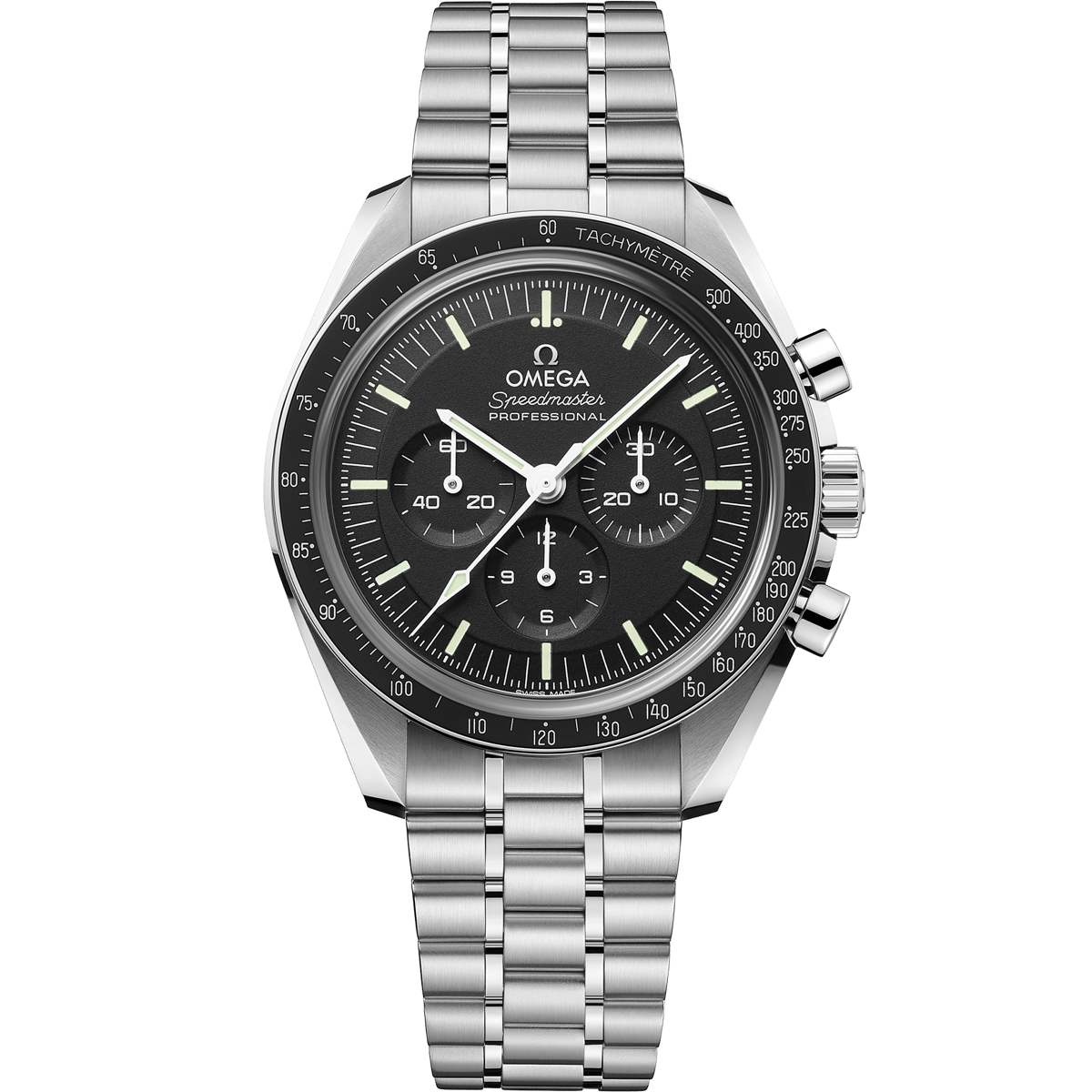
The Omega Speedmaster Moonwatch in 2024: A Collector’s Market Read
The Speedmaster Moonwatch is the rare watch that needs no introduction but still deserves a sober read. It is the chronograph that went to the Moon, the one NASA qualified in 1965, and the one that has stayed in continuous production longer than most of its rivals have existed. That story sells watches. But stories do not pay the bills, and serious collectors should ask a harder question: does the current generation — the 3861 Moonwatch introduced in 2021 — earn its place on merit, and does it hold value?
The short answer is yes, with caveats. The Moonwatch is not a hype piece. It does not trade at a multiple of retail, and in its standard form it never will. What it does is behave like a blue-chip: it depreciates modestly from retail, holds a deep and liquid secondary market, and rewards the buyer who intends to wear it for a decade rather than flip it in a quarter. In a hobby increasingly dominated by allocation games and speculative limited editions, that is a feature, not a bug.
This review covers the current 3861 references, the movement, the real-world ownership experience, and the hold-versus-sell call. Prices cited are approximate U.S. market figures and move with the cycle.
A Short History of the Moonwatch
Omega was founded in 1848 by Louis Brandt in La Chaux-de-Fonds, Switzerland, and built its reputation on precision and industrial scale long before the Speedmaster existed. The Speedmaster launched in 1957 as a racing chronograph — the name referred to speed, not space — with a tachymeter bezel and a clean, legible dial. It was a tool watch for drivers, and it was designed to be read at a glance.
Then NASA came calling. In 1965, after a qualification process that subjected candidate chronographs to extreme temperatures, vibration, vacuum, and shock, NASA selected the Speedmaster as its flight-qualified chronograph. That same year, Ed White wore one during America’s first spacewalk. In July 1969, Buzz Aldrin wore a Speedmaster onto the lunar surface — the first watch on the Moon. The “Moonwatch” nickname followed, and Omega has leaned into it ever since.
The modern lineage is well documented. The reference 3570.50.00, with the hand-wound Calibre 1861, was the standard Moonwatch for years and remains the reference many collectors grew up wanting. The 1861 gave way to the 3861 in 2021, a movement that brought Co-Axial escapement technology and Master Chronometer certification to the line. That is the watch under review, and it is the one most buyers should focus on.
The 3861 Movement: What Changed
The Calibre 3861 is a manual-winding chronograph, and it is the most significant movement update the Moonwatch has received in a generation. It retains the architecture collectors know — hand-wound, no rotor, a slim profile that keeps the case wearable — but adds a Co-Axial escapement, a free-sprung balance, and a silicon balance spring. It is certified as a Master Chronometer by METAS, which means it is tested as a complete watch, not just as a movement, and it is resistant to magnetic fields of 15,000 gauss.
The numbers: 50 hours of power reserve, a frequency of 21,600 vibrations per hour (3 Hz), and 26 jewels. The 50-hour reserve is a modest improvement over the 1861’s 48 hours, but the real story is the certification and the anti-magnetic performance. In practical terms, the 3861 is a movement you can wear around a laptop, a phone, and a magnet-lined bag without the rate wandering.
Finishing is industrial but honest. This is not a movement built to be admired through a display back in the way a hand-finished Swiss chronograph might be — although the sapphire version does show it off. It is built to be serviced, to keep time, and to survive. That is the correct brief for a tool chronograph, and Omega executed it. The pusher action is crisp, the winding is smooth, and the movement feels engineered rather than decorated.
Specifications That Matter
The Moonwatch is a 42mm stainless steel chronograph with 50 meters of water resistance. The standard reference uses a hesalite crystal — acrylic, in the traditional sense — while the “sapphire sandwich” reference uses sapphire front and back. Both are available on a steel bracelet or a black-coated nylon strap.
The dial is matte black with three registers and a tachymeter scale on the bezel. Lume is applied to the hands and indices, and it is adequate rather than spectacular. The bracelet on the current generation is a meaningful improvement: it tapers, it wears closer to the wrist, and the folding clasp includes micro-adjustment. If you have owned an older Moonwatch, the new bracelet is the upgrade you will notice first.
| Spec | Detail |
|---|---|
| Case | 42mm stainless steel |
| Crystal | Hesalite (standard) or sapphire |
| Water resistance | 50m |
| Movement | Calibre 3861, manual wind |
| Power reserve | 50 hours |
| Frequency | 21,600 vph |
| Certification | METAS Master Chronometer |
On the Wrist
The Moonwatch wears true to its 42mm specification, and that is the first thing to understand. It is not a small watch, but it is not a slab either. The case has a domed profile that sits down on the wrist, and the revised bracelet keeps the whole package balanced. On a 6.75-inch wrist, it reads as a substantial but entirely livable daily watch. On a smaller wrist, it will wear large but not absurd; on a larger wrist, it will feel just right.
The hesalite version is the purist’s choice, and it is also the warmer one on the wrist — the crystal has a slight dome and a softer look than sapphire. The trade-off is obvious: hesalite scratches, and it scratches easily. PolyWatch and a few minutes of polishing will fix most of it, but if you are the kind of owner who winces at a scuff, buy the sapphire reference and stop pretending otherwise.
Weight is moderate. This is a steel chronograph, not a titanium featherweight, and you feel it on the wrist in a way that reassures rather than annoys. The pushers have a positive, mechanical action, and the crown is easy to grip for the daily wind. The manual-wind ritual is part of the ownership experience — some collectors love it, some find it a chore. Know which one you are before you buy. The Moonwatch is not a watch you put on and forget; it is a watch you interact with.
Accuracy and Ownership
Master Chronometer certification specifies a daily rate of 0 to +5 seconds per day across five positions and two temperatures. In practice, most 3861 Moonwatches run comfortably inside that window, and many owners report rates closer to 0 to +3 seconds per day. That is excellent for a hand-wound chronograph, and it is a genuine improvement over the 1861 generation.
The bigger ownership consideration is the winding routine. With 50 hours of reserve, you can skip a day, but the Moonwatch is happiest when wound daily. The chronograph function should be exercised periodically to keep the lubricants distributed, and the pushers should be operated with the watch running — standard chronograph hygiene. Water resistance is rated at 50 meters, which means the Moonwatch is fine in the rain and fine at the sink, but it is not a pool watch and it is not a dive watch. If you want one watch for the beach, this is not it.
The Reference Guide
The current lineup is refreshingly simple. The two references that matter most are the 310.30.42.50.01.001 — hesalite crystal, steel bracelet — and the 310.30.42.50.01.002 — sapphire crystal front and back, steel bracelet. The first is the purist’s Moonwatch and the one most collectors buy. The second is the “sapphire sandwich,” with a display back and a more scratch-resistant crystal.
Nylon-strap versions of both exist for buyers who want the tool-watch look out of the box. The previous generation — the 1861 references such as 3570.50.00 and 311.30.42.30.01.005 — remains the value play on the secondary market, and the 321 “Ed White” and various Apollo anniversary editions sit above the standard line as collector pieces. If you are buying your first Moonwatch, buy the 3861. If you are buying your second, the 1861 and the 321 become interesting.
The Competitive Set
The obvious rival is the Rolex Daytona. The Daytona is a different animal: automatic, more expensive, allocation-gated at retail, and trading at a significant premium on the secondary market. If you can get one at retail, it is the better financial asset. If you want a chronograph you can actually buy and wear, the Moonwatch is the more rational purchase.
The Zenith El Primero Chronomaster offers the original high-beat automatic chronograph and a richer movement story. The TAG Heuer Carrera delivers racing heritage at a lower price. The Breitling Navitimer is busier and more pilot-focused. The Tudor Black Bay Chrono adds a date and a more modern case at a comparable price. None of them have the Moonwatch’s provenance. That is the whole point.
The Investment Case
Let’s be clear about what the standard Moonwatch is and is not. It is not an appreciating asset. It is a stable one. At an MSRP in the high four figures, it depreciates modestly on the secondary market — recent 3861 examples trade in the $4,800-$6,300 range depending on condition, box, and papers — and then it holds. Over a decade, that is a reasonable outcome for a watch you actually wear.
The speculative money in the Speedmaster family lives in the limited editions: the Silver Snoopy Award, the Apollo 11 50th Anniversary, and the 321 “Ed White.” Those trade at meaningful premiums and carry real auction interest. The standard Moonwatch does not, and buyers should not expect it to. Demand for the standard reference is steady rather than cyclical — it dips in recessions, recovers with the market, and never disappears. That is exactly what you want from a keeper.
The hold recommendation is straightforward. Buy the 3861 to wear, hold it for years, and let the provenance do the work. Do not buy it as a flip. The liquidity is there if you need it — the Moonwatch sells quickly on the secondary market — but the spread between retail and resale means a quick flip is a losing trade. The collectors who do best with this watch are the ones who forget it is an asset and remember it is a watch.
Service and Long-Term Ownership
Omega recommends service every five to eight years, and a full chronograph service typically runs in the several-hundred-dollar range. Independent watchmakers can service a 3861, but parts access favors Omega’s own network, and the Master Chronometer certification is easiest to preserve through authorized service. Budget for it, factor it into your cost of ownership, and the Moonwatch remains a low-drama long-term companion. The bracelet and case are robust, the crystal is replaceable, and the movement has decades of service history behind it.
The Verdict
The Omega Speedmaster Moonwatch remains the default serious chronograph, and the 3861 generation is the best standard Moonwatch yet. It pairs a Master Chronometer movement with the deepest provenance in the category, a versatile 42mm case, and a secondary market that behaves. It is not a get-rich-quick watch. It is a get-it-right watch.
Buy the hesalite if you are a purist, the sapphire if you are practical, and either one if you want a chronograph you will still be wearing in twenty years. That is the highest compliment a watch can receive.