The Proportional Pivot: Why 39mm Matters
In the landscape of luxury horology, the 42mm Speedmaster Professional is often cited as the 'standard.' However, standards are frequently dictated by history rather than ergonomics. The Speedmaster Reduced, introduced in 1988, was a calculated pivot by Omega to address a segment of the market that desired the Moonwatch aesthetic but found the 42mm case prohibitive. By reducing the diameter to 39mm and the lug-to-lug to a compact 44mm, Omega achieved a level of wearability that many argue is superior to the original NASA-certified model.
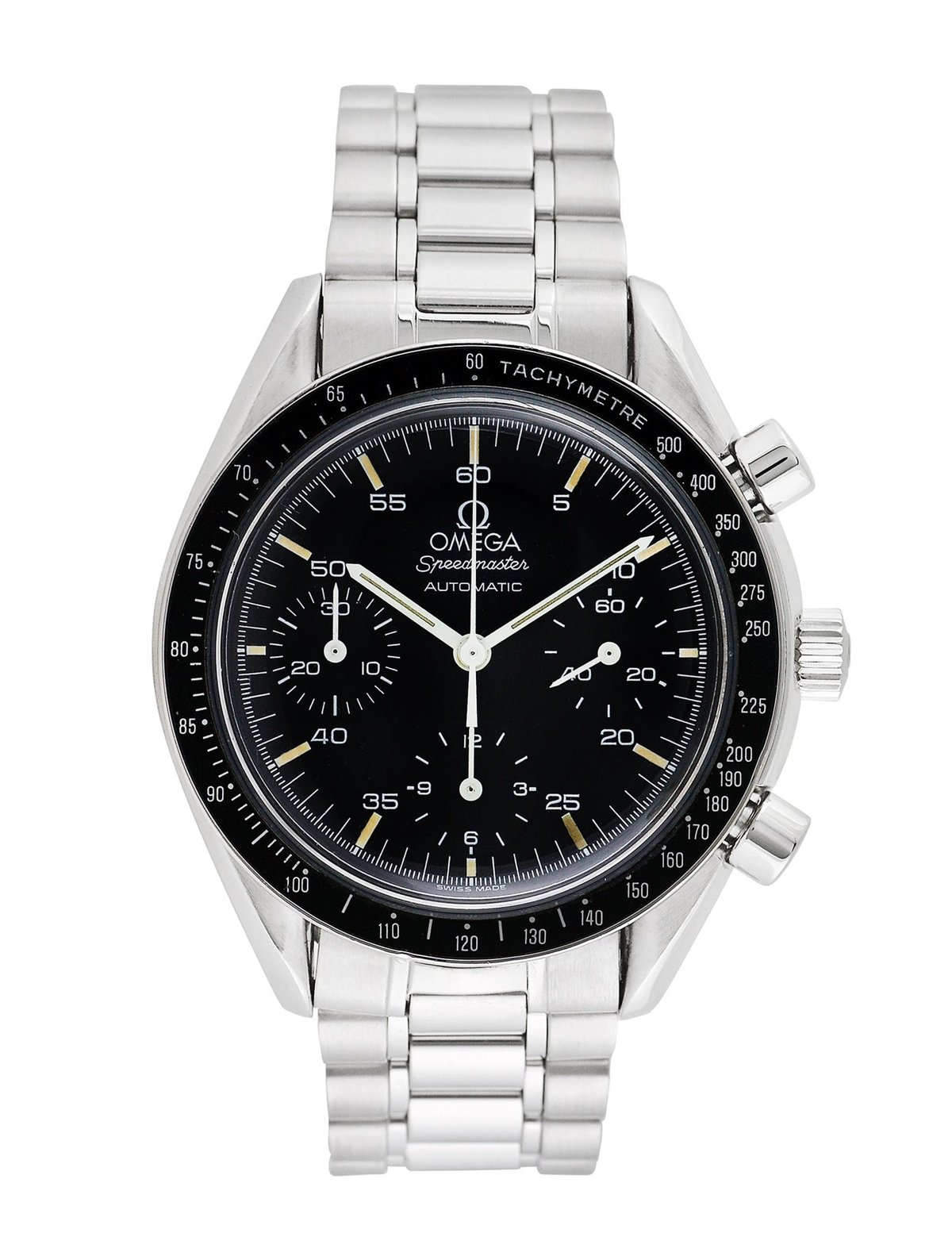
The 3510.50 reference, which we are examining today, is the quintessential iteration of this philosophy. It features the classic black dial, the tachymeter bezel, and the Hesalite crystal that defines the Speedmaster range. Yet, underneath the skin, it is a vastly different machine. For the sophisticated collector, the 'Reduced' moniker is not a signifier of lesser quality, but rather of a more refined, focused engineering approach to daily wear.
The Architecture of the Calibre 3220
The most significant technical departure from the Moonwatch is the movement. While the Professional utilizes the manual-wind Calibre 1861 (or the modern 3861), the Reduced employs the Calibre 3220. This movement is a fascinating example of modular horology. It begins with the ETA 2892-A2, a highly respected, slim automatic workhorse known for its reliability and thin profile. Atop this base, Omega integrated a Dubois-Dépraz 2020 chronograph module.
This 'piggyback' construction is a marvel of 20th-century watchmaking. By separating the timekeeping and chronograph functions into distinct layers, Omega was able to maintain a relatively slim case height while providing automatic winding. To the trained eye, this architecture is revealed by the positioning of the pushers and the crown; because the chronograph module sits on top of the base movement, the pushers are slightly higher than the winding crown. This misalignment is a quirk that has become a hallmark of the Reduced, a subtle 'tell' that speaks to its unique mechanical identity.
Dial Nuances and the Hesalite Glow
The dial of the 3510.50 is a masterclass in information density. While it mirrors the layout of the Professional, there are key differences that collectors should note. The sub-dials are spaced further apart, pushing toward the edge of the dial, which is a direct result of the modular movement's gear train. Additionally, the Reduced features Arabic numerals at the five-minute intervals—a detail that adds a slightly more 'instrument-like' feel compared to the purely baton-indexed Professional.
One cannot discuss the Reduced without mentioning the Hesalite crystal. While sapphire is prized for its scratch resistance, Hesalite (an acrylic polymer) offers a warmth and a specific refractive quality that sapphire cannot replicate. It allows light to enter the dial from the sides, creating a soft 'halo' effect that enhances the vintage charm of the watch. For the purist, the Omega logo etched into the center of the crystal—visible only under magnification—is a satisfying Easter egg that confirms the component's authenticity.
The Bracelet Ecosystem: Reference 1469
The interface between the watch and the wearer is handled by the 1469 bracelet. For those accustomed to the heavy, chunky bracelets of modern divers, the 1469 will feel remarkably light and articulated. It features five-link construction with a significant taper from the 18mm lugs down to the clasp. This taper is essential for comfort, allowing the wrist to move freely without the bracelet digging into the skin.
The clasp is a simple friction-lock folding design. While it lacks the micro-adjustment capabilities of modern 'push' clasps, its slimness ensures that it doesn't add unnecessary bulk to the underside of the wrist. For many collectors, the first step after acquiring a 3510.50 is to swap the bracelet for a high-quality leather racing strap or a grey NATO, both of which accentuate the watch's tool-watch heritage.
The Collector's Calculus: Investment and Service
For years, the Speedmaster Reduced lived in the shadow of its larger brother, often selling for a fraction of the price. However, the market is shifting. As the 'neo-vintage' trend gains momentum, the 3510.50 is being recognized for what it is: a discontinued, historically significant model with perfect proportions. Prices have seen a steady climb, moving from the sub-$2,000 range to closer to $3,500 for mint examples with box and papers.
Prospective buyers must, however, account for service costs. The Calibre 3220 is notoriously difficult for independent watchmakers to service due to the complexity of the Dubois-Dépraz module. Often, a full service involves replacing the module entirely, which can be costly. When purchasing, it is vital to look for examples with a documented service history to avoid a significant immediate expense. At Vivir, we recommend a service interval of five years to ensure the lubrication of the 47 jewels remains optimal.
Final Verdict
The Omega Speedmaster Reduced 3510.50 is not a compromise; it is a choice. It is a choice for the collector who values the Golden Ratio of case design over the brute force of 42mm presence. It is a choice for the individual who appreciates the technical ingenuity of modular movements. Most importantly, it is a choice for those who want a piece of the Speedmaster legacy that feels as at home under a shirt cuff as it does in a cockpit. In an era where watches are getting larger and louder, the Reduced stands as a testament to the power of restraint and the enduring appeal of precise, technical horology.