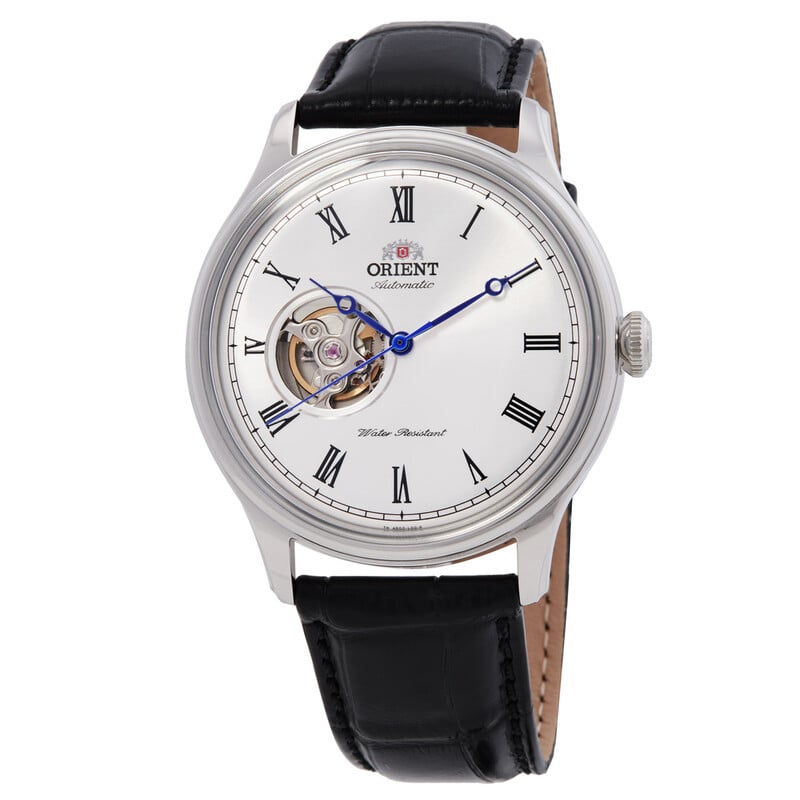
Japan's value king does restraint better than watches at ten times the price.
There is a particular kind of collector who ends up with an Orient Envoy on their wrist, and it is almost never the person who set out to buy one. They set out to buy a dress watch — something thin, quiet, mechanical — and they discovered that the entry tier of that category is a graveyard of quartz fashion pieces and Swiss cases wrapped around generic movements. Then they found reference AG0001W, and the search ended.
The Envoy is what happens when a Japanese manufacture that builds its own movements decides to make a sober three-hander with no marketing hooks attached. No co-branding, no limited-edition dial, no waitlist. It arrives on leather, tells the time, and disappears under a cuff. In a year when steel sports watches dominated every auction headline and every drop, that anonymity is precisely the point.
The House That Makes Everything Itself
Orient was founded in 1950 in Hino, on the western edge of Tokyo, at a moment when Japanese watchmaking was still being dismissed as a curiosity. The company's answer was not marketing but vertical integration: it built its own movements, its own escapements, its own dials, and it did so at prices that made Swiss manufacturers uncomfortable. The Orient Star line arrived in the early 1950s as the brand's statement of ambition, and the philosophy behind it — real mechanical watchmaking, democratically priced — has barely shifted in seventy years.
Since 2009, Orient has operated inside the Seiko Epson group. That parentage matters for a buyer: it gives the brand industrial scale, stable parts supply, and a distribution network that reaches far beyond Japan. What it has not done is turn Orient into a badge-engineered Seiko. The movements are still Orient's own designs, still assembled in Orient facilities, still regulated to Orient's own standards. For a collector, that is the entire value proposition sitting on the spec sheet.
The Envoy sits within Orient's classic dress tradition, alongside the Bambino that most people know and the Esteem that most people overlook. It is the line that exists for people who want a mechanical watch to wear with a suit and nothing more complicated than that.
What the Envoy Actually Is
Strip away the reference number and the Envoy is a straightforward proposition: a stainless steel case, a light dial with applied indices, a date window at three, and a slim bezel that leaves the dial doing most of the visual work. The design language is mid-century without being a pastiche of it. The hands are slim and legible, the indices catch light without sparkling, and there is no text on the dial that needed a committee to approve.
What separates it from the crowd at this price is proportion discipline. Plenty of affordable dress watches are technically dress watches but wear like sport watches that got lost on the way to the gym. The Envoy does not. It reads as a watch that was drawn before it was specified — the kind of thing you would expect from a brand that spent the 1960s making watches for people who wore suits to work because that is what people did.
The reference reviewed here, AG0001W, carries the light dial; the W suffix in Orient's naming convention is the tell. Orient releases dial and finish variations under separate references and varies them considerably by market, so the surest way to know what you are buying is to read the caseback rather than the product photo. The watch arrives on a leather strap with a pin buckle, and no lume — correctly, because a dress watch that glows in the dark has misunderstood its own job.
The Movement
The Envoy runs an in-house Orient automatic, part of the company's long-serving F-series family. This is the single most important fact about the watch. At this price, the overwhelming majority of competitors are using bought-in calibers, or derivatives of bought-in calibers, dressed up in a marketing narrative. Orient makes its own. That means the escapement, the gear train, the winding system, and the regulation were all designed by the same company that designed the case they sit in.
The architecture is a conventional three-hand-plus-date layout with a roughly forty-hour power reserve and a beat rate of 21,600 vibrations per hour. That frequency is unfashionable — modern Swiss value movements like to advertise longer reserves and higher beat rates — but 3 Hz is a perfectly sensible engineering choice for a watch that will spend most of its life being wound by a desk-bound wrist. The finishing is industrial: you will find perlage on the plates and a signed rotor, not hand-bevelled bridges. Nobody buying an Envoy should expect otherwise.
What matters more is serviceability. The F-series has been in continuous production in one form or another for years and lives inside millions of Orient watches worldwide. Parts are not a treasure hunt. Any watchmaker who services Japanese movements has seen one this month.
On the Wrist
The Envoy is a dress watch in the old sense of the phrase: designed to slide under a shirt cuff rather than announce itself at the table. On the wrist it reads light and balanced, with the strap doing most of the work — the case sits close to the arm rather than perching on top of it, and the modest proportions mean there is no overhang on smaller wrists and no sense of a borrowed watch on larger ones. The all-polished case profile and slim bezel keep the visual mass low.
Comfort is the headline. The leather strap supplied is decent rather than luxurious, and swapping it for a slimmer aftermarket strap transforms the watch — it suddenly reads a decade older and twice as expensive. It is not a watch you notice while typing. That is a compliment. It is also not a swimmer; this is a watch for offices, dinners, and the walk between them.
Accuracy, Day to Day
Orient does not submit the F-series to COSC, and no seller should promise you chronometer performance. Realistically, expect a new example to run within a few tens of seconds a day, and expect it to settle after a few weeks of wear. Any competent watchmaker can regulate an Orient automatic on a timegrapher for a modest sum, and regulated examples routinely land in single-digit territory. For a dress watch worn a few days a week, that is more than sufficient — and it is worth remembering that a mechanical watch left on a desk is worst-case for rate anyway. Keep it on a winder or give it a few turns before an evening out, and the Envoy will behave.
The Market: Where the Envoy Sits
Here is where the Envoy gets interesting, because the watch world has spent the last few years teaching young collectors that the only reason to buy a watch is that someone else will pay more for it later. The Envoy is the direct refutation of that idea. It is not an asset. It is a watch. Buy it, wear it, and accept that the money you did not spend on a Swiss alternative is the return on investment.
The natural comparison is Seiko's Presage line, which occupies the same country and roughly the same price bracket. The Presage wins on dial drama and brand recognition; the Envoy wins on restraint and, arguably, on the honesty of its movement story. Then there is Tissot's Le Locle, the Swiss default in this segment — a genuinely good watch with a longer power reserve and a name that reassures people at dinner. Hamilton's Jazzmaster occupies a slightly sportier space, and Citizen's NB1050 offers a sharper case for buyers who lean modern. On the secondary market, the discontinued Seiko SARB033 has become the collector's darling of this exact aesthetic, and it now trades well above its original retail — a reminder that scarcity, not quality, drives the only resale stories in this segment.
None of those watches is a mistake. The Envoy's case is simply the most coherent: a light dial, a slim profile, an in-house movement, and no design decision made to chase a trend cycle that will look dated in three years.
Service and Ownership
Orient does not publish a fixed service interval for this reference, and the honest advice is to service on symptoms rather than on a calendar: when the watch starts losing time consistently, or when the winding feels gritty, take it in. The F-series automatic is well within the competence of any independent watchmaker, and the cost of a service sits in a completely different universe from Swiss servicing. You do not need to ship it to Japan. That accessibility is a genuine ownership advantage and one of the most underrated arguments for buying Japanese at this price.
Pros and Cons
Pros:
- In-house automatic movement at a price where rivals use bought-in calibers
- Genuinely restrained dress-watch design that survives trend cycles
- Light, comfortable, and easy to wear under a cuff all day
- Cheap and straightforward to service through independent watchmakers
Cons:
- Crystal is not sapphire — the most obvious cost cut on the whole watch
- Orient's brand recognition in Western boardrooms is close to zero
- Strap is serviceable rather than good; budget for a replacement
- No meaningful secondary market if you change your mind
Verdict
The Orient Envoy is the rare watch that wins by refusing to perform. It does not chase a trend, does not pretend to be a heritage piece it is not, and does not ask you to pay for a name. What it asks is that you care more about how a watch is made than about what it signals — and for the collector who has already been through the hype cycle, that is an easy trade.
Buy it as your first real dress watch, or as the one you stop worrying about. Either way, it will outlast the trend that made you start looking.