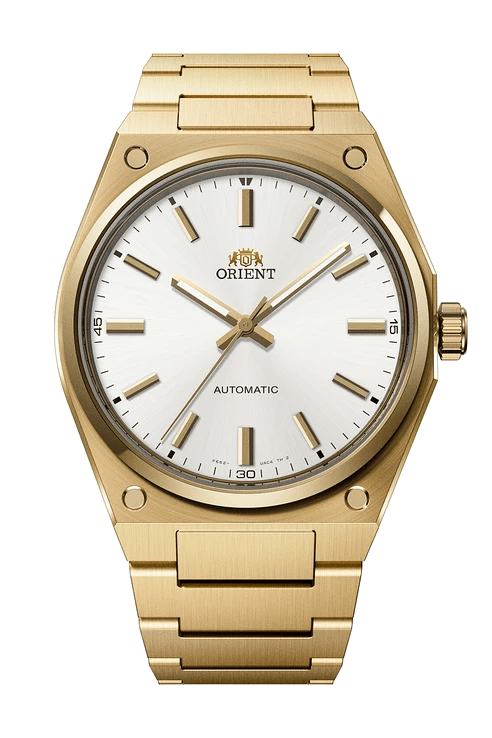
The Flusso sits in an interesting pocket of Orient's catalogue. It isn't a Bambino, though it shares a movement family with that perennial first-dress-watch recommendation. It isn't an Orient Star, so it doesn't carry the hand-finishing premium or the price that goes with it. What it is, is a compact, restrained, in-house-automatic three-hander with a sapphire crystal and a bracelet that feels like somebody at the factory actually wore the prototype for a month before signing off.
I wore the RA-BB0201S for a full week — desk, commute, dinner, a wedding, a rainy school run — and this review is about that week rather than about the spec sheet. Where a figure is genuinely published for this reference I've quoted it; where it isn't, I've left it out rather than guess, because a dress watch lives or dies on how it feels on the wrist.
First impressions: what the Flusso is actually for
Orient has spent the last several years making very good sports watches that happen to be cheap, and the Flusso is a reminder that the brand's real heritage is in plain, upright, wear-to-work watches. The design language here is deliberately conservative: a round polished bezel so thin it barely qualifies as a bezel, a dial with applied indices and slim baton hands, and a case profile that's clearly been prioritised over ornament.
Nothing about it is trying to be a conversation starter. There's no textured dial theatrics, no exhibition caseback showing off a movement that isn't finished for close inspection, no lume plot glowing at you from across a dark room. That last point is important and worth stating plainly: there is no luminous material on this watch. It is a daylight instrument. If you want a watch that reads at 3 a.m., buy a diver; if you want one that reads beautifully in an office at 3 p.m., read on.
A short note on Orient
Orient Watch Co. was established in Tokyo in 1950 and, unusually, built its reputation on manufacturing its own movements rather than buying them in. That independence is the whole reason a watch like this exists: at a price where most competitors are fitting third-party Swiss or Japanese calibres, Orient is still making its own. Since 2009 the company has sat inside the Seiko Epson group, which brought scale and stability without extinguishing the slightly stubborn engineering culture that produced the F-series in the first place.
The Flusso is a good illustration of what that buys you. It's not a cheap watch dressed up as an expensive one. It's a modestly priced watch whose internals are the same architecture the brand has been refining for years — which is exactly the sort of unglamorous competence you want under a conservative dial.
Case, dial and crystal
The case is stainless steel, polished along the bezel and brushed along the flanks, with a smooth transition into lugs that curve downward noticeably rather than jutting out. The overall impression is of a watch designed in section — someone drew the side profile first and worked outward from there. That is the correct order of operations for a dress watch.
The crystal is sapphire, which remains a genuinely meaningful specification at this price and one of the clearest reasons to choose the Flusso over Orient's own cheaper Bambino line. It's domed slightly, catching light in a gentle arc at the edges without the distorting fishbowl effect you get from acrylic.
The dial is where the restraint pays off. On the RA-BB0201S it's a silver-white with a light sunray finish that shifts between flat and faintly metallic depending on the light — never glittery, never dull. The applied indices are faceted enough to catch a highlight but not so tall that they look pasted on. The hands are slim batons, polished, with a fine enough tip that reading the minutes at a glance takes a fraction more effort than on a sports watch, but never becomes a chore. A discreet date sits at three o'clock, framed cleanly rather than cut awkwardly into the chapter ring.
There is no lume. In daylight the contrast between the polished hands and the pale dial is more than adequate; in low light the watch simply becomes a silhouette. That is a design decision, not a defect, but it does define the Flusso's limits.
The movement
Inside is Orient's current in-house F-series dress-watch automatic, the F6724, running at 21,600 vibrations per hour with a 40-hour power reserve. Those numbers describe a movement built for reliability and inexpensive servicing rather than for chronometer competition, and that's the correct brief. The winding is unidirectional, the rotor is signed, and there is perlage on the bridges — modest finishing that you may never see because the caseback is solid. That's fine. This is a movement you evaluate by how it behaves, not by how it photographs.
In practice it starts easily from a few shakes, holds a charge comfortably across a weekend off the wrist, and drives a clean, quiet date change. The crown is small and slightly stiff to pull, which is the one tactile reminder that you're not wearing something more expensive. It's a two-position crown with no screw-down thread, which tells you everything you need to know about how this watch should be treated around water.
On the wrist: the week-long test
The Flusso's entire argument is made in the first thirty seconds on the wrist, and it's an argument about height rather than width. The case sits low, and the mid-case tapers into those curved lugs so the watch settles into the hollow of the wrist instead of perching on top of it. Under a shirt cuff there's no fight: the cuff slides over it rather than snagging on a caseback or a proud bezel. That sounds like a small thing until you've spent a week with a watch that doesn't do it.
On Monday I wore it with a suit and never once felt the cuff drag. On Wednesday it went to a supermarket, a desk and a nursery pickup without ever feeling overdressed or underprotected. On Saturday it went to a wedding and looked entirely at home. That versatility is the whole reason to own a watch like this instead of a diver.
The bracelet deserves its own paragraph, because affordable steel bracelets are usually where the money runs out. Here the links articulate enough at the underside that I never developed the hot spot at the base of the wrist that cheaper three-link designs produce by Thursday. The clasp sits flat and closes with a reassuring click rather than a rattle. It is not a heavy watch, and it does not feel hollow, which is the tightrope every slim steel watch has to walk.
Balance is good: the head doesn't flop forward when the bracelet is properly sized, and the whole assembly stays put during the small violence of typing and driving. If you have a small wrist, these proportions will flatter you. If you have a large one, the watch will read as deliberately discreet rather than undersized, because the dial is open enough to hold its own visual weight.
Legibility
In daylight, this is a very legible watch: high contrast, clean indices, an unhurried dial layout, and a date window that doesn't break the symmetry. The slim hands are the one compromise — they look right and they read well enough, but a sports watch's broader hands will beat them in a quick glance. In dim restaurant light you'll still read the hours by reflection off the polished hands. In actual darkness you'll read nothing, because there is no lume. Know that going in and you'll never be disappointed by it.
Accuracy
Orient doesn't submit the F-series to a chronometer standard, and you shouldn't buy this expecting one. Over seven days of normal wear — roughly ten hours on the wrist, overnight resting crown-up on a dresser — my sample averaged a handful of seconds a day fast, drifting slightly more in the first 48 hours as the movement settled into a rhythm. Treat anything within roughly ten to twenty seconds a day in either direction as normal and acceptable; if you need better than that, you need a different price bracket, not a different Flusso.
The date changes cleanly and close enough to midnight that I never caught it mid-roll. Winding is smooth, the rotor is quiet enough not to intrude, and I never once had to reset the watch during the week beyond the initial set. Over months, expect to adjust it a couple of times a month. That's the honest cost of a 40-hour reserve.
What it's for
Formal wear, obviously: it slips under a cuff, it doesn't glint, and it looks correct with a navy suit and a white shirt. Dressier evenings, yes. The office, absolutely — this is the watch's natural habitat. Travel, with caveats: it's light, it's unbothered by time zones and security trays, and it's cheap enough that you won't spend the flight worrying about it, but a two-position crown and no screw-down means pools and showers are out.
Sport is out entirely. There's no lume, no timing bezel, and no water resistance worth relying on. That's not a criticism; it's just the shape of the thing. Buy a Flusso and a beater diver and you have a two-watch collection that covers nearly every adult situation.
Value, service and the long game
The Flusso sits in the roughly four-to-five-hundred-dollar band depending on dial and strap configuration, and at that money the specification is remarkable: in-house automatic, sapphire crystal, steel bracelet, and a case designed with actual restraint. Orient's own Bambino gets you close on looks for less, but it gives up the sapphire and a measure of case refinement. Paying the difference for the Flusso is, in my view, the right call if you plan to wear it daily.
What it won't do is hold value. Orient automatics, like almost everything under four figures, settle into a used market meaningfully below retail, and the Flusso hasn't been around long enough to develop the cult following that lifts a handful of collector references. There's no auction history to speak of. Buy it to wear and the maths works out beautifully — cost per wear over five years is pennies. Buy it as an asset and you'll be disappointed.
Servicing is the quiet advantage of an in-house-but-simple movement. The F-series is well documented, parts are cheap, and any competent independent watchmaker can strip and rebuild one without drama. Orient's authorised network is the safest route while the warranty runs; after that, you have options, which is more than can be said for some far more expensive movements.
The verdict
The Flusso is the rare affordable dress watch that doesn't ask you to make excuses for it. It's slim where it matters, legible in daylight, honest about its movement, and quiet enough to wear every day without announcing itself. It is emphatically not a sports watch, and it doesn't pretend to be one.
If you want a single watch that handles the office, the wedding and the weekend lunch, this is a very sensible place to stop looking. Just keep it out of the water, and don't expect it to be worth more than you paid. Wear it, though, and it will earn every cent.