Orient Ray II FAA02004B9: The People's Diver
There is a moment in every collector's life when the hunt stops being theoretical. You have read the auction results, saved the screen grabs, and convinced yourself that a five-figure dive watch is the only way to prove you care. Then you actually wear a watch for a week. The Orient Ray II FAA02004B9 is what that reality check looks like at the affordable end: a stainless-steel dive-style watch with an in-house automatic movement, a day-date, 200m water resistance, and a price that does not require a group chat vote.
The Ray II is not a status symbol, and that is the point. It is the watch that gets worn to a first job, a first marathon, a first international flight, and a first badly lit group photo where the bezel catches the flash. It connects the entry-level collector to the same rituals as a Submariner owner: checking the bezel, setting the day and date, feeling the rotor swing when you stand up. The difference is that the Ray II lets you learn those rituals without turning your taste into a financial position.
Orient has been making mechanical watches in Japan since 1950, and the Ray line has become the brand's quiet gateway drug. The reference FAA02004B9 is the black-dial, steel-bracelet version, the one that looks serious with a T-shirt and disappears under a cuff. This review covers what it is, how it wears, and whether it deserves a place in a young collection that is still figuring out what it wants to be.
Why the Ray II matters now
The entry-level dive watch market is crowded with nostalgia. Seiko SKXs have become collector folklore, Citizen Promasters have a cult following, and every week brings another microbrand promising sapphire and specs for less. The Ray II survives because it refuses to be a spec-sheet novelty. It has a classic silhouette, a proven in-house movement, and a wearing experience that feels more expensive than the price suggests. In a culture obsessed with drops and limited editions, the Ray II is almost anti-hype. That is exactly why it keeps showing up on wrists that are still building their first serious watch box.
It also has the right cultural posture. It is not pretending to be a vintage Heuer or a modern Black Bay. It is a tool watch for people who actually need a tool watch, or at least need to know what one feels like. The Ray II is the watch you buy when you want to stop reading about mechanical watches and start living with one.
Brand history: Orient's quiet machine
Orient Watch Co. was founded in Tokyo in 1950, at a time when Japanese watchmaking was still fighting for global respect. The brand built its reputation on in-house mechanical movements at prices that undercut Switzerland without feeling like a compromise. Orient is now part of the Seiko Epson group, which gives it access to serious manufacturing muscle while leaving it enough independence to keep doing what it does best: accessible automatics with a distinct identity.
The Ray line is part of that identity. It sits alongside the Mako and Kamasu as Orient's affordable dive-style family, and the F6922 caliber is the mechanical heart that makes the whole proposition work. The Ray II is not a rare collector piece, but it is a historically relevant one: it represents the moment when a young collector realizes that an in-house automatic does not have to cost a month's rent.
Movement: Caliber F6922
The Ray II runs on Orient's Caliber F6922, an in-house automatic with 22 jewels, a 40-hour power reserve, and a frequency of 21,600 vibrations per hour. It hacks, it hand-winds, and it includes a day-date complication. Those features sound basic until you remember how many entry-level automatics still skip hacking or hand-winding. The F6922 makes the Ray II easy to live with: you can set it precisely, wind it when it has been sitting in a drawer, and trust it to keep running through a normal week.
Finishing is industrial rather than decorative. You will not find Geneva stripes or hand-bevelled bridges through a display caseback, because the Ray II does not have a display caseback. What you get instead is a robust architecture that has been proven in years of daily wear. The rotor is audible when you move quickly, which is either charming or annoying depending on your relationship with mechanical watches. I find it charming. It reminds you that the watch is doing something.
Case, dial, and bracelet
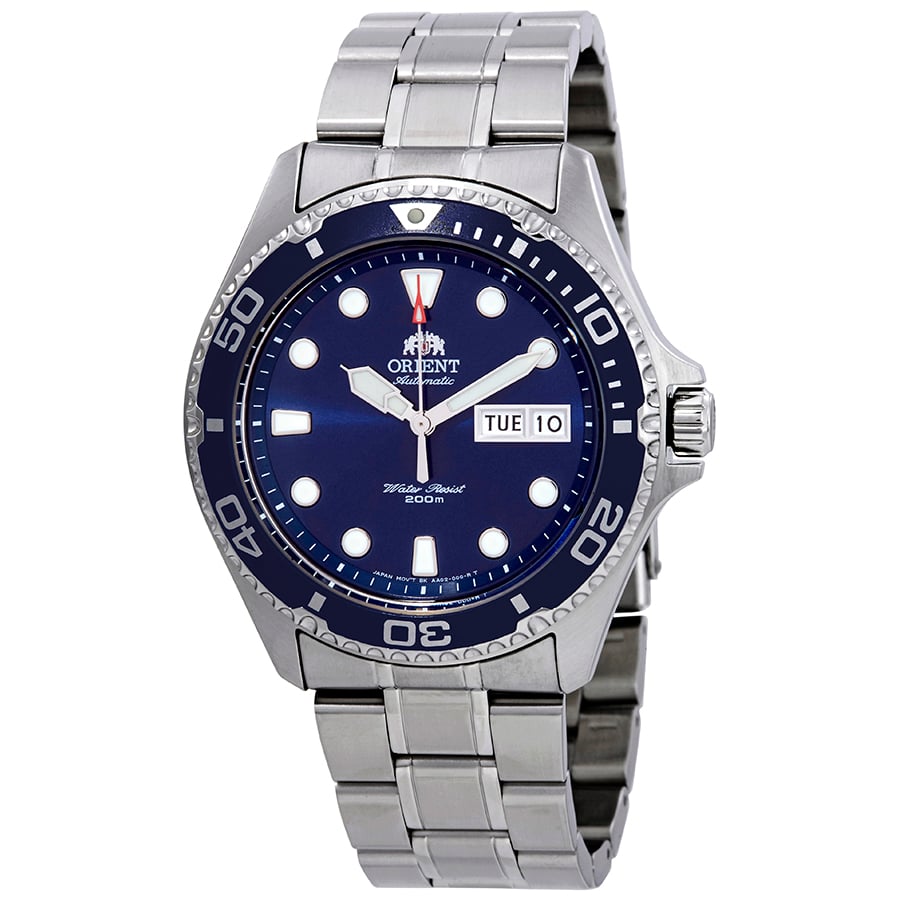
The case is stainless steel, 41.5mm across and 13mm thick, with a screw-down crown and a unidirectional rotating bezel. That combination gives the Ray II a substantial tool-watch stance without crossing into oversized territory. The black dial is legible and clean: applied hour markers, a day-date window at 3 o'clock, and hands that are easy to read at a glance. The bezel action is crisp enough to fidget with and precise enough to time a parking meter or a pasta boil. It is not a luxury bezel, but it is a satisfying one.
The dial is also a reminder that Orient knows how to do restraint. The black surface is matte enough to avoid glare, and the markers catch light without turning into a disco ball. Orient's proprietary lume is not the most advanced compound on the market, but it is effective: charge it with a phone light and it glows green long enough to read the time in a dark hotel room. It will not last all night like a high-end diver, but it is more than adequate for the watch's purpose.
The crystal is mineral, not sapphire. That is the Ray II's most obvious compromise, and it is worth being honest about. Mineral crystal can scratch, and if you wear your watch hard you will eventually notice. The upside is that mineral crystal is cheaper to replace and less likely to shatter in a way that damages the dial. For a watch at this price, the trade-off is defensible. If sapphire is non-negotiable, Orient's Kamasu is the sibling to consider.
The stainless-steel bracelet is functional and comfortable, with a folding clasp that does the job without pretending to be a glide-lock. It is not the reason to buy the Ray II, but it is not a reason to avoid it either. The bracelet gives the watch a finished, everyday look, and it balances the case well on the wrist. Swap it onto a NATO and the Ray II becomes more casual, more colorful, and slightly taller on the wrist. Both versions make sense.
On the wrist
At 41.5mm across and 13mm thick, the Ray II wears like a proper dive watch. It has presence without being a dinner plate, and the steel bracelet keeps the head from feeling top-heavy. The case sits securely on the wrist, and the crown is easy to grip when you need to set the time or wind it. It is not a watch that disappears; it is a watch that reminds you it is there, in the way a good pair of boots reminds you that you are ready for the day.
Comfort is good for a watch of this type. The bracelet articulates well enough, and the clasp does not dig into the wrist during normal desk work. If you have a smaller wrist, the 41.5mm case may feel like the upper limit, but it is not unreasonable. If you have a larger wrist, the Ray II will look proportionate rather than delicate. The 13mm thickness is the main thing to note: it gives the watch a tall, tool-watch profile that can catch a shirt cuff. That is the price of a 200m water-resistant case and a screw-down crown. It is a fair trade.
Accuracy and daily life
The F6922 is not a chronometer, and Orient does not certify it as one. Real-world accuracy varies by example and by how you wear the watch. Most owners report something in the range of -10 to +20 seconds per day, with positional variation that can be managed by resting the watch in different orientations overnight. If you need tighter timekeeping, a watchmaker can regulate it, but for daily wear the Ray II is accurate enough. You will set it once a week, maybe less if you are not obsessive.
The day-date complication is genuinely useful. The day window makes it easy to keep track of the week, and the date is large enough to read without squinting. The hacking movement means you can set the watch precisely to the second, which is a small pleasure that never gets old. The 40-hour power reserve is adequate for a daily wearer: take it off Friday night, put it on Monday morning, and it will still be running. If you rotate watches often, you will need to wind it, but that is part of the ritual.
How it fits a collection
The Ray II works best as a daily driver, a travel watch, or a first automatic. It is at home with jeans and a T-shirt, a casual button-down, or a wet suit. It is not a formal watch, and it does not pretend to be. That honesty is part of its appeal. In a collection, it can be the watch you grab when you do not want to think about what to wear, or the watch you take on a trip because it is reliable, legible, and replaceable. It also makes a strong case as a one-watch starter: 200m water resistance, a day-date, and a classic dive silhouette cover a lot of ground.
If you already own a Submariner or a Black Bay, the Ray II is not a replacement. It is a reminder of why you fell in love with dive watches in the first place. It is the beater that lets you keep the expensive watch safe, and it is the watch you hand to a friend who asks what the fuss is about. In that role, it is almost perfect.
Variants and family
The most obvious sibling is the FAA02005D9, which shares the Ray II platform but swaps the black dial for blue. The blue version has a slightly more playful character, while the black reference FAA02004B9 remains the classic choice. The Ray family also includes the first-generation Ray, the Mako II, and the Kamasu. The Kamasu is the one to look at if you want sapphire crystal and a more modern spec sheet. The Mako II is the one to look at if you prefer a different dial layout and a slightly different case shape. Within Orient's wider catalog, the Bambino is the dress-watch counterpart, and the Orient Star Diver is the step-up for buyers who want more finishing and a higher price point.
Alternatives and homages
The Seiko SKX007 is the most obvious alternative, and for good reason. It has a cult following, a huge modding community, and a very different wearing experience. The Citizen Promaster NY0040 is another legitimate dive watch with a left-side crown and a rugged reputation. The Seiko 5 Sports SRPD line offers a modern everyday alternative with a wider range of colors, though it lacks the Ray II's classic dive-watch silhouette. The Casio MDV106 is the quartz option for buyers who want the look without the service. Each of these watches has its own personality, and none of them makes the Ray II obsolete.
If you are looking at homages, the Invicta Pro Diver 8926OB is the budget Submariner-style automatic that undercuts the Ray II on price but not on brand history or in-house movement. The Pagani Design PD-1661 is another modern homage with sapphire and a Seiko-derived movement, trading Orient's in-house credibility for spec-sheet bragging rights. These watches can be fun, but they are not the same project. The Ray II has its own design language and its own movement, which matters if you care about the story behind the watch.
Value and ownership
The Ray II has an MSRP around $250 and a street price that often lands in the same range. On the secondary market, examples typically trade between $120 and $180, depending on condition and whether the bracelet and box are included. That makes it a stable entry-level piece rather than an appreciating asset. It will not fund your next grail, and it will not appear in a major auction house catalog. What it will do is hold a modest floor because the demand for affordable dive watches is deep and constant. Buy it to wear, not to flip.
Service is straightforward but not glamorous. Orient USA and independent watchmakers can handle the F6922, though parts availability and official service routing vary by region. Routine service is not something you need to obsess over on a watch at this price, but it is worth knowing that the movement is serviceable. If you wear the Ray II daily, expect to have it looked at eventually. If you wear it occasionally, it may run for years without drama.
Verdict
The Orient Ray II FAA02004B9 is not trying to be a grail, and that is its charm. It delivers the core rituals of mechanical dive-watch ownership at a price that lets young collectors learn their taste without risking a down payment. The in-house movement, the 200m water resistance, the day-date practicality, and the classic black-dial silhouette add up to a watch that feels more considered than its price tag suggests. The mineral crystal and basic bracelet are real compromises, but they are the right compromises for this watch.
If you want a first serious automatic, the Ray II earns its place. If you want an asset, keep scrolling. If you want a watch that makes the entry-level hunt feel serious, this is the one.