The Rebirth of a Legend: Why the Sixty-Five Matters
In the world of luxury watches, heritage is often used as a marketing shield to protect stagnant design. However, Oris took a different path in 2015. Instead of simply reissuing a museum piece, they looked at their 1965 dive watch and asked: "How would this feel if it were made with the best of today's materials?" The result was the Divers Sixty-Five, a watch that arguably saved the brand from being pigeonholed as just the 'Aquis' company.
For the Vivir reader, this watch represents a specific kind of sophistication. It’s for the collector who has grown tired of the 'bigger is better' philosophy that dominated the early 2000s. It’s a watch that understands that a Tuesday at the office is not a saturation dive, but still respects the aesthetic codes of the sea.
Anatomy of the 40mm Case: A Lesson in Proportions
The case is where the Sixty-Five wins its most loyal fans. At 40mm, it hits the sweet spot for the modern wrist. But diameter is a deceptive metric. What truly matters is the 48mm lug-to-lug measurement. This length ensures that the watch occupies enough real estate to have presence, yet the lugs curve downward sharply, hugging the wrist bone rather than hovering over it.
The thickness—or lack thereof—is the watch's secret weapon. Measuring 12.8mm, it sounds standard on paper. However, when you hold the watch in profile, you see that the steel case side is incredibly thin. The bulk of that 12.8mm is found in the 'box' sapphire crystal, which rises above the bezel like a bubble of water. This design choice mimics the look of vintage plexiglass while offering the scratch resistance of sapphire. On the wrist, this makes the watch feel like it's only 10mm thick, allowing it to disappear under a cuff.
The Tapered Bracelet: A Masterclass in Comfort
I cannot emphasize enough how much the bracelet contributes to the daily-wear experience. Many modern bracelets are heavy, blocky affairs that maintain a consistent width. The Sixty-Five bracelet tapers from 20mm at the lugs to a dainty 16mm at the clasp. This taper is a direct nod to mid-century design, and functionally, it is a dream. It reduces the weight on the underside of the wrist, making it far more comfortable for those of us who spend our days typing or moving between meetings.
The 'rivet' style links are a point of contention for some—they are aesthetic rather than functional—but they add a level of visual texture that differentiates the watch from the ubiquitous Oyster-style bracelets found elsewhere. The clasp itself is simple, with three micro-adjustment holes, allowing you to dial in the fit as your wrist expands and contracts throughout the day.
Legibility and the Dial: The Warmth of 'Faux-Lume'
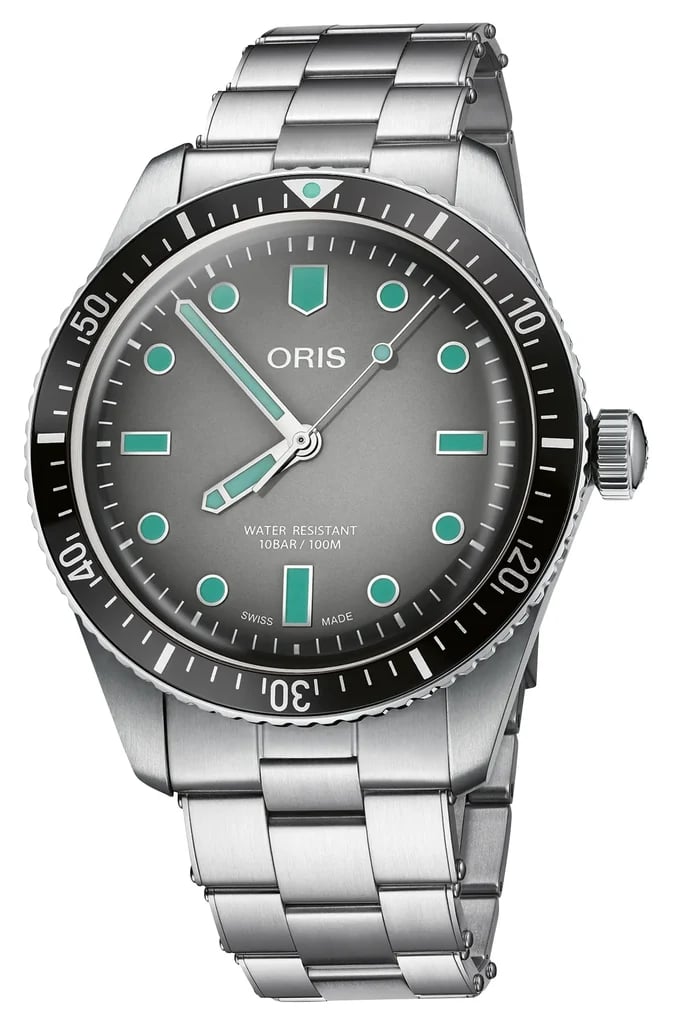
The dial of the reference 01 733 7707 4055 is a masterclass in depth. The deep blue is so dark it often passes for black in low light, only revealing its true color when hit by direct sunlight. The use of 'Light Old Radium' Super-LumiNova—what collectors often call 'fauxtina'—is handled with restraint. It provides a warm, creamy contrast to the blue dial that stark white lume simply couldn't achieve.
Legibility is excellent, thanks to the oversized geometric indices and the high-contrast handset. Even at extreme angles, the distortion caused by the domed sapphire crystal creates a beautiful 'melting' effect on the edges of the dial, which is a delight to check throughout the day. It turns the simple act of checking the time into a brief moment of aesthetic appreciation.
The Movement: Reliability Over Ornamentation
Inside beats the Oris 733, which is a modified Sellita SW200-1. In an era where every brand is racing to produce 'in-house' calibers, there is something refreshing about a high-quality, third-party movement. It keeps the initial cost down and, more importantly, it makes the watch incredibly easy to live with long-term. Any competent watchmaker in any city in the world can service this movement. For a daily-wear watch, that peace of mind is invaluable.
While the 38-hour power reserve is admittedly short by modern standards—you can't take it off on Friday night and expect it to be running Monday morning—the winding action is smooth and the hacking seconds feature allows for precise setting. For those who demand more, Oris does offer the Calibre 400 version, but for the entry-level collector, the 733 remains the pragmatic choice.
Seven Days in Paris: A Real-World Test
To truly understand the Sixty-Five, I wore it for a week of varying intensity. On Monday, under a grey flannel suit, it was a subtle companion. On Wednesday, during a rainy commute, the 100m water resistance provided all the protection needed (despite what the '300m-or-nothing' crowd might claim). By Saturday morning, paired with a denim jacket and a leather NATO strap, the watch transformed into a rugged weekend warrior.
What struck me most was the lack of 'wrist fatigue.' There are many beautiful divers that I find myself wanting to take off by 4:00 PM because of their weight or the way the crown digs into the back of my hand. The Sixty-Five never once prompted that feeling. It is a watch that works with you, not against you.
Comparison: Oris vs. The Field
When considering the Sixty-Five, one inevitably looks at the Tudor Black Bay 58. The Tudor is objectively a 'better' watch on paper—it has a 70-hour power reserve, 200m water resistance, and a COSC-certified in-house movement. However, it is also nearly double the price on the secondary market and carries a certain 'hype' baggage. The Oris feels more personal, more approachable, and in many ways, more charming due to its independent roots.
Final Verdict
The Oris Divers Sixty-Five is not trying to be the most rugged tool on the market. It is not trying to break depth records or win a laboratory precision contest. Instead, it aims to be the most wearable, stylish, and honest dive watch in the sub-$2,500 category. For the sophisticated collector who values ergonomics and heritage, it is a nearly perfect daily companion. It is a watch that reminds us that horology is not just about specs—it's about how a watch makes you feel when you check the time on a Tuesday afternoon.