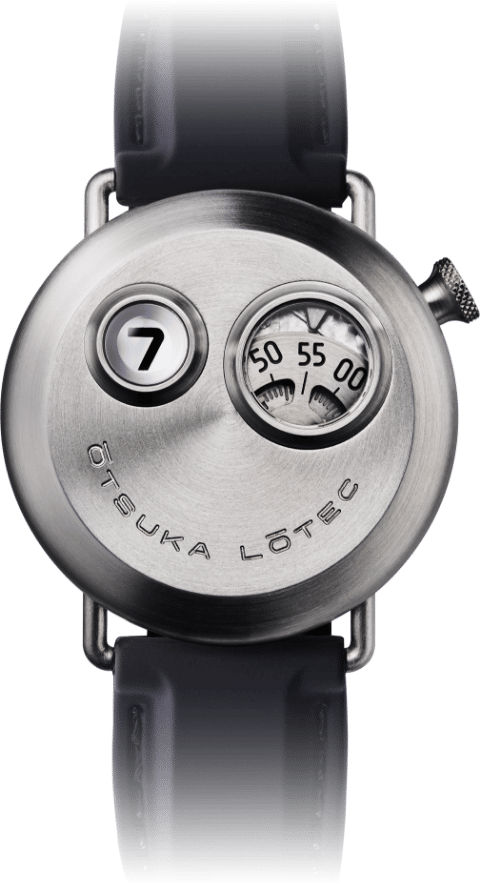
This review focuses on the OLD MODEL, the version that preceded the current No.5. That distinction matters because the old model carries the date complication and the original dial layout that many purists prefer. If you are hunting one on the secondary market, you are buying a piece of Otsuka Lotec's early history, not just another field watch. The OLD MODEL is also the version that established the brand's reputation for combining vintage Japanese instrument design with modern reliability.
Collectors often ask whether the No.5 is a tool watch, a dress watch, or a curiosity. The answer is that it is all three in moderation. It has the legibility of a field watch, the proportions of a vintage piece, and the build quality of a modern microbrand. That versatility is why it has developed such a loyal following.
Manufacture history
Otsuka Lotec was founded in 2009 in Japan by Jiro Katayama, a former Seiko engineer. Katayama's background in industrial design and his affection for vintage Japanese measuring instruments shaped the brand's aesthetic from the start. The name 'Lotec' is a nod to low technology: simple, robust, and repairable. Production is tiny, often measured in dozens of pieces per year, which explains why the brand has a cult following rather than mainstream distribution.
The No.5 is the model that brought Otsuka Lotec wider attention. It takes cues from mid-century field watches and railway clocks, but it is not a direct homage. The OLD MODEL is particularly sought after because it represents the original vision before later revisions softened some of the dial details. For collectors, that provenance is part of the appeal. The brand's small output also means that each batch tends to sell out quickly, and secondary prices have remained firm as a result.
Katayama's approach is not about chasing trends. He designs watches that look like they could have been issued to a surveyor or a railway engineer in the 1960s, but with the convenience of a modern automatic movement. That philosophy resonates with collectors who are tired of oversized cases and busy dials. The No.5 is a statement of restraint, and the OLD MODEL is the purest expression of that idea.
Movement and accuracy
The OLD MODEL runs on a Miyota 9015 automatic. This is a sensible choice for a small brand: the 9015 is thin, reliable, and easy to service. It beats at 28,800 vph, offers a 42-hour power reserve, and carries 24 jewels. It is not an in-house movement, and it is not COSC-certified, but it is a known quantity that any competent watchmaker can maintain. The finishing is industrial, with a rotor that is more functional than fanciful, but that fits the No.5's tool-watch ethos.
In real-world use, expect accuracy in the range of -10 to +15 seconds per day. That is typical for a Miyota 9015, and most examples can be regulated to perform better. The date function is a practical addition for daily wear, though purists may prefer the cleaner dial of the later no-date version. The movement is not the star of the show here; the dial and case are. But the 9015 provides the dependable heartbeat that makes the No.5 a genuine everyday watch.
One of the advantages of the Miyota 9015 is that it is thin enough to keep the case profile comfortable without sacrificing automatic winding. It also has a reputation for robustness, which matters for a watch that is meant to be worn rather than babied. If you are the kind of collector who likes to swap straps and wear a watch hard, the 9015 is a sensible companion. It will not win any beauty contests through an exhibition caseback, but the No.5 does not have an exhibition caseback anyway.
Case, dial, and specs
The case is stainless steel with a compact footprint that suits a wide range of wrists. Otsuka Lotec does not publish every dimension for every batch, and the OLD MODEL is no exception; what matters is that it wears smaller than its visual mass suggests. The sapphire crystal is a welcome upgrade over acrylic, and the leather strap with pin buckle keeps the package comfortable and understated. There is no lume, which is a deliberate choice: this is a watch for reading in daylight, not for night dives.
The dial is where the No.5 earns its cult status. It is matte and highly legible, with printed Arabic numerals, a fine minute track, and a date window at 3 o'clock. The hands are simple and purposeful, and the overall layout feels like a precision instrument from another era. It is not a busy dial, but it rewards close inspection with small details that reveal the designer's hand. The old model's dial is the one to have if you prefer the original proportions and the date complication.
The absence of lume is worth discussing because it is a polarizing choice. Some collectors see it as a flaw in a field watch, while others appreciate the purity of a dial that is not interrupted by luminous plots. In practice, the No.5 is a daylight watch. If you need to read the time in the dark, you will need a different tool. But for office work, travel, and weekend wear, the lack of lume is a non-issue. The sapphire crystal adds scratch resistance, which is more important for daily wear.
The leather strap is a good match for the vintage-inspired design. It is comfortable from the first wear and develops a patina over time. The pin buckle is simple and secure, and it keeps the profile low. If you prefer a bracelet or a NATO, the lug design should accommodate strap changes, though the watch looks best on leather in our view.
Wrist feel and presence
On the wrist, the No.5 OLD MODEL feels balanced and unobtrusive. The compact case sits close to the arm, and the leather strap breaks in quickly. It is the kind of watch you forget you are wearing until someone asks about it. The weight is moderate, and the crown does not dig into the wrist. For a daily wearer, that comfort is more important than any single specification. The case shape is distinctive without being bulky, and the proportions feel deliberate rather than trend-driven. It wears well under a cuff and equally well with a t-shirt.
Wrist presence is rated at 3/5. It is not a flashy watch, and it will not announce your arrival in a boardroom. But the distinctive dial and the obvious quality of the case draw second glances from people who know watches. It is a connoisseur's piece, not a status symbol. That is precisely why collectors love it. The No.5 has a quiet confidence that comes from thoughtful design rather than loud branding.
Comfort also depends on the strap, and the stock leather is a good starting point. If you have a smaller wrist, the compact case will sit nicely without overhang. If you have a larger wrist, the watch may look slightly undersized, but that is part of its vintage charm. The No.5 is not trying to be a modern sports watch, and it should not be judged by those standards.
Occasions
The No.5 OLD MODEL is at home in daily wear, sporty casual settings, and travel. It is not a formal watch, and it is not a dress watch, but it can handle a weekend hike, a coffee run, or a long flight without missing a beat. The date complication is useful for travel, and the legible dial makes it easy to read at a glance. It is not water-resistant enough for serious diving, so leave it on land for water sports.
For collectors who like a one-watch rotation, the No.5 is a strong candidate. It pairs well with denim, chinos, and even a casual blazer. It is not the watch you wear to a black-tie event, but it is the watch you wear when you want to feel connected to the history of Japanese watchmaking without shouting about it.
Reference variants and family
The OLD MODEL is distinguished from the current No.5 by its dial and date window. The later model moved to a Miyota 9039 and dropped the date, which gives it a cleaner look but loses some of the original's utility. Other references in the family include the No.6, No.7, and No.8, each with its own instrument-inspired design. Otsuka Lotec also makes limited editions and dial variations, but they are rare and often sell out immediately.
If you are comparing the OLD MODEL to the new model, the decision comes down to whether you value the date window and the original dial proportions. The new model is arguably more refined, but the old model has the charm of a first edition. Collectors tend to prefer the OLD MODEL for its historical significance, while daily wearers may appreciate the cleaner look of the new version.
Similar watches
If you like the No.5 OLD MODEL, consider the Seiko Alpinist SPB121 for its Japanese field-watch DNA, the Hamilton Khaki Field Mechanical for its military legibility, and the Sinn 556 I for its German tool-watch toughness. None of them have the same quirky charm, but they offer comparable utility. For a budget alternative, the Seiko 5 SNK805 and the Timex Expedition Scout deliver a similar vibe for a fraction of the price.
The Seiko Alpinist is the closest in spirit, with a compass bezel and a rich dial that feels at home in the outdoors. The Hamilton Khaki Field Mechanical is more overtly military and offers a hand-wound experience. The Sinn 556 I is the most robust of the three, with a sterile dial and a reputation for toughness. The No.5 sits somewhere between these watches: more distinctive than the Hamilton, less rugged than the Sinn, and more artisanal than the Seiko.
Investment value
The OLD MODEL originally retailed around $1,650, and current retail is no longer applicable because it is discontinued. Pre-owned examples trade in the $1,200 to $1,800 range, depending on condition and completeness. The trend is stable. Otsuka Lotec's limited production and cult following support values, but this is not a watch to flip. Hold recommendation: buy to wear, and enjoy the fact that it will not lose much value if you keep it in good condition. There is no major auction history, so do not expect investment-grade returns.
For a microbrand, the No.5 has unusually strong value retention. That is because supply is limited and the brand has a dedicated following. If you find one at a fair price, it is unlikely to depreciate significantly. But do not confuse stability with appreciation. This is a watch to enjoy, not a speculative asset.
Service and ownership
Service interval is not fixed by the brand, but a Miyota 9015 typically benefits from a service every five to seven years. Approximate cost is not disclosed by Otsuka Lotec, but independent watchmakers can handle it for a reasonable fee. Authorized service is not strictly necessary because the movement is widely supported. That is a big advantage for collectors outside Japan.
Ownership is straightforward. The watch is robust, the movement is common, and the sapphire crystal is scratch-resistant. The leather strap will wear out over time, but replacement straps are easy to find. If you are careful with the case, the No.5 will last for decades.
Pros and cons
Pros: reliable Miyota 9015, distinctive dial and case design, comfortable on the wrist, and strong value retention for a microbrand. Cons: no lume, limited availability, and the date window disrupts symmetry for some purists. The OLD MODEL also lacks the cleaner no-date look of the later version, which is a matter of taste.
For collectors who value character over specifications, the pros far outweigh the cons. The No.5 is not a watch for everyone, but it is a watch for someone who wants something different from the usual Swiss suspects.
Final verdict
The Otsuka Lotec No.5 OLD MODEL is a cult classic that delivers Japanese quirk and everyday reliability. It will not impress spec-sheet warriors, but collectors who value character will find it hard to let go. If you can find one at a fair price, buy it and wear it. It is a watch that rewards the patient enthusiast.