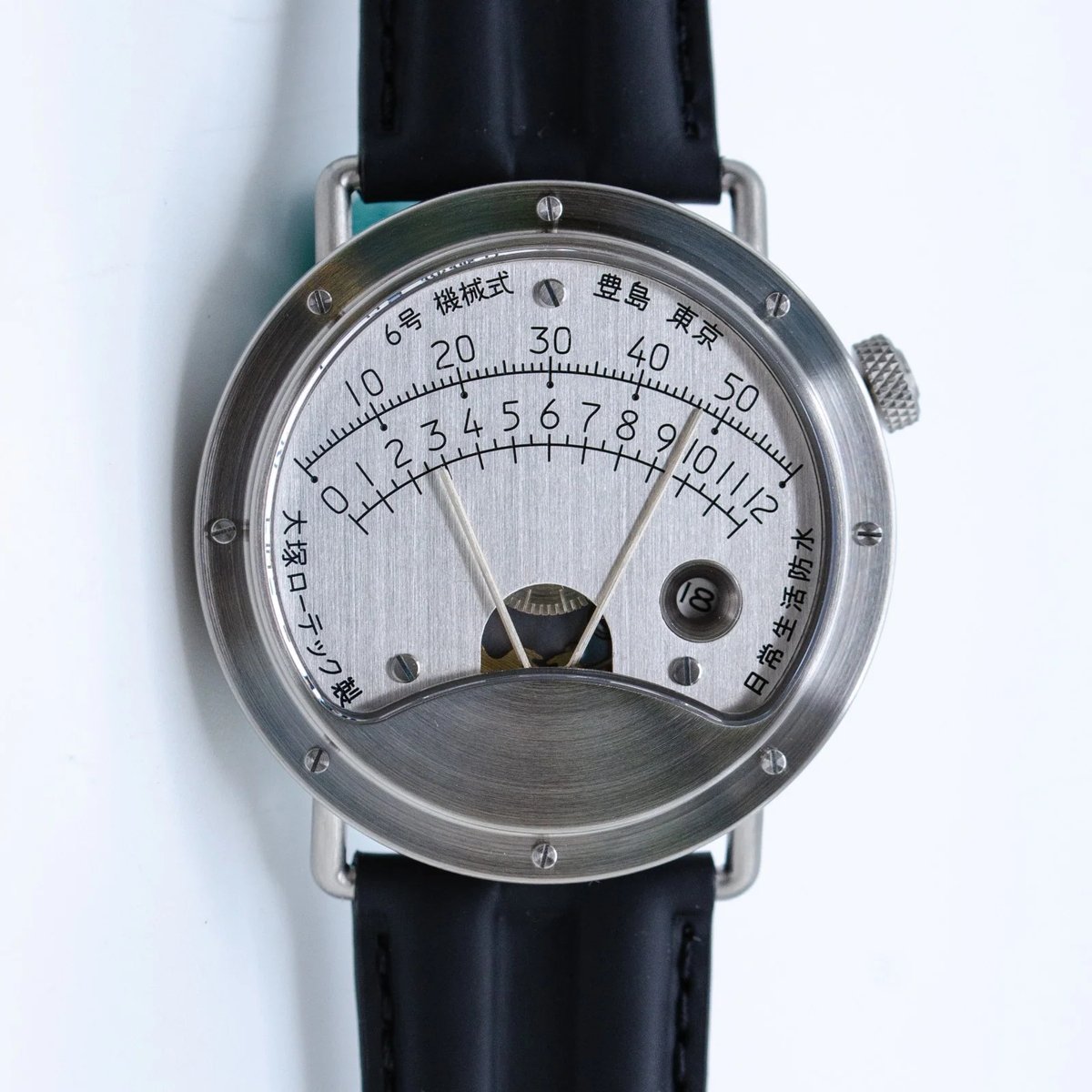
Japan's quietest cult watchmaker turns a camera aperture into a dial — and a waiting list into a religion.
An object that refuses the category
Otsuka Lotec does not behave like a watch brand. There are no boutiques. There are no ambassadors posing in front of a heritage building. There is a small workshop in Tokyo, a designer named Jiro Katayama, and a queue of collectors who have learned to check a website the way people once checked for concert tickets. The № 6 is the model that made that queue exist.
The idea is almost insolent in its simplicity: take a wristwatch and rebuild its face as a camera. Not a camera-print dial, not a shutter-shaped subdial used as a decorative wink — the entire display reads as an aperture, hour and minute information surfacing through a window the way light surfaces through a lens. It is the rare design exercise that gets stronger the longer you look at it, and the rare microbrand watch that has earned a genuine secondary market rather than a manufactured one.
This is the OLD MODEL. That designation matters more than it usually would. In an industry where "v2" is often a marketing formality — a new font, a slightly different bezel, a press release about "evolution" — the first № 6 has quietly become the version collectors ask for. This review is about why.
Jiro Katayama and the anti-brand
Katayama founded Otsuka Lotec in Tokyo in 2016, arriving at watchmaking from design rather than from the Swiss apprenticeship pipeline. That origin story is the whole key to reading the № 6. A trained watchmaker starts with the movement and builds outward. A designer starts with the object — what it should look like, how it should feel in the hand, what it should communicate when it's sitting on a table — and then works backward to whatever mechanical solution makes that possible.
The result is a watch that looks like it was designed by someone who had never been told what a watch dial is supposed to do. The № 6 doesn't have a dial in any conventional sense. It has a face that behaves like an instrument panel, and the reference points are photographic rather than horological: the aperture ring, the exposure window, the sense that you are reading a value through a mechanical system rather than looking at hands.
Equally important is how the brand sells. Otsuka Lotec releases in small batches and allocates rather than stocks. There is no global dealer network, no duty-free presence, no easy way in. For a certain kind of collector — the kind who came to watches through design, architecture, or photography rather than through a grandfather's Rolex — that opacity is part of the appeal. It signals that the object exists because someone wanted to make it, not because a distributor wanted to move units.
The dial: an aperture, not a face
Everything worth saying about the № 6 begins and ends at the display. Where a conventional watch gives you a flat plane with markers printed on it, the № 6 gives you depth: a window set into a structure, with the time information appearing behind it. The effect is disorienting for approximately one afternoon and then becomes completely intuitive — which is the hallmark of a genuinely good design idea rather than a gimmick. A gimmick stays confusing. A good idea becomes obvious.
What makes it work is the restraint. There is no lume, no date, no branding shouting across the surface. The index and the aperture do all the talking. At a glance the watch reads as a piece of equipment; up close it reads as a small piece of mechanical theatre. That dual character is why it photographs so well and why it survives being worn daily — you don't get bored of it, because the light keeps changing what the aperture does.
It also means the № 6 is not for everyone, and the brand has never pretended otherwise. If your relationship with a watch is built on legibility at a half-second glance, this will frustrate you. If your relationship is built on the small pleasure of looking, it's very hard to go back.
On the wrist
The № 6 wears small, and it wears deliberately so. This is a vintage-scaled object in an era of overconfident case sizes, and the effect is closer to strapping on a piece of gear than strapping on jewellery. The case sits low and central, the strap does the locating work, and there's none of the top-heavy wobble you get from oversized cases with thin lugs. Under a shirt cuff it simply disappears — which is the point. You forget it's there until someone asks about it.
What you notice instead is the parallax. Because the display is a window rather than a full dial, and because the aperture sits at a slight depth beneath the crystal, the read changes continuously as your wrist moves. It looks different in a car, in a meeting, in low bar light. That's the trade: this is not a watch you glance at, it's a watch you look at. Some people will find that exhausting. The audience this watch was built for finds it to be the entire proposition.
The strap choice matters more than usual here. The case has a strong, slightly industrial character and a soft leather strap takes the edge off it in a way that makes the watch feel considered rather than costumey. It's the right call by the brand, and it's the reason the № 6 can move from a studio to a dinner without changing anything about itself.
The movement nobody photographs
Otsuka Lotec doesn't publish full movement specifications, and this is where a certain kind of collector loses patience. The № 6 runs a Japanese automatic — the sort of robust, unglamorous engine that has powered a thousand small Japanese brands — and the brand makes no attempt to dress it up as something it isn't. There's no exhibition caseback theatre, no hand-bevelled bridges to photograph for the forum.
That's a deliberate allocation of resources. Katayama's budget went into the display mechanism and the case architecture, which is where the design lives. Industrial finishing inside a watch that hides it is not a compromise; it's a decision, and it's the correct one for a piece whose entire argument is made on the front. What you should care about is that the movement is serviceable, that parts exist, and that any competent independent watchmaker can work on it — and all three of those things are true.
Living with it: accuracy and daily use
Otsuka Lotec doesn't publish rate figures, and the honest answer is that a Japanese automatic at this level behaves like a Japanese automatic at this level. It will settle into a stable daily rate once broken in, it will drift with temperature and position like every mechanical watch ever made, and it will ask you to reset it occasionally. Expect seconds a day, not fractions. If you need chronometer certainty, this isn't that kind of object, and the brand has never suggested otherwise.
What day-to-day ownership actually asks of you is adaptation. You learn to read an aperture instead of a hand. You learn that checking the time takes an extra half-beat. You learn that people will notice the watch and ask about it, usually with a slightly puzzled expression, which is a social experience most watches at any price cannot deliver. It is, in the truest sense, a conversation piece — but an unpretentious one, because there's nothing on it announcing how expensive it was.
Water resistance isn't published, no lume is fitted, and the watch makes no sporting claims whatsoever. Treat it as a city watch. Rain and handwashing are fine; the pool is not. That's an honest limitation rather than a flaw — nobody buying an aperture-dial Japanese indie is planning a triathlon in it.
OLD MODEL: why the label matters
Otsuka Lotec revised the № 6 and designated the original as the OLD MODEL. In most of the watch world, being the "old" version is a mild demotion. Here it's closer to the opposite.
The OLD MODEL is the watch that established the language. It's the version that appeared in the coverage, that built the cult, that taught the market what an aperture dial could look like on a wrist. Collectors of small Japanese independents are unusually attentive to first-generation design, because the changes in a revision are rarely about improving a defect — they're about a designer continuing to think about a problem. Sometimes the second thought is better. Sometimes it's simply different, and the first thought becomes the historical one.
Practically, the OLD MODEL is also scarcer. The brand's production was smaller when it was current, and most examples live in collections rather than circulating. That's a real consideration for anyone buying on the secondary market: you're not choosing between two equivalent watches at different prices, you're choosing between a first edition and a second edition, and the market prices that distinction accordingly.
Buying, owning, servicing
Buying an Otsuka Lotec is a project. Pieces come up through enthusiast networks, through the brand's own allocation process when it opens, and occasionally through the specialist dealers who serve the Japanese indie niche. There is no meaningful price guide because there is no meaningful volume, and anyone quoting you a firm market value is guessing with confidence.
Servicing is more reassuring than the availability problem suggests. A Japanese automatic is standard-practice work for any competent independent watchmaker, and the movement's ubiquity is a genuine advantage for a watch made in tiny numbers by a small studio. You are not hostage to a single service centre on the other side of the world — though shipping to Japan remains an option if you want the brand's own hands on it.
The honest ownership calculus: this is a watch you buy because the design does something to you, and you accept the friction as part of the deal. The friction is not a bug. It's the filter that keeps the watch in the hands of people who actually want it.
What else to consider
If the № 6 appeals because of the Japanese indie context and the design-first thinking, Kurono Tokyo is the obvious sibling in spirit — allocation-sold, design-led, and equally indifferent to normal retail logic. If what you want is craft you can see, anOrdain makes a dial-first argument with a waitlist attached. And if the № 6 attracts you because it treats the dial as a piece of industrial design rather than a canvas, MING is doing the most interesting work in that register at a comparable level of obsession.
None of them is a substitute. The № 6's specific trick — the camera aperture, the depth, the refusal to put anything else on the face — has no real equivalent at any price, which is precisely why the secondary market behaves the way it does. Cheaper alternatives with an industrial-instrument flavour exist, from Brew at a few hundred dollars to the more playful end of Mr Jones, but they're a different category of object: they gesture at the idea rather than committing to it.
Verdict
The Otsuka Lotec № 6 is what happens when a designer with no interest in the watch industry's conventions builds the watch he wants to look at — and it turns out a great many people wanted to look at it too. The OLD MODEL is now the historically significant version, the one that established the language, and its scarcity is the honest kind: a small studio making small numbers of something it believes in.
Buy it to wear. Buy it because checking the time should occasionally be a small event. Do not buy it as an asset, and do not buy it if you need published specs and a service centre in every capital. Buy it if you want the most quietly subversive thing on the wrist of anyone in the room — and accept that you'll have to work to get one.